
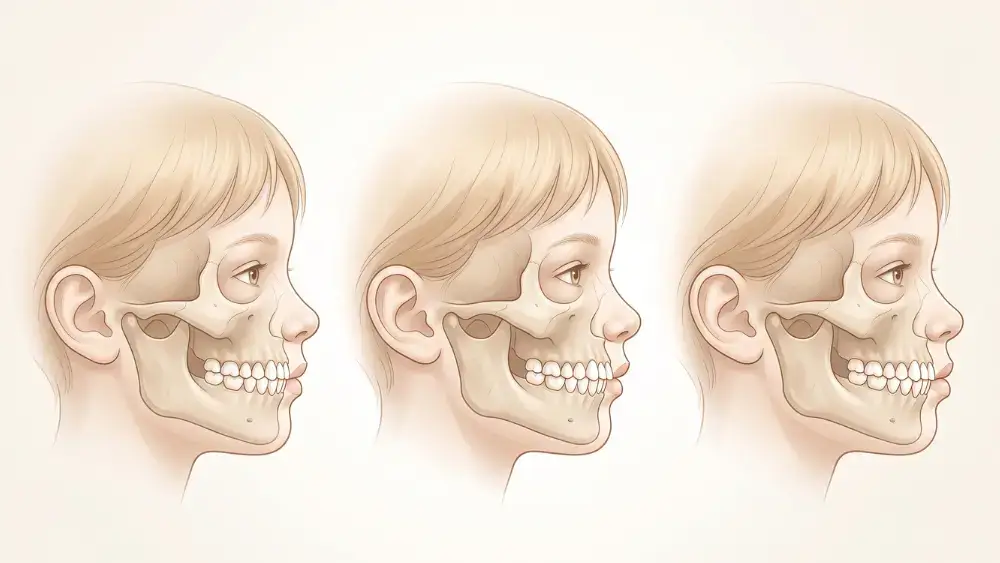
Malocclusion is the clinical way of saying “bad bite”. That’s when your upper and lower teeth don’t line up correctly when your jaw is closed. It’s one of the most common conditions in dentistry, ranging from a mild misalignment to an issue affecting chewing, speech, or long-term oral health.
A few quick facts worth knowing:
- Malocclusion can affect just the teeth, just the jaw, or both.
- It can be corrected at almost any age.
- It’s usually inherited, but habits and injuries can also cause or worsen it.
- Severity determines whether treatment is necessary or preferable.
Malocclusion Types & Classes
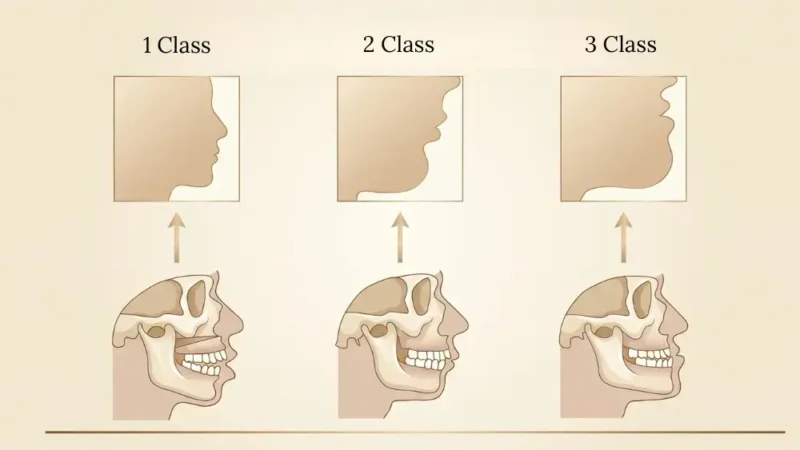
Angle’s Classification (Class I, II, and III) is the actual diagnostic system, first published in 1899 by American dentist Edward Angle, now considered the father of modern orthodontics. Angle’s system, still the most widely used in dentistry today, based on how your back molars line up with each other.
Overbite, overjet, underbite, crossbite, open bite, crowding, and spacing are traits that can appear inside any of the three Angle classes:
- Class I: a normal molar occlusion, though the front teeth may be crowded, rotated, or gapped. The most common type, often known as crooked teeth.
- Class II: what most people mean by “overbite.” The upper teeth and jaw sit forward of the lower ones.
- Class III: commonly called an “underbite.” The lower jaw and teeth sit forward of the upper ones. Often the hardest class to correct.
Term | What it actually describes | How it relates to Angle’s classes |
Overbite | Vertical overlap of the upper front teeth over the lower ones | A trait, not a class — can occur in Class I, II, or III |
Overjet | Horizontal protrusion of the upper front teeth beyond the lower (“buck teeth”) | Distinct from overbite (vertical vs. horizontal) |
Underbite | Lower front teeth sit in front of the upper front teeth | Loosely equivalent to Class III |
Crossbite | One or more upper teeth sit inside the lower teeth when biting down | Can be anterior or posterior; appears across all classes |
Open bite | Front or side teeth don’t touch at all when the jaw is closed | A vertical trait, distinct from over/underbite |
Crowding / Spacing | Too little (crowding) or too much (spacing) room for teeth | Most common alongside Class I |
Orthodontists also classify malocclusion by where it originates. These three origins frequently overlap:
- Dental malocclusion means the jaw bones are fine but individual teeth are crowded or misplaced (often fixable with braces alone).
- Skeletal malocclusion means the jaw bones themselves are mismatched in size or position (the type to need orthognathic (jaw) surgery).
- Muscular (functional) malocclusion happens when jaw muscles guide the bite off-course, rather than bone or tooth position alone.
The 8 Most Common Types of Malocclusion
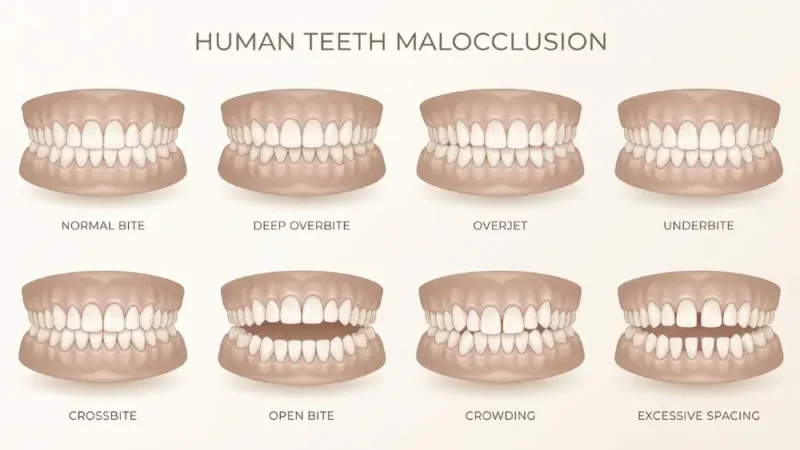
The image above shows the traits dentists see most often. Remember that these are descriptions of what the bite looks like, not diagnoses. Several can appear together in the same mouth, and any of them can occur within any of Angle’s three classes.
- Deep overbite: The upper front teeth cover far more of the lower ones than they should, sometimes hiding them almost completely. A vertical problem.
- Overjet: The upper front teeth angle or sit forward of the lower ones horizontally, the trait usually meant by “buck teeth.” Often confused with overbite.
- Underbite: The lower front teeth sit in front of the upper ones when the jaw closes. Usually skeletal in origin, and the trait most closely tied to Class III.
- Crossbite: One or more upper teeth sit inside the lower teeth instead of outside. It can affect the front teeth, the back teeth, or just one side, and may cause the jaw to shift sideways to find a comfortable bite.
- Open bite: The front teeth don’t touch at all when the back teeth are closed, leaving a visible gap. Frequently linked to prolonged thumb-sucking or tongue thrusting.
- Crowding: There isn’t enough room in the jaw for all the teeth, so they overlap, rotate, or push out of line. The most common reason people seek orthodontic treatment.
- Excessive spacing: The opposite problem: visible gaps between teeth, caused by teeth that are small relative to the jaw, or by missing teeth.
How Common Is Malocclusion? Prevalence in the US, UK, and Worldwide
Malocclusion is extremely common — a 2020 systematic review in the European Journal of Paediatric Dentistry put the worldwide average at 56%, highest in Africa (81%) and Europe (72%). Be aware the underlying studies ranged from 11% to 99%, reflecting real inconsistency in how malocclusion is measured. The same review found something notable: prevalence stayed stable at around 54% across primary (baby-tooth), mixed, and permanent dentition — meaning malocclusion generally isn’t something a child “grows out of” as adult teeth erupt, which is exactly why early evaluation matters.
In the UK, a 2016 British Dental Journal study found 9% of 12-year-olds and 18% of 15-year-olds were already in orthodontic treatment. For the US, we couldn’t independently verify a specific national percentage, so we won’t quote one here. And reliable breakdowns by sex or race simply don’t exist in the literature — treat any site that confidently cites one with skepticism.
What Causes Malocclusion? Genetic and Environmental Factors
Most cases trace back to a mix of genetics and habits. MedlinePlus describes malocclusion as “most often hereditary,” while a 2020 twin-study review in Progress in Orthodontics found genetics mainly shapes the skeletal blueprint of your jaw (arch width/length), while dental positioning and muscular shifts respond more to habits and environment. There’s no single “X% genetic” figure — anyone quoting an exact split is oversimplifying.
Cause category | Examples | What the evidence shows |
Hereditary/genetic | Jaw size mismatch, family bite pattern | Strongly linked to arch width, length, and crowding |
Childhood habits | Thumb-sucking/pacifier use past age 3–4 | Up to a 4.25-fold higher risk of malocclusion |
Breathing/oral posture | Chronic mouth breathing, tongue thrusting | Linked to increased overjet and open bite |
Tooth loss/decay | Early loss of baby teeth | Lets neighboring teeth drift, causing crowding |
Trauma/structural | Jaw injury, cleft lip/palate, ill-fitting restorations | Well-established, though exact rates aren’t published |
Other risk factors include family history, prolonged sucking habits, chronic mouth breathing, untreated decay, dental trauma, cleft lip/palate, and bruxism (teeth grinding). If malocclusion runs in your family you likely can’t prevent it entirely — but several environmental risk factors above can be addressed early.
Signs and Symptoms of a Misaligned Bite
Signs are what you or a dentist can see; symptoms are what you feel. Plenty of people have one without the other.
Visible signs: crooked, crowded, or gapped teeth; an unusual facial profile; front teeth that don’t meet correctly.
Symptoms: discomfort chewing or biting, accidentally biting your cheek/tongue, occasional mild speech difficulty (uncommon), mouth breathing, and jaw pain or tension.
How Is Malocclusion Diagnosed?
Diagnosis usually happens during a routine dental exam checking how your back teeth align, sometimes followed by impressions, photographs, X-rays, or referral to an orthodontist.
Timing matters: the American Association of Orthodontists (AAO) recommends an evaluation by age 7, even without visible problems, since the jaw is still growing and problems can sometimes be guided into place without more invasive treatment later. Treatment generally works fastest in children and teens, and published timelines run from 6 months to 2+ years, commonly around two years.
What Happens If Malocclusion Is Left Untreated? Possible Complications
Leaving malocclusion untreated doesn’t guarantee problems — but for more significant cases, it can raise the risk of several downstream issues, broken down honestly below rather than exaggerated for effect.
- Tooth decay and gum disease — crowded teeth are harder to clean, raising long-term risk.
- Jaw pain and TMJ disorders (TMD) — a 2025 meta-analysis found ~43% of malocclusion patients also had TMD, but a 2025 scoping review cautions this is an association, not proven causation — TMD is multifactorial.
- Speech and chewing difficulties — possible in more severe cases, though relatively uncommon.
- Self-esteem and social impact — a quality-of-life reason to seek treatment that’s just as valid as a physical symptom.
Most of these risks are manageable or preventable with timely care.
Can Malocclusion Be Prevented?
Partly. Hereditary cases can’t be prevented, but several environmental factors can be managed:
- Discourage thumb-sucking/pacifier use by around age 3–4
- Keep up regular dental checkups to catch decay or early tooth loss
- Replace missing baby teeth promptly to stop drifting
- Address chronic mouth breathing early
- Book an orthodontic evaluation by age 7 — the single most reliable step, per the AAO
Think of prevention less as “avoiding malocclusion entirely” and more as catching and managing the factors you can control, early enough that they don’t compound into something more complex to treat later.
Treatment Options for Malocclusion: From Braces to Jaw Surgery
Most cases are treated without surgery. Braces (metal or ceramic) and clear aligners like Invisalign remain the first-line option for the vast majority of patients, followed by a retainer to hold results in place. For growing children, a palatal expander (best around age 7–8), headgear, or chin caps can guide jaw development, and extraction can relieve crowding.
Non-surgical options at a glance: braces, clear aligners, retainers, palatal expanders, headgear/chin caps, tooth extraction.
For severe skeletal cases, orthognathic (jaw) surgery repositions the jaws so the bite can finally meet correctly — available through the UK’s NHS as well as privately. Complex cases like these are rarely handled by one provider alone: NHS orthognathic and craniofacial clinics bring together orthodontists, oral and maxillofacial surgeons, restorative dentistry specialists, and sometimes speech therapists or ENT specialists, in joint clinics. Finally, when habits like thumb-sucking or mouth breathing are contributing factors, correcting the habit itself — sometimes via myofunctional therapy — is usually built into the plan alongside braces or aligners.
A Real-World Case Study: The “Habsburg Jaw”
One of history’s most striking examples of Class III malocclusion is the “Habsburg jaw” — the protruding lower jaw seen across generations of Spain and Austria’s Habsburg dynasty, immortalized in portraits by Diego Velázquez. A 2019 genetic study in Annals of Human Biology linked higher inbreeding coefficients across more than 20 generations of the family to more severe mandibular prognathism.
The most extreme case was King Charles II, whose inbreeding coefficient of 0.25 was comparable to that of a child born to siblings — leaving his jaw so protruded that, according to a contemporary account, his teeth couldn’t even meet. It’s a dramatic real-world illustration of how strongly genetics can shape the skeletal form of malocclusion.
How Much Does Treating Malocclusion Cost?
No major dental or medical body publishes an official price list — costs depend on your case, provider, and location, so treat any single quoted figure with caution. In the UK, NHS eligibility for free treatment is decided by the Index of Orthodontic Treatment Need (IOTN): under-18s generally qualify only at higher-need scores, tying funding to clinical need, not preference.
Country / system | What’s typically covered |
UK — NHS | Free for under-18s meeting IOTN clinical-need thresholds |
UK — Private | Available to anyone, including cosmetic-only cases |
US | Partial insurance coverage; average plan contribution reported around $1,772, often capped near $3,000; FSA/HSA can help offset costs |
Australia | CDBS covers general child dental care but explicitly excludes orthodontics — private cost for most families |
Ireland | HSE free treatment only for the most severe cases (IOTN-style index); milder cases go private |
Canada | CDCP orthodontic coverage is very limited and not yet active; otherwise depends on province/employer plans |
New Zealand | Free basic dental exists for under-18s; we couldn’t confirm from an official source whether this extends to orthodontics — verify directly |
Jaw surgery | Provided via the NHS (UK) and medically-necessary insurance pathways (US) for skeletal cases |
The pattern across the UK, Australia, Ireland, and Canada is consistent: public systems reserve free treatment for the most severe cases, not cosmetic preference — private treatment is the realistic default for milder malocclusion almost everywhere. We also couldn’t find a solid, malocclusion-specific figure for its broader economic burden on health systems (the often-cited “45% of the world affected by oral disease” statistic covers oral disease generally, not malocclusion specifically) — so a personalized assessment is more reliable than a generic number online.