

Composite bonding is built in thin layers of about 2mm, restoring broken or chipped teeth with minimal to no drilling. Composite bonding in Turkey costs £150–£250 per tooth, so patients can expect 50-70% savings for full mouth treatments. In general, it’s a cost-effective, reversible, low-risk treatment that can last for 4 to 8 years with proper care habits. Let’s look at all key facts in detail.
Composite bonding in Turkey costs £150–£250 per tooth, compared with £300–£600 in the UK (a saving of 50–70% on full smile treatments, even after flights and accommodation are added in). The procedure is typically completed in a single visit, requires little to no drilling and generally last 4 to 8 years with good care.
It’s best suited to minor chips, gaps, discolouration, and small corrections. Safety comes down to the clinic: look for Health Türkiye centification, licensed dentists and a transparent quote before you travel.
At a Glance | Details |
Average cost per tooth | £150–£250 |
Procedure time | Usually 1 visit, 1–3 hours |
Expected lifespan | 4–8 years |
Invasiveness | Minimal to no drilling |
Best for | Chips, gaps, discolouration, minor reshaping |

Composite bonding is a cosmetic dental procedure that uses tooth-colored resin to repair, reshape, or improve the appearance of teeth. The resin is applied directly onto the tooth’s surface, shaped by the dentist, and hardened with a curing light, without the need to shave down healthy enamel.
The treatment, reversible and minimally invasive, is usually performed to fix chips, gaps, discolouration, uneven edges, and minor shape irregularities.
The technique your dentist recommends should match the problem you’re solving. Part of a proper consultation for composite bonding in Turkey is the dentist explaining why they’ve chosen one technique over another.
The most common and affordable composite bonding. Resin is sculpted directly onto the tooth by the dentist, freehand, in one visit.
A thin layer of composite covers the visible surface of the tooth. For broader changes across several teeth (colour, shape, symmetry) rather than a single chip or gap.
Composite pieces made to fit a specific cavity or damaged area, sometimes fabricated indirectly in a lab and then bonded in.
Resin applied specifically to the biting edge of front teeth to repair chips or lengthen worn-down edges.
A newer technique using a digitally designed mould injected with composite, giving more uniform results across multiple teeth than freehand sculpting.
Composite added to the sides of two teeth to close a visible gap between them. One of the most frequently searched and requested applications of bonding.
Composite built up on worn or eroded biting surfaces to restore lost tooth height, typically used for wear caused by grinding (bruxism) rather than cosmetic concerns alone.
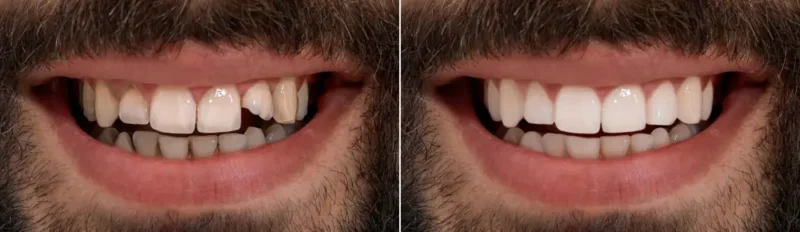
The most common before-and-after changes patients see with composite bonding are closed gaps, repaired chip or crack lines, more uniform tooth length, and a brighter, more even shade across the smile. Results are visible immediately after the appointment.
What genuine before-and-after results should show:
Composite bonding in Turkey costs £150–£250 per tooth, compared with £300–£600 in the UK, but the journey is not necessarily worth it for all patients. Real savings depend on how many teeth you’re treating and which country you’re from.
Country | Cost per tooth (local currency) | Approx. GBP equivalent* |
Turkey | £150–£250 | £150–£250 |
UK | £300–£600 | £300–£600 |
US | $300–$900 (avg. $431) | ≈£235–£705 |
Canada | CAD $300–$700 | ≈£175–£410 |
Ireland | €200–€400 | ≈£170–£340 |
*Approximate, based on mid-2026 exchange rates — these fluctuate, so treat this column as a general point of reference, not a fixed quote.
What’s typically not included in the packages are flights, which patients book separately, and any extra dental work you need first (such as treating a cavity or gum inflammation before bonding can safely go ahead).
A Turkey composite bonding package should typically include:
If a quote is given from photos alone, without an X-ray or in-person exam, extra work discovered on arrival (a filling that needs replacing, a tooth requiring more shaping than expected) can add cost once you’re already there.
Questions worth asking before you book include:
For a full smile makeover in Turkey (6–10 teeth), savings outweigh flights and hotel costs — typically £150–£450 return from the UK and £250–£500 for 3–4 nights’ accommodation. For a single tooth, the maths is tighter, which is why bonding trips abroad are usually planned around treating several teeth at once, not one.
The right choice comes down to what you’re solving for. Bonding is usually the sensible first option for easy, affordable fixes. If you’re planning a long-term repair across many teeth, it’s worth weighing porcelain veneers.
Pros:
Cons:
Porcelain veneers require removing a layer of 0.3 to 0.7mm of enamel, which is irreversible, compared to bonding which is fully reversible. On the upside, porcelain veneers last 10 to 15 years compared to composite’s 4 to 8. But that durability comes at a cost, too: porcelain veneers in Turkey run roughly £150–£300 per tooth, versus £150–£250 for composite bonding.
Porcelain veneers also require two visits to Turkey (preparation, then fitting the lab-fabricated veneer) rather than composite’s single sitting.
Composite Bonding | Porcelain Veneers | |
Cost per tooth (Turkey) | £150–£250 | £150–£300 |
Enamel removal | Minimal to none | ~0.3–0.7mm (irreversible) |
Visits required | 1 | 2 (prep + fit) |
Lifespan | 4–8 years | 10–15 years |
Stain resistance | Can discolour over time | High |
Repair if damaged | Spot-repaired chairside | Usually full replacement |
Best for | Chips, gaps, minor reshaping | Broader smile makeovers |
Composite bonding works best on teeth that are healthy, the issue being minor (a chip, a gap, slight discolouration), not decay or gum disease. Our dentists in Turkey assess that the tooth has enough healthy enamel for the resin to bond to, that there’s no active infection or cavity underneath, and that your bite and oral hygiene won’t undermine the result.
Composite bonding is not the right treatment, or needs extra planning, if you have:
General risks, even in suitable candidates, include:
A proper composite bonding in Turkey follows a structured sequence. Here’s what each stage involves, from pre-opplanning to the finishing touches.
Before any resin touches a tooth, the dentist carries out a full oral examination, including X-rays, to confirm there’s no decay, infection, or gum disease. Shade matching happens at this stage too after any teeth whitening you want(composite can’t be whitened once placed). Teeth are cleaned and polished to remove plaque and surface debris, ensuring the resin bonds to a clean enamel surface.
At One Life Dental, we employ an 8-step Digital Smile Design (DSD) process to plan the result before any resin is applied:
Once the plan is set, the dentist lightly roughens the enamel and applies a phosphoric acid etch, creating a microscopic surface for the resin to grip. A bonding agent is applied, then the composite resin is built up in thin layers of roughly 2mm, each shaped and cured under an LED light for about 20 seconds.
Once the desired shape is achieved, the tooth is trimmed, contoured, and polished to match the sheen of the surrounding natural teeth. Most single teeth take 30 to 60 minutes; a full “social six” case is usually completed within a single extended appointment.
One of composite bonding’s advantages is that there’s no healing period. The resin is fully hardened before you leave the chair, so you can eat, drink, and speak normally straight away.
Normal, expected after treatment:
Worth contacting your dentist about:
Simple aftercare habits protect the result:
Most composite bonding trips to Turkey run 3 to 4 days. Here’s a realistic day-by-day breakdown for a typical 6-teeth case.
Airport pickup and transfer to the hotel, usually included in the package. Some clinics schedule a brief initial consultation the same day.
Full oral exam, X-rays if needed, shade selection, and the Digital Smile Design session to plan tooth shape and proportion. Any pre-existing issues (a cavity, gum inflammation) are identified and addressed before bonding begins.
The bonding itself: etching, layering, curing, and polishing. For most patients, this is completed within a single appointment, roughly 2–4 hours.
A short follow-up appointment to check the bite feels correct, make any minor shape adjustments, and confirm you’re happy with the shade and finish.
Airport transfer and flight home, with written aftercare instructions and a contact point for any questions.
Turkey now has 46 JCI-accredited hospitals, more than any country outside the US. So, rest assured, composite bonding in Turkey is safe when performed by a licensed dentist at a clinic certified by the Ministry of Health.
Composite bonding typically lasts 4 to 8 years, regardless of which country it’s performed in. Where a tooth sits in the mouth affects durability too. Biting edges on front teeth tend to chip sooner. Patients who grind their teeth at night, bite nails or pens, or consume a lot of coffee, tea, red wine, or tobacco will generally see faster wear and staining than patients who don’t.
Simple daily habits do more to extend the lifespan of composite bonding than anything the clinic can control after you’ve flown home:
Composite bonding isn’t the right fit for every case, and knowing the alternatives helps confirm whether it’s actually the treatment you need. Here’s how the main options compare, and when each makes more sense.