
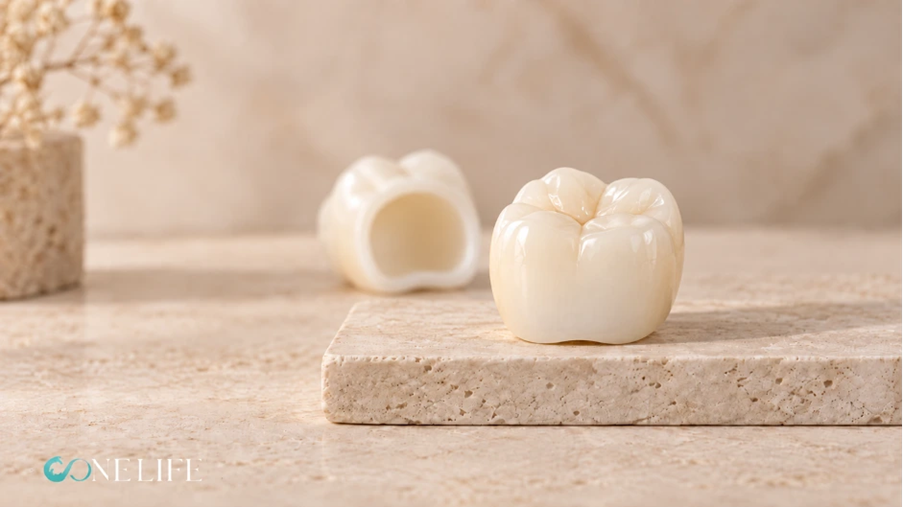
3Y zirconia is a dental ceramic known for high strength and resistance to cracks, while keeping a medium-level translucency compared with some other zirconia crowns. However, a strong material does not always produce the best result. Appearance, tooth condition, bite, and design all influence the decision. We discuss all in detail.
Why 3Y zirconia is a smart material
A key property of 3Y zirconia is it can increase in volume, which helps resist further crack growth. In simpler terms, the material makes it harder for an existing crack to spread.
Nevertheless, 3Y zirconia is not immunity to fracture. Defects, inadequate dimensions, or unfavorable loading can break it. Material strength must be combined with suitable design and careful fabrication.
On another point, calling 3Y zirconia “hard” does not fully explain its advantages. These terms describe different properties:
- Flexural strength: resistance to failure under bending stress.
- Fracture toughness: resistance to the growth of an existing crack.
- Hardness: resistance to biting pressure or surface deformation.
How strong is 3Y zirconia?
3Y zirconia has a strength range of approximately 900–1,300 MPa. MPa means megapascals, a unit used to report stress.Results depend on the product, processing conditions, preparation, and test method.
For this reason, a strength figure should be interpreted alongside the manufacturer’s instructions and the clinical situation. It should never become a promise that a restoration cannot break.
3Y zirconia at a glance
Characteristic | What it means for treatment |
Approximately 3 mol% yttria | Identifies the zirconia formulation |
Predominantly tetragonal structure | Enables transformation toughening |
High mechanical strength | Useful when resistance to loading is important |
Relatively low translucency | May limit matching highly translucent natural teeth |
Different construction options | Can form a full-contour restoration or a framework beneath porcelain |
Product-specific requirements | Thickness, processing, and permitted uses must be checked |
These characteristics explain the material’s general role. They do not determine whether it is appropriate for every patient.
What does ‘3Y’ zirconia mean?
The “3” refers to approximately 3 mole percent of yttria, also called yttrium oxide, added to zirconia. Yttria helps stabilize the material’s crystal structure. You may also see the name 3Y-TZP, meaning 3 mol% yttria-stabilized tetragonal zirconia polycrystal. “Polycrystal” means the ceramic contains many crystalline grains.
What is 3Y zirconia used for?
Dentists may consider 3Y zirconia for crowns, bridge frameworks, and other fixed restorations where its mechanical properties are useful.
Crowns on back teeth
Premolars and molars require a careful assessment of chewing contacts and available space. A high-strength zirconia formulation may be considered when resistance to fracture is an important treatment objective.
This does not mean every back tooth requires 3Y zirconia. Your dentist also considers the remaining tooth structure, visibility of the restoration, and how it contacts opposing teeth.
Dental bridges
A bridge replaces missing teeth by connecting artificial teeth to supporting teeth or implants. Its performance depends partly on the dimensions and arrangement of the connecting structures.
3Y zirconia may be used where an approved product’s strength and indications suit the proposed bridge. However, the term “3Y” alone does not authorize any bridge length or design. The laboratory must follow the specific material’s requirements.
Frameworks beneath porcelain
3Y zirconia can also provide a framework covered with veneering porcelain. This allows the framework’s mechanical properties to be combined with additional appearance customization.
Here, the outer porcelain introduces its own potential complications. A strong zirconia framework does not make the porcelain covering equally resistant to chipping.
Can 3Y zirconia look natural?
Yes, a restoration made with 3Y zirconia can have an acceptable, natural-looking appearance. However, the material generally transmits less light than more translucent zirconia formulas.
This being said, improvements in formulation and processing have increased translucency compared with early zirconia materials, without making every product equivalent.
Finally, not all 3Y zirconia look identical. The final appearance also depends on the crown’s thickness, shape, shade, surface texture, laboratory finishing, and the undertones of the underlying tooth.
Can its opacity help cover a dark tooth?
Masking is not guaranteed. The severity of discoloration, ceramic thickness, and selected material affect the outcome. Your dentist should assess the actual background color rather than assume that 3Y zirconia will hide every dark tooth.
The goal is an appropriate match for the individual tooth.
Is 3Y zirconia suitable for front teeth?
It may be appropriate in selected cases. However, a full-contour 3Y restoration may be less suitable when reproducing a front tooth. Depending on the case, your dentist may consider porcelain veneering or a different material.
How does 3Y differ from 4Y and 5Y zirconia?
The main distinction is yttria content. Broadly, increasing yttria changes the crystal structure and can improve translucency while reducing transformation toughening and some mechanical properties.
Material | Brief distinction |
3Y zirconia | Emphasizes high strength and resistance to crack growth, with relatively low translucency |
4Y zirconia | Generally offers an intermediate balance of mechanical and optical properties |
5Y zirconia | Generally offers greater translucency with lower fracture toughness than conventional 3Y |
These are general trends. The appropriate material depends on the restoration’s requirements, which is why each formulation deserves its own explanation.
Is 3Y zirconia always monolithic?
No. A full-contour crown made from 3Y zirconia is monolithic when there is no separate porcelain covering. A 3Y framework covered with porcelain is a layered restoration.
Similarly, a manufactured block with color gradients can still contain a uniform 3Y formulation. Other graded products combine different formulations, so “multilayer” does not necessarily mean entirely 3Y.
What are the limitations of 3Y zirconia?
The principal considerations include:
- Appearance: relatively low translucency can complicate some visible restorations.
- Fracture risk: high strength does not eliminate damage from defects or unfavorable loading.
- Manufacturing sensitivity: milling, sintering, and surface treatment influence material behavior.
- Material aging: moisture-related changes, called low-temperature degradation, have been studied in tetragonal zirconia.
- Restoration-specific suitability: evidence and requirements differ between crowns, bridges, and veneers.
How long do 3Y zirconia crowns last?
There is no guaranteed lifespan for every 3Y crown.
Clinical studies of monolithic zirconia crowns have reported encouraging outcomes over several years. However, studies use particular products, designs, and patient groups; their findings cannot be applied equally to every zirconia restoration.
The crown is also only one part of treatment. Retention, the supporting tooth, periodontal health, and the bite remain relevant even when the ceramic itself stays intact.
FAQs
What does the Y in 3Y zirconia stand for?
It refers to yttria, or yttrium oxide, which stabilizes zirconia’s crystal structure. The number identifies its approximate concentration in mole percent.
Is 3Y zirconia metal?
It is a zirconium oxide ceramic. Although zirconium is a metallic element, dental zirconia is an oxide ceramic rather than a metallic alloy.
Is 3Y zirconia the best choice for teeth grinding?
It may be considered when mechanical demands are important, but the material alone does not resolve grinding-related risks. Your dentist must assess the bite and restoration design.
Does 3Y zirconia always look opaque?
Its translucency is relatively low, but appearance varies between products and restorations. Thickness, shade, finishing, and surrounding teeth influence the final result.
Can a 3Y zirconia crown break?
Yes. Transformation toughening improves resistance to crack growth, but inadequate dimensions, defects, or unfavorable loading can still lead to fracture.
Scientific and medical references
- Sulaiman TA, et al. Zirconia restoration types, properties, tooth preparation design, and bonding. A narrative review. Journal of Esthetic and Restorative Dentistry. 2024.
https://pmc.ncbi.nlm.nih.gov/articles/PMC10842315/ pmc.ncbi.nlm.nih.gov - Zhang Y, Lawn BR. Novel zirconia materials in dentistry. Journal of Dental Research. 2018.
https://pmc.ncbi.nlm.nih.gov/articles/PMC5784474/ pmc.ncbi.nlm.nih.gov - Kongkiatkamon S, et al. Current classification of zirconia in dentistry: an updated review. PeerJ. 2023.
https://pmc.ncbi.nlm.nih.gov/articles/PMC10351515/ pmc.ncbi.nlm.nih.gov - Recent advances in dental zirconia: 15 years of material and processing evolution.
https://pubmed.ncbi.nlm.nih.gov/38521694/ pubmed.ncbi.nlm.nih.gov - Translucency and masking ability of translucent zirconia; comparison with conventional zirconia and lithium disilicate.
https://pubmed.ncbi.nlm.nih.gov/36452362/ pubmed.ncbi.nlm.nih.gov - Survival and complication rates of feldspathic, leucite-reinforced, lithium disilicate and zirconia ceramic laminate veneers: a systematic review and meta-analysis.
https://pubmed.ncbi.nlm.nih.gov/39523553/ pubmed.ncbi.nlm.nih.gov - Prospective study of monolithic zirconia crowns: clinical behavior and survival rate at a 5-year follow-up.
https://pubmed.ncbi.nlm.nih.gov/33041280/ pubmed.ncbi.nlm.nih.gov