
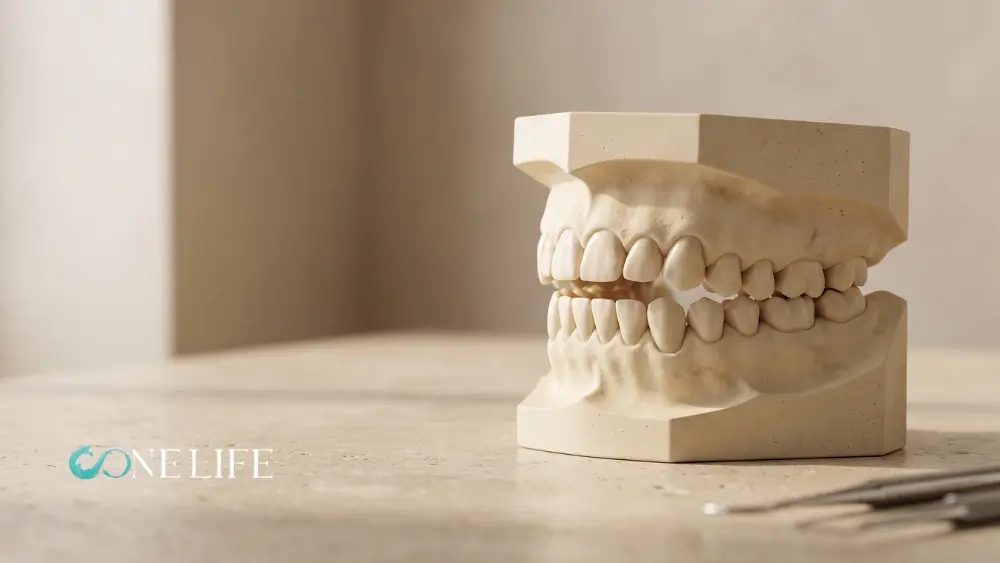
When you close your mouth, your teeth should meet in a way that supports biting, chewing and speaking. With an open bite, some teeth remain separated even though the mouth is closed. An open bite is a type of malocclusion. It can be subtle or clearly visible, and its effects may be cosmetic and/or functional.
Corrective treatment will depend on its causes, which can involve:
- Tooth position
- Jaw growth
- Oral habits (like thumb sucking)
- Tongue posture
- Tooth eruption
Types of Open Bite
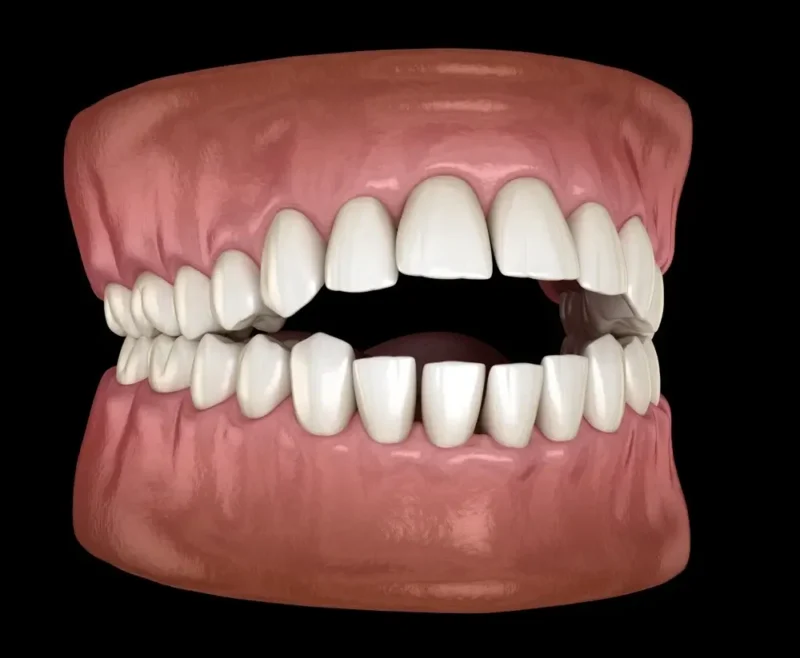
To determine your type of open bite, dentists look at where the gap is placed: in the frontal incisors or the back molars. This will determine the cause and, ultimately, the treatment, too.
Type of Open Bite | Where is the gap? | Causes |
Anterior | Around the incisors and sometimes the canines | Oral habits, tongue position and jaw-growth |
Posterior | Around the premolars or molars, on one or both sides | Tooth eruption, ankylosis, obstruction or treatment-related bite changes |
Combined | A broader portion of the dental arch | Several dental or skeletal factors may coexist |
Anterior Open Bite
An anterior open bite is the most common. When the molars are together, a vertical space remains between the upper and lower front teeth. Some anterior open bites are dental, involving the position or eruption of the teeth. Others are skeletal, involving particularities of the skull. Many combine both elements.
Posterior Open Bite
A posterior open bite is less common and more difficult to notice. It occurs when the back teeth do not meet on one or both sides. Causes include an eruption obstacle or failure of eruption. A posterior gap can also appear during orthodontic treatment, including aligners.
What Causes an Open Bite?
An open bite has a complex origin, in the sense that more than one influence is usually behind it. To determine the causes, you will need an in-person consultation with an experienced orthodontist.
Causes | Effect on the bite | Often associated with |
Thumb or finger sucking | Sustained pressure can alter front-tooth eruption and the shape of the developing dental arches | Anterior open bite in children |
Pacifier use | Frequent, long-term use may interfere with normal tooth contact and arch development | Anterior open bite and sometimes posterior crossbite |
Tongue posture | Repeated pressure or the tongue resting between the teeth may help maintain a gap | Anterior open bite |
Facial growth | The back of the jaws may grow or erupt vertically in a way that rotates the lower jaw downward and backward | Skeletal anterior open bite |
Mouth breathing | Altered lip and tongue posture may be associated with changes in facial and dental development | Some developing anterior open bites |
Ankylosis | An affected tooth remains below the biting plane while neighboring teeth continue to erupt | Localized posterior open bite |
Primary failure of eruption | The eruption mechanism does not function normally, often affecting several back teeth | Unilateral or bilateral posterior open bite |
Trauma | Injury, altered jaw-joint growth, craniofacial conditions or neuromuscular differences may affect jaw development or eruption | Anterior, posterior or asymmetric open bite |
Orthodontics | Temporary bite changes can develop as teeth move or while aligners cover the chewing surfaces | Treatment-related posterior open bite |
How Can an Open Bite Be Treated?
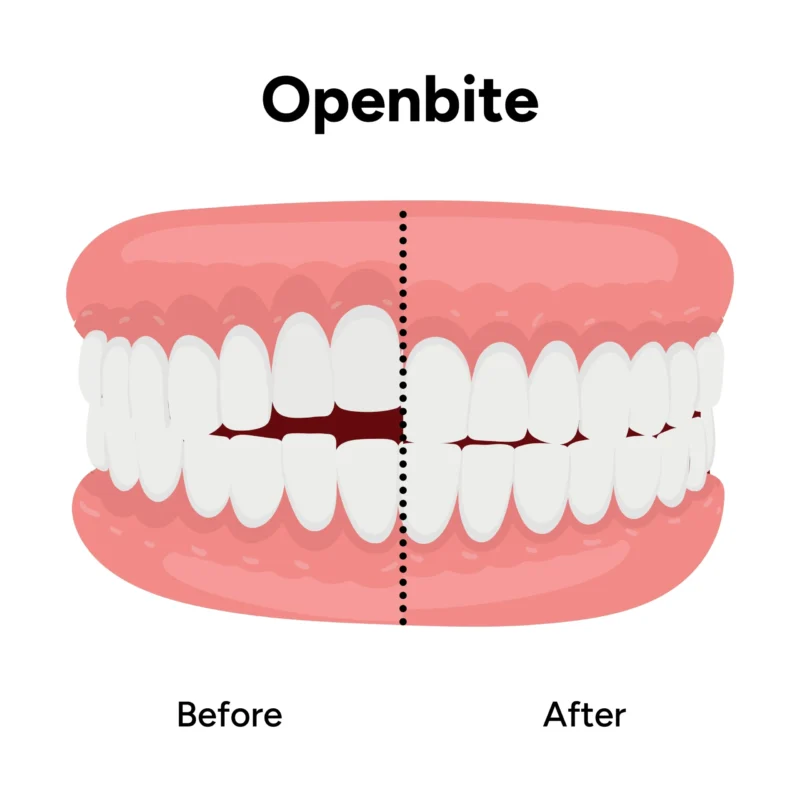
Open bite treatment should aim to establish teeth contact while managing what created the problem. Braces may be combined with elastics or TADs. Rare skeletal cases may require surgery to reposition one or both jaws.
Treatment | What it may address | Typical candidates or limitations |
Habit guidance or reminder appliance | Persistent sucking habit or tongue in the gap | Mainly selected children; should be supportive, not punitive |
Growth-modifying appliance | Helps control vertical development or tooth eruption while the jaws are growing | Bite blocks or selected headgear may be considered after individual growth assessment |
Myofunctional or speech therapy | Tongue, swallowing or speech patterns | Supportive in selected cases; does not replace needed tooth or jaw correction |
Braces and elastics | Coordinate teeth and close many dental open bites | Mechanics depend on the cause and facial pattern |
Clear aligners | Planned movement in selected mild-to-moderate and some complex cases | Requires suitable design and consistent wear |
Temporary anchorage devices (TADs) | Often intrude back teeth using fixed bone anchorage | Can expand nonsurgical options, but does not suit everyone |
Orthognathic surgery | Repositions jaws in severe skeletal cases | Usually after growth, combined with orthodontics |
Eruption-specific care | Ankylosis, obstruction or PFE | Multidisciplinary; ordinary orthodontic extrusion may be inappropriate in PFE |
Can an Open Bite Return After Treatment?
Yes. Relapse means some opening returns, although it is not inevitable. Continuing growth, skeletal pattern, an unresolved habit or tongue posture, unstable tooth movements and inconsistent retention may influence risk. Retainers—sometimes used long-term at night—are important. Addressing associated habits or functional patterns may support stability, but no method can guarantee permanence.
At What Age Does an Open Bite Become Obvious?
An open bite may become visible in the primary teeth, especially with a prolonged sucking habit. However, temporary lack of contact can also occur while primary teeth are being replaced and permanent teeth are still erupting. An early or transitional gap does not necessarily predict a permanent open bite.
Stage | What may become noticeable | Usual clinical approach |
Toddler–preschool | A gap may accompany a sucking habit | Monitor development and address the habit constructively |
Around 5–7 | Permanent incisors and first molars reveal more about the developing bite | Evaluation can identify habits, eruption problems and growth patterns |
Ages 7–12 | Dental and skeletal features become clearer | Interceptive care may address a specific cause or guide development |
Adolescence | Most permanent teeth are present | Comprehensive orthodontic treatment is often planned |
Adulthood | Jaw growth is largely complete | Treatment remains possible; severe skeletal cases may need a different approach |
When Is the Best Age to Treat an Open Bite?
There is no universal best age. For a young child with a habit-related dental open bite, stopping the habit may allow improvement as teeth erupt; support should be positive rather than punitive. Persistent habits affecting development may require behavioral strategies or a habit-reminder appliance.
Assessment during growth can be valuable when jaw development is involved, although early treatment is not automatically required and comprehensive care may still be needed later. Adolescence is a common treatment period because most permanent teeth are present while some growth may remain. Adults can also be treated successfully, but established skeletal discrepancies require different methods.
Signs and Possible Effects of an Untreated Open Bite
Not every open bite causes the same difficulties. Small gaps may create few functional symptoms, whereas larger or more complex open bites can affect everyday activities.
Possible effects include difficulty biting with the front teeth, less efficient chewing, speech differences, a tongue that rests in the gap, uneven tooth wear or loading, cosmetic concerns and difficulty finding comfortable, stable tooth contact.
An open bite does not inevitably cause jaw-joint pain, and treating the bite cannot be guaranteed to resolve temporomandibular disorder symptoms. Jaw pain, clicking or restricted movement should be evaluated separately rather than automatically attributed to the open bite.
Untreated open bite may remain similar, worsen or occasionally improve, depending on its cause and whether growth or a habit remains active. Skeletal patterns and eruption disorders are less likely to disappear than a mild early habit-related dental open bite.
Can You Fix an Open Bite Naturally?
No home exercise, chewing method or DIY device corrects every open bite. A young child’s habit-related gap may improve after the habit stops, but skeletal open bite, ankylosis and PFE require professional diagnosis. Unsupervised appliances or pressure can move teeth unpredictably, damage tissues or delay care.
How Is an Open Bite Diagnosed?
Diagnosis considers which teeth contact, gap size and location, facial proportions, jaw movement, tooth eruption, habits, tongue and swallowing patterns, lip closure, breathing history, tooth wear, function and previous orthodontic care.
Photographs and digital scans or impressions may document the bite. Panoramic X-rays assess tooth development and eruption, while a lateral cephalometric X-ray may help study jaw relationships and vertical growth. Three-dimensional imaging is reserved for selected cases. Airway, speech or eruption concerns may require other qualified professionals.