
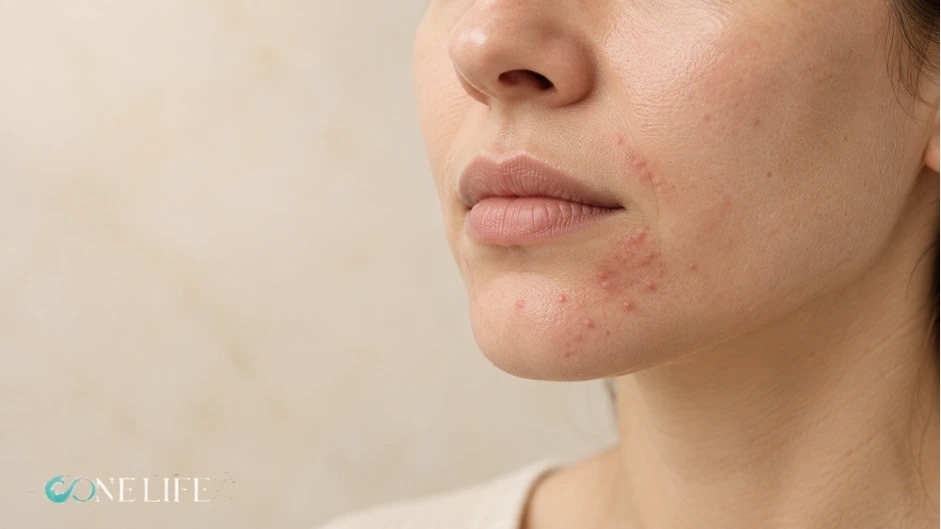
Perioral dermatitis is an inflammatory skin condition that affects the area around the mouth. Similar eruptions can also develop around the nose and eyes, which is why healthcare professionals may use the broader term periorificial dermatitis.
Although it is not contagious or dangerous, it can persist for weeks or months without proper management.
Perioral dermatitis is:
- Not contagious
- Not caused by poor personal hygiene
- Not usually dangerous
- Not generally associated with systemic illness
What is Perioral Dermatitis?
Perioral dermatitis is a chronic inflammation that appears mainly around the mouth. It usually consists of clusters of small bumps called papules. Some may contain fluid or pus and resemble tiny spots.
The term “perioral” means “around the mouth,” but the rash may also affect other areas of the face:
Term | Area affected |
Perioral dermatitis | Around the mouth |
Perinasal dermatitis | Around the nostrils |
Periocular dermatitis | Around the eyes |
Periorificial dermatitis | General term covering one or more facial openings |
A narrow border immediately next to the lips often remains unaffected. This pattern can help distinguish perioral dermatitis. Perioral dermatitis can affect people of any sex, age, or skin tone. It occurs most frequently in young and middle-aged women, but children and men can also develop it.
What Does Perioral Dermatitis Look Like?
On lighter skin, inflammation may look pink or red. On brown or black skin, redness is less visible, and the affected area may appear darker, purple or gray. Pain is not usual. Burning, dryness, sensitivity, and tightness are more typical.
Common features include:
- Clusters of small, firm bumps
- Red, pink, skin-colored, brown, or purple papules
- Occasional pustules containing a small amount of pus
- Dry or flaky skin
- A red or discolored background
- Burning or stinging
- Tightness and sensitivity
- Mild itching
- A clear strip of skin next to the lip border
Can Perioral Dermatitis Spread?
The rash may gradually extend to the nose, chin, cheeks, or eyes. This is an expansion of the inflammation, not an infection spreading.
The rash may spread toward:
- The sides of the nose
- The folds between the nose and mouth
- The chin
- The lower or upper eyelids
- The cheeks
- The forehead in more extensive cases
What Causes Perioral Dermatitis?
The exact cause is not fully understood. Perioral dermatitis is probably not produced by one single factor in every patient.
Research suggests that disruption of the skin barrier may make the skin more vulnerable to irritation. Dryness and tightness can then encourage the use of more creams or cosmetics, creating a cycle of occlusion and further irritation.
Several exposures and individual factors have been associated with the condition.
Topical corticosteroids
Facial use of topical corticosteroids is the best-recognized association. These creams may initially suppress redness, making the rash appear better. However, the eruption can return or worsen with continued use or after the steroid is stopped.
This cycle may lead patients to reapply the cream, creating temporary improvement followed by repeated flares.
Prescription and over-the-counter steroid products should not be used repeatedly on an undiagnosed facial rash without professional advice.
Inhaled and nasal steroids
Steroids used in asthma inhalers or nasal sprays may occasionally contribute when the medication or device repeatedly contacts the skin around the mouth or nose.
Medically necessary inhaled, nasal, or oral steroids should not be discontinued without consulting the prescribing clinician. Rinsing the mouth and gently cleaning contacted facial skin after use may be recommended.
Cosmetics and skincare products
Potentially aggravating products may include:
- Heavy moisturizers
- Occlusive ointments
- Facial oils
- Foundation and concealer
- Multiple layered skincare products
- Fragranced products
- Harsh cleansers
- Physical or highly occlusive sunscreens
- Exfoliating acids
- Retinoids
- Scrubs and cleansing brushes
This does not mean that every cosmetic causes perioral dermatitis. The problem may arise from one ingredient, excessive layering, occlusion, or an already damaged skin barrier.
Hormonal and environmental influences
Some patients report flares during pregnancy, before menstruation, or while using hormonal contraception. Heat, wind, and ultraviolet exposure may also aggravate symptoms.
These observations do not establish one universal hormonal cause, but they may help explain why the condition changes over time in some individuals.
Atopic or sensitive skin
People with eczema, allergies, or generally sensitive skin may be more vulnerable to barrier disruption and irritation. Nevertheless, perioral dermatitis is not simply another form of eczema.
Can Toothpaste Cause Perioral Dermatitis?
Toothpaste is frequently mentioned in discussions about perioral dermatitis because it regularly contacts the skin around the mouth. However, it is important not to assume that toothpaste—or one ingredient—is responsible in every case.
Possible irritants may include:
- Strong flavorings
- Cinnamon derivatives
- Mint or menthol
- Foaming agents
- Whitening ingredients
- Tartar-control ingredients
- Preservatives
- Residual toothpaste left on the skin
A more reasonable approach is to:
- Avoid allowing toothpaste foam to remain on the surrounding skin.
- Rinse the mouth carefully after brushing.
- Gently rinse and pat dry the skin around the lips.
- Avoid aggressive rubbing.
- Discuss a temporary change of toothpaste with a dentist or dermatologist if a specific product is suspected.
- Introduce only one product change at a time.
Can Dental Treatments or Materials Trigger the Rash?
DermNet lists toothpaste and dental fillings among possible irritants or allergens associated with periorificial eruptions. Nevertheless, a temporal association does not prove that a restoration caused the condition.
A rash appearing after dental treatment might instead be related to:
- Skin contact with disinfectants or dental materials
- Adhesive tape or protective equipment
- Lip stretching and saliva exposure
- A newly introduced oral-care product
- Irritant or allergic contact dermatitis
- Stress-related worsening of a pre-existing condition
How Is Perioral Dermatitis Treated?
Treatment depends on age, severity, pregnancy status, previous steroid exposure, affected area, and other medical considerations.
Improvement is rarely immediate. The rash may require several weeks or months to settle, and recurrence is possible.
Simplifying the skincare routine
A “zero-therapy” approach removes unnecessary facial products that may irritate or occlude the skin.
A clinician may recommend temporarily stopping:
- Cosmetics
- Heavy moisturizers
- Facial oils
- Exfoliants
- Scrubs
- Retinoids
- Fragranced skincare
- Occlusive ointments
- Unnecessary topical medications
Some patients may initially wash with lukewarm water alone. Others may tolerate a mild, fragrance-free, non-soap cleanser. If moisturizer is needed, a light, bland product without unnecessary additives may be preferable to a heavy ointment.
Complete avoidance of sunscreen is not always practical or advisable. A clinician may recommend a lighter gel or fluid formulation that is better tolerated.
Managing topical steroids safely
Topical corticosteroids can perpetuate perioral dermatitis. Nevertheless, stopping a potent steroid abruptly may produce a significant rebound flare.
The safest approach depends on:
- The potency of the steroid
- How long it has been used
- Why it was originally prescribed
- The area being treated
- Whether another skin condition is present
A healthcare professional may recommend stopping it directly or tapering to a less potent preparation before withdrawal. In some cases, a non-steroid anti-inflammatory treatment may be used during the transition.
The temporary flare after discontinuation should not automatically lead to restarting the steroid without advice.
Topical prescription treatments
Mild or localized cases may be treated with topical medication. Options a clinician may consider include:
- Metronidazole
- Erythromycin
- Pimecrolimus
- Azelaic acid
- Clindamycin
Evidence and tolerability vary. Inflamed facial skin may sting when topical products are applied, so treatment must be selected individually.
Oral treatment
More extensive, persistent, or resistant cases may require oral medication. Tetracycline-class medicines, including doxycycline, are commonly used because of their anti-inflammatory effects.
Treatment may continue for several weeks. It is important to complete the prescribed course rather than stopping as soon as the rash begins to improve, because an inadequate duration may contribute to recurrence.
Tetracyclines are not appropriate for everyone. Pregnancy, breastfeeding, childhood, medication interactions, allergies, and medical history influence treatment selection. Alternative medicines may be considered by the prescribing clinician.
Antibiotics should not be obtained or used without medical supervision.
How Long Does Perioral Dermatitis Last?
The condition often improves gradually. Mild cases may begin settling after triggers are removed, while more persistent eruptions can require several weeks of treatment. Without effective management, perioral dermatitis may continue for months or longer.
Once the skin clears, products should be reintroduced cautiously. Adding one product at a time makes it easier to identify a trigger.
Factors that may prolong recovery include:
- Continued facial steroid exposure
- Medically necessary inhaled or nasal steroids
- Reintroducing irritating products too quickly
- Stopping prescribed treatment prematurely
- Using heavy or occlusive products
- Incorrect diagnosis
- Repeated switching between treatments
Does Perioral Dermatitis Leave Scars?
Most cases heal without permanent scarring. Temporary changes in skin color may remain after the active inflammation has resolved, particularly in darker skin tones.
Severe or uncommon variants may carry a greater risk of lasting discoloration or scarring. Picking, squeezing, or repeatedly irritating the lesions can also increase skin damage.
What Should You Avoid During a Flare?
Attempting multiple home remedies simultaneously makes it difficult to identify what is helping or worsening the rash.
General measures may include:
- Do not pick, squeeze, or scratch the bumps.
- Avoid introducing several new skincare products.
- Do not repeatedly apply steroid cream to an undiagnosed rash.
- Avoid heavy ointments unless specifically recommended.
- Pause irritating acids, scrubs, and retinoids if advised.
- Keep toothpaste residue off the surrounding skin.
- Avoid excessive rubbing with towels or cleansing devices.
- Protect the face from harsh wind and excessive heat.
- Use only treatment recommended for the diagnosed condition.
Is Perioral Dermatitis the Same as Acne?
No. Perioral dermatitis may resemble acne, but the two conditions have different patterns and treatments.
Perioral dermatitis | Acne |
Usually clusters around the mouth, nose, or eyes | Commonly affects the face, chest, shoulders, and back |
Small, relatively uniform bumps | Lesions may vary considerably in size and type |
Blackheads and whiteheads are generally absent | Comedones are characteristic |
Burning and skin tightness may occur | Tenderness is more common in inflamed lesions |
Steroid creams may trigger or worsen it | Steroids are not a typical cause of acne vulgaris |
Often leaves a narrow clear border around the lips | Does not usually follow this pattern |
Using strong acne products without a clear diagnosis may worsen dryness and irritation. Persistent facial eruptions should therefore be assessed before introducing multiple active ingredients.
How Is Perioral Dermatitis Diagnosed?
Diagnosis is usually clinical. A dermatologist or other qualified healthcare professional examines:
- The appearance of the lesions
- Their distribution around the mouth, nose, or eyes
- Whether the immediate lip border is spared
- Current and previous skincare products
- Use of topical, nasal, inhaled, or oral steroids
- Recently introduced toothpaste or cosmetics
- Symptoms such as itching, burning, pain, or drainage
- Previous treatment and how the rash responded
Laboratory testing is not required in most typical cases.
When the diagnosis is uncertain, additional investigations may include:
- A bacterial swab
- Skin scraping to investigate fungal infection
- Patch testing for allergic contact dermatitis
- Skin biopsy in atypical or persistent cases
These tests do not directly confirm every case of perioral dermatitis. They are generally used to exclude other conditions.
Conditions That Can Look Similar
Correct diagnosis matters because several facial conditions require different treatment.
Condition | How it may differ |
Acne | Usually includes blackheads, whiteheads, nodules, or cysts |
Rosacea | More often affects the central cheeks, nose, forehead, and chin; flushing may occur |
Allergic contact dermatitis | Often causes more intense itching and may follow direct product exposure |
Irritant contact dermatitis | Frequently produces burning, dryness, and irritation at the contact site |
Seborrheic dermatitis | Commonly affects the scalp, eyebrows, sides of the nose, and other oily areas |
Lip-licker’s dermatitis | Often crosses the lip border and follows the area reached by the tongue |
Impetigo | May produce spreading sores and honey-colored crusts |
Eczema | Often has a history of recurrent itchy, dry skin in other locations |
Cold sores | Usually cause grouped, painful blisters rather than uniform papules |
Self-diagnosis can be difficult, especially when a rash has been altered by steroid creams, antibiotics, acne medication, or multiple skincare products.
When Should You See a Dermatologist?
Seek professional advice when:
- The rash persists or repeatedly returns.
- It spreads around the eyes or nose.
- Steroid cream temporarily improves it but it returns afterward.
- The diagnosis is uncertain.
- The skin becomes painful, crusted, or produces drainage.
- You are pregnant, breastfeeding, or treating a child.
- Over-the-counter products make the eruption worse.
- The rash affects confidence or emotional well-being.
- You use medically necessary steroid medication.
- Eye irritation, eyelid inflammation, or visual symptoms occur.
A sudden facial rash accompanied by difficulty breathing, swelling of the lips or tongue, or other signs of a severe allergic reaction requires urgent medical attention and is not typical perioral dermatitis.
FAQs
What is the main cause of perioral dermatitis?
There is no single confirmed cause. Facial corticosteroids are the strongest recognized association, while cosmetics, occlusive skincare, inhaled or nasal steroids, toothpaste, hormonal changes, and skin-barrier disruption may contribute.
Should I stop steroid cream immediately?
Do not make this decision without considering why and how long it has been used. Abrupt withdrawal of a potent facial steroid may cause a rebound flare. A healthcare professional can advise whether it should be stopped immediately or reduced gradually.
Is perioral dermatitis caused by fluoride toothpaste?
Fluoridated toothpaste has been proposed as a possible trigger in some individuals, but it is not the cause in every case. Because fluoride protects against tooth decay, any change should be discussed with a dentist or dermatologist.
Can I moisturize perioral dermatitis?
Some heavy or occlusive moisturizers may worsen the condition. If the skin is very dry, a clinician may recommend a light, bland, fragrance-free product. Tolerance varies among patients.
Can makeup make perioral dermatitis worse?
Cosmetics can irritate or occlude inflamed skin. Temporarily simplifying the routine may help. Makeup should be reintroduced cautiously after the condition improves.
Is perioral dermatitis contagious?
No. It cannot be passed through touching, kissing, sharing utensils, or using the same bathroom.
Can perioral dermatitis return after treatment?
Yes. Recurrence can occur, especially if a trigger is reintroduced or treatment is stopped too early. Recurrent or resistant cases should be reassessed to confirm the diagnosis.
A Persistent Rash Around the Mouth Deserves the Correct Diagnosis
Perioral dermatitis is manageable, but treating it as acne, eczema, or an allergic reaction without a diagnosis may prolong the eruption. Steroid creams can be particularly misleading because they may produce temporary improvement followed by a stronger flare.
If the rash began after changing toothpaste, undergoing dental treatment, or introducing a new oral-care product, mention the timing to your healthcare professional. A coordinated assessment can help distinguish perioral dermatitis from contact irritation or allergy without compromising necessary oral care.
References
- British Association of Dermatologists. “Peri-oral Dermatitis.”
https://www.bad.org.uk/pils/peri-oral-dermatitis - DermNet. “Periorificial Dermatitis.”
https://dermnetnz.org/topics/periorificial-dermatitis - Tolaymat L, Syed HA, Hall MR. “Perioral Dermatitis.” StatPearls. National Library of Medicine.
https://www.ncbi.nlm.nih.gov/books/NBK525968/ - Cleveland Clinic. “Perioral Dermatitis: Treatment, Symptoms and Causes.”
https://my.clevelandclinic.org/health/diseases/21458-perioral-dermatitis - American Academy of Dermatology Association. “Red Rash Around Your Mouth Could Be Perioral Dermatitis.”
https://www.aad.org/public/diseases/a-z/perioral-dermatitis - MedlinePlus. “Perioral Dermatitis.” U.S. National Library of Medicine.
https://medlineplus.gov/ency/article/001455.htm - Australasian College of Dermatologists. “Perioral Dermatitis.”
https://www.dermcoll.edu.au/atoz/perioral-dermatitis/