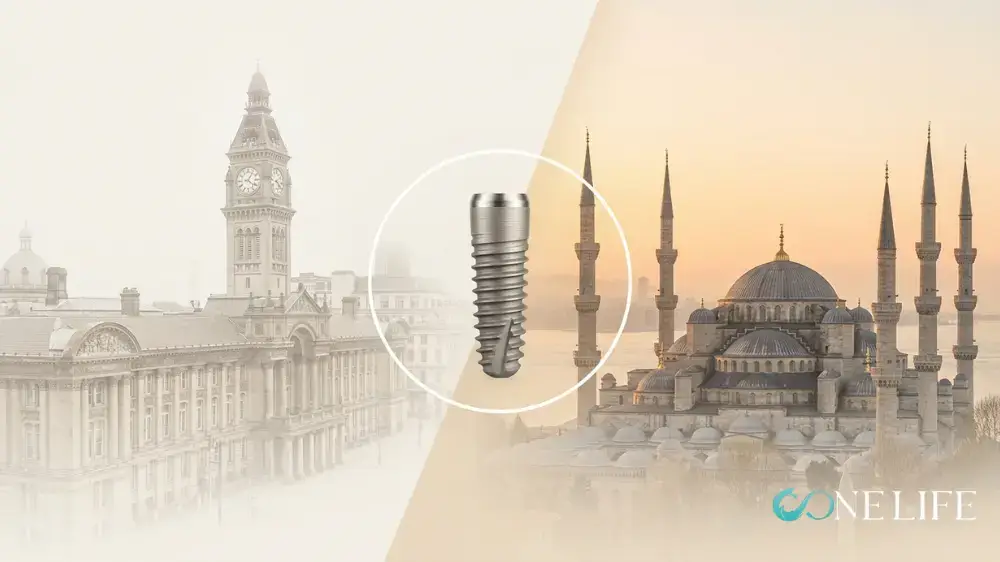
Ask a Birmingham dentist about dental implants in Turkey and you’ll hear about botched cases. Ask a Turkish clinic and you’ll hear about miracle savings. Both are telling you half the story. The fact is a Swiss Straumann® implant costing £2,400 in Birmingham costs £750 in Istanbul – £1,650 less for the exact same product.
Savings, however, only make sense if you know how to verify implant authenticity and choose a qualified oral and maxillofacial surgeon. This guide explains exactly that.
Key takeaways:
- A single implant costs £1,700–£3,350 in Birmingham vs £500–£1,100 in Turkey (2026)
- Over 500,000 UK residents now travel abroad for dental treatment each year (ONS, 2025)
- Top-tier Turkish clinics report 95–97% success rates, matching UK stats
- Verify Ministry of Health authorisation, Temos accreditation and implant REF codes before booking
BDA Warnings About Dental Implants Abroad
The UK’s General Dental Council has published guidance on the risks of treatment abroad, and the British Dental Association reports a rise in patients needing corrective work after overseas procedures. Both warnings deserve to be taken seriously.
According to ONS data, around 523,000 UK residents travelled abroad for dental treatment in 2025 (a 50% increase in just two years), driven by NHS waiting lists exceeding 7 million and rising private fees. The rational response is not to dismiss Turkey, but to apply UK-level due diligence to it. Booking by price alone, with no verification of surgeon, materials or facility is the problem here.
Are Dental Implants in Turkey Safe?
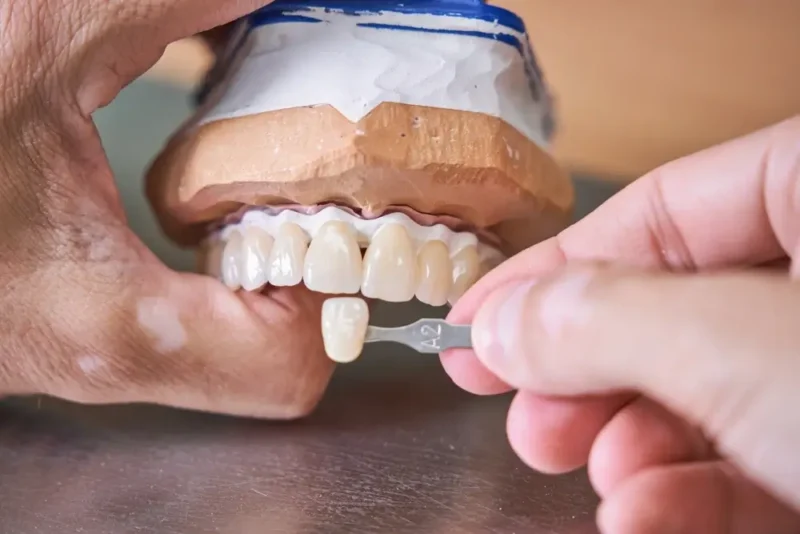
Yes, at high-level, accredited clinics, Turkish success rates match UK statistics of 95-97% success rates. The horror stories that circulate online are real, but they are born almost entirely in unaccredited low-cost centres.
Here is how the landscape actually looks:
Accredited Turkish Clinic | Low-Cost “Dental Mill” | |
Primary surgeon | Oral & maxillofacial surgeon | General dentist |
Implant brands | Straumann®, Nobel Biocare® | Generic, unbranded |
Diagnostics | 3D CBCT + digital planning | Basic panoramic X-ray |
Success rate | 95–97% | 85–90% |
How Much Do Dental Implants Cost in Birmingham vs Turkey?
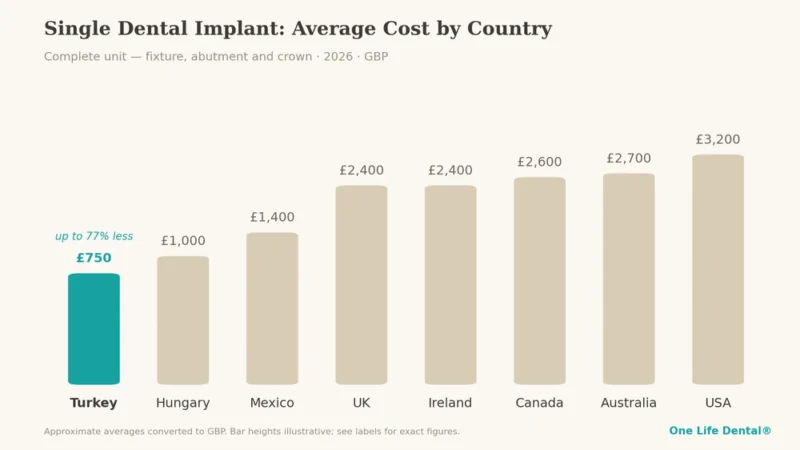
A single dental implant costs £1,700–£3,350 in Birmingham in 2026, with most patients paying around £2,400. In Turkey, the same treatment and implant brand costs £500–£1,100. For full-arch work, All-on-4 in Birmingham runs £8,550–£14,250 per arch, with the full mouth dental implants package price in Turkey at £2,450–£4,650 on average.
The table below puts them side by side:
Treatment | Birmingham | Turkey Package |
Single implant (fixture + abutment + crown) | £1,700 – £3,350 | £500 – £1,100 |
All-on-4 (per arch) | £8,550 – £14,250 | £2,450 – £4,650 |
All-on-6 (per arch) | £10,000 – £20,000 | £3,150 – £5,950 |
Full mouth (both arches) | £30,000 – £45,000+ | £4,950 – £12,000 |
What’s Included & Hidden Extras
A typical Turkish all-inclusive package covers the whole implant components and zirconia or e.max crown, full CBCT diagnostics, surgeon and clinic fees, hotel accommodation and VIP transfers. Before comparing anything, request an itemised written quote from your clinic.
A typical UK implant quote may exclude:
- CBCT 3D scan and X-rays: £100–£300
- The abutment and crown: sometimes billed separately, adding £800–£2,500
- Bone grafting or sinus lift, if needed: £400–£2,000+
Which Certifications and Licences Should a Turkish Dental Clinic Have?
Four credentials distinguish a legitimate dental clinic in Turkey and every one of them can be verified before you book a flight. In Turkey, accredited dental clinics treating international patients operate under a tight regulatory framework:
- Turkish Ministry of Health authorisation: Every legal clinic must hold the Health Tourism Authorization Certificate, which subjects it to unannounced inspections and strict sterilisation protocols.
- Temos accreditation: For travelling patients, arguably the most important seal. Temos specifically audits the international patient journey: pre-operative transparency, informed consent in your language, protection against hidden costs, and continuity of care after you return to the UK.
- ISO 9001 certification: A voluntary standard that documents every clinical process into repeatable, audited protocols — drastically reducing the human-error factor behind infections and mechanical failures.
- Professional memberships: Membership of the Turkish Dental Association (TDB), adherence to International Team for Implantology (ITI) protocols, and — for the surgeon — verifiable oral & maxillofacial credentials.
Red Flags to Spot a Dental Mill
The inverse checklist is just as valuable as the accreditations checklist. Whatever the country, these five signs should end the conversation:
- A quote 70% below the accredited market average is a signal that generic implants or non-medical-grade prosthetics are involved.
- Safe implant placement is impossible to plan on a flat panoramic X-ray. Ask for a CBCT scanner on site.
- Ask one direct question: “Will an oral & maxillofacial surgeon perform my surgery?” For full-arch cases especially, anything less is a lower tier of surgical safety.
- No implant passport or REF codes. If material traceability cannot be documented, material quality cannot be trusted.
- A fixed temporary bridge on surgery day is legitimate. A permanent one is not. Clinics that promise otherwise are selling against your own healing process.
Is the Quality of Dental Implants the Same in Turkey as in Birmingham?
Yes, provided the clinic uses verifiable premium brands. The quality risk sits at budget “dental mills” that substitute premium brands with generic, unbranded copies. That is the difference that matters.
Are You Getting Authentic Straumann® Implants or Counterfeits?
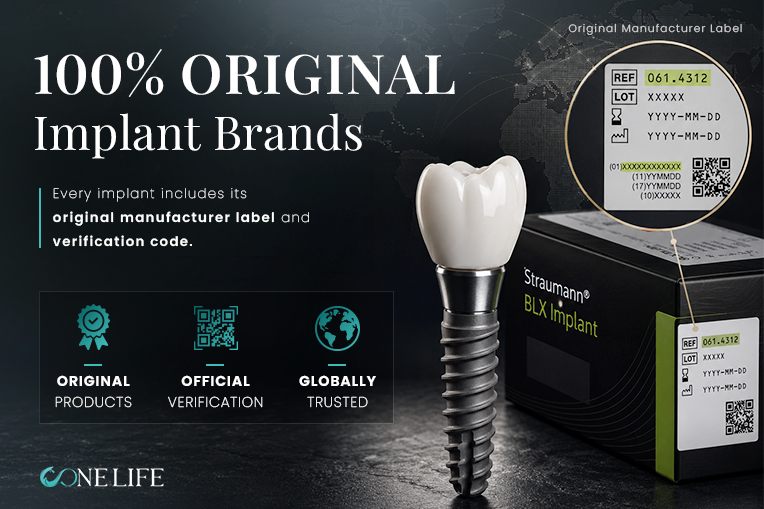
Premium implant brands are globally standardised. Here is how you remove all doubt of counterfeits and imitations. Every authentic implant ships in original sealed packaging carrying two identifiers: a REF code and a LOT code. A trustworthy clinic hands you this packaging and records both codes in your implant passport. You can then confirm authenticity directly through the manufacturer’s official verification tool.
Why Are Dental Implants So Much Cheaper in Turkey?
In short: you are not paying less for the implant but for the overheads around it. A Straumann® implant leaves the same Swiss production line whether it is shipped to the West Midlands or to Istanbul. What changes is everything around it:
- Operating costs: rent, staff salaries, utilities and laboratory fees in Turkey are dramatically lower
- Government support: Turkey treats medical tourism as a strategic industry, with lower taxation and reduced import duties on medical materials.
- Volume: high-caseload clinics purchase hundreds of premium implants at bulk rates.
Mandatory Complication Insurance for UK Patients in Turkey
Since 1 January 2026, every international patient undergoing dental implant surgery in Turkey must be covered by complication insurance. The regulation, introduced by the Turkish Ministry of Health, closes the question: who pays if something goes wrong after you fly home?
Here is what the mandatory policy covers:
- Revision surgery if a complication requires re-intervention
- Hospitalisation and intensive care costs arising from the procedure
- Return travel to Turkey for treatment, included in many policies
- Coverage period: typically 6 months post-procedure, with some plans extending to 12
Birmingham vs Turkey: Which Is Right for You?
For many patients, the real alternative to Turkey is not Birmingham; it is no treatment at all and years of accelerating bone loss. The economics and logistics point in different directions for different cases, these can be largely summarised in the following considerations:
The Decision at a Glance
Your Situation | Best Option | Why |
Single implant, simple case | Birmingham | Savings (~£1,500) shrink after travel costs |
Complex medical history | Birmingham | Direct coordination with your GP |
Cannot travel twice in 3–6 months | Birmingham | Standard implant protocol requires two trips |
Multiple implants (3+) | Turkey | Savings scale with every implant |
Full-arch / All-on-4 / All-on-6 | Turkey | £10,000–£25,000+ saved |
Full mouth restoration | Turkey | £20,000+ saved |
Priced out of UK treatment entirely | Turkey | The real alternative is often no treatment |
Birmingham is the stronger choice when:
- You need a single, straightforward implant
- You have a complex medical history requiring close coordination with your GP
- You cannot travel twice (which is a must for dental implants in Turkey)
Turkey is the stronger choice when:
- You need full-mouth treatment, saving you £10,000–£25,000+
- Your Birmingham quote includes extensive bone grafting or complex full-mouth work
- You want premium brands (Straumann®, Nobel Biocare®) with full traceability