
A single dental implant in Bristol costs between £2,000 and £3,000. The same Swiss-made brand, placed in Istanbul, costs £500 to £1,100. But savings only works if you are compare the same implant brand, surgeon qualification, guarantee, and aftercare.
Key takeaways from this article:
- Bristol single implant: £2,400 average (Bupa Almondsbury), £2,995+ at specialist practices
- Turkish all-inclusive full-arch packages: £3,250–£5,950 per jaw, hotel and transfers included
- Demand the REF and LOT codes: they are the only way to prove authentic implants
- Verify Ministry of Health Health Tourism Authorisation, ISO 9001 and Temos before booking
How Much Do Dental Implants Cost in Bristol?
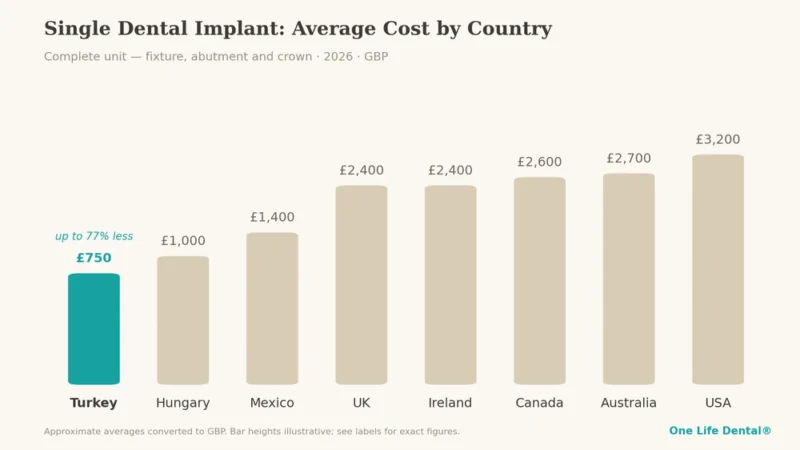
A single dental implant in Bristol costs £2,000–£3,000 in 2026. Bupa’s dedicated implant clinic in Almondsbury advertises a fixed £2,400 package, while other private practices start from £2,995. A full arch replacement ranges from £15,000 to £25,000+ per jaw.
Providers (2026) | Single Implant Price |
Bupa – Almondsbury Implant Clinic | £2,400 |
The Bristol Dental Practice | From £2,995 |
Queen Square Dental Clinic | £2,000–£3,000 |
UK national average | £1,900–£2,700 |
What’s Included & What is Extra
The prices mentioned above usually cover the implant, abutment and crown only. A realistic Bristol total for one implant with a scan and minor grafting: £3,100–£4,500.
Budget separately for:
- Consultation: £0–£80 (often redeemable against treatment)
- 3D CBCT scan: £100–£300 — non-negotiable for safe planning
- Bone grafting: £400–£1,200 per site, if bone volume is insufficient
- Sinus lift: £1,000–£2,500 (upper jaw only)
- Sedation: £200–£500 per session
Are Dental Implants Available on the NHS in Bristol?
Almost never. The NHS classes implants as a private treatment except in rare clinical cases (such as reconstruction after oral cancer) arranged via hospital referral, not your local practice. For the vast majority of Bristol patients, implants mean private fees or finance plans.
How Much Do Dental Implants Cost in Turkey?
A single dental implant in Turkey costs £500–£1,100 all-in, including the surgeon’s fee and crown. That is 60–80% less than Bristol for the same brands (Straumann, Nobel Biocare) or proven mid-range systems (Bego, Osstem).
Clinics sell full mouth dental implants Turkey package deals rather than itemised bills: diagnostics, surgery, hotel and airport transfers bundled.
Treatment | Package Price | Typical Saving |
Single implant (complete) | £500–£1,100 | 60–75% |
All-on-4 (per jaw) | £2,450–£4,500 | ~70% |
All-on-6 (per jaw) | £3,150–£5,950 | ~72% |
Full mouth (both jaws) | £4,950–£12,000 | Up to 80% |
Single Implant vs Full Arch Savings
For one implant, flying to Turkey is not worth it in most cases, as flights and hotel eat much of the saving. For full-arch or full-mouth cases, the story is completely different, with savings of £10,000–£30,000 absorbing a £150 return flight.
Always Verify Turkish Implant with REF Codes
Counterfeit or unbranded “Swiss” implants are the quietest scam in dental tourism. The defence is simple and absolute:
- Demand the implant’s original sealed packaging with its REF and LOT codes
- Verify both codes on the manufacturer’s official website (Straumann, Nobel Biocare and Bego all offer this)
- Insist on a written implant passport documenting brand, model and batch — your home dentist will need it for any future maintenance
What Implants Cost A Clinic in Any Country
A premium Straumann or Nobel Biocare fixture costs the clinic roughly £250–£450 wholesale in Bristol and in Istanbul. What you are actually paying for in Bristol is overheads, surgical time and UK accountability. What you are paying for in Turkey is the same hardware plus your own due diligence.
Why Are Dental Implants So Much Cheaper in Turkey?
The price gap comes from three factors, none of which involve the titanium in your jaw:
- Lower operating costs: Clinic rent, staff salaries, laboratory fees and insurance in Istanbul or Antalya are a fraction of UK levels.
- Government backing: Turkey treats health tourism as a strategic export supported by lower taxation and import duties on medical materials.
- Volume economics: High-volume clinics buy implants by the hundreds directly from Straumann or Nobel Biocare, securing bulk discounts.
Are Dental Implants in Turkey Safe?
Yes, at accredited clinics with specialist surgeons. At uncertified, high-volume “dental mills,” not. Some low-cost operators report success rates as low as 85%. In other words: the country is not the risk variable. Turkey contains both some of the best implant surgeons in Europe and some of the worst commercial dentistry on the market… often within the same postcode.
What to Verify Before You Book
A clinic that cannot show its credentials in writing does not have them. Both countries operate real regulatory systems. Knowing exactly what to check is your strongest protection.
GDC Registration, CQC and Indemnity (UK)
In Bristol, three layers of accountability protect you by default:
- GDC registration: Every practising dentist must be on the General Dental Council register.
- CQC inspection: The Care Quality Commission independently inspects and rates practices, with reports published publicly.
- Mandatory indemnity insurance:UK dentists must carry professional indemnity — meaning if negligence occurs, there is an insurer to claim against.
Ministry of Health, HealthTürkiye, ISO & Temos (Turkey)
In Turkey, equivalent safeguards exist. A legitimate clinic will hold:
Certification | What It Proves | How to Check |
Ministry of Health Authorisation | Legal licence to treat international patients; unannounced inspections | Ask for the unique authorisation certificate number |
HealthTürkiye registration | Mandatory state registration of every overseas patient case | Clinic should appear on the official portal |
ISO 9001 | Standardised, audited clinical processes | Request the current certificate |
Temos accreditation | Audited specifically for international patients: transparency, aftercare, consent in your language | Verify on Temos’s public directory |
JCI accreditation | The gold standard of hospital-level care (Turkey has 40+ JCI facilities) | JCI’s online directory |
Who Fixes It If Something Goes Wrong?
In Bristol, your dentist is twenty minutes away, GDC-bound, and insured. If treatment fails through negligence, you have a clear complaints route and an insurer to claim against. In Turkey, a good clinic will offer a written guarantee and remote follow-up, but enforcing anything means dealing with a foreign jurisdiction, in Turkish, at your own expense.
Three facts every traveller should know before booking:
- Standard travel insurance will not cover you. Nearly all policies exclude complications from planned dental treatment.
- The NHS is not your safety net. NHS dentists are not obliged to fix failed private work from abroad.
Turkey’s 2026 Mandatory Complication Insurance
Since 1 January 2026, complication insurance is mandatory for every international patient undergoing surgical or interventional procedures in Turkey (dental implant surgery included).
What the new rules mean in practice:
- Coverage is a legal requirement: Authorised clinics must verify valid complication insurance at admission and record the policy in your file.
- Funded post-operative care: If an unforeseen complication arises from your procedure, the policy — issued through a licensed Turkish insurer — covers the cost of retreatment at accredited facilities, including a contribution towards return travel of up to €600.
- Built into compliant packages: At authorised clinics the insurance is arranged as part of your treatment, representing roughly £120–£200 of value.
- Accountability with teeth. The same reform requires clinics to register every international case on the HealthTürkiye portal, and submit to ongoing evaluation based on complaint rates. Facilities that fail lose their certificate.
What Are the Risks of Dental Implants?
Implant surgery carries the same biological risks everywhere. What changes between clinics is how well those risks are anticipated, disclosed and managed. The three that matter:
- Early failure (first 3–6 months): The bone fails to fuse with the implant. Usually caused by poor bone quality, smoking during healing, surgical overheating of the bone, or loading the implant too soon. Affects roughly 2–5% of cases.
- Peri-implantitis (year 1 onwards): A bacterial infection of the gum and bone around the implant. The implant world’s version of gum disease, and the leading cause of late failure
- Nerve injury (rare but serious): An implant placed too close to the inferior alveolar nerve can cause lasting numbness in the lip, chin or jaw. This is a planning failure, not bad luck — 3D imaging shows the nerve’s exact position before the first incision.
7 Signs to Walk Away From a Dental Clinic
If any of these appear, keep your money and keep looking — in Bristol or Istanbul:
- Prices far below the market
- No CBCT scanner on site
- A quote without seeing your scans
- Permanent teeth promised in days
- No named surgeon
- Claims of zero complications
- No written guarantee or aftercare protocol
Bristol or Turkey: Which Should You Choose?
There is no universal answer, but there is a right answer for your case.
Choose Bristol if:
- You need one or two implants
- You value a dentist twenty minutes from home
- Legal redress through the GDC and UK courts matters to you
- Your case is medically complex and needs multi-visit monitoring
Choose Turkey if:
- You need full-arch or full-mouth treatment
- The UK price means postponing treatment indefinitely
- You are willing to do the verification work