
Every year, tens of thousands of patients weigh the same two names before booking a flight: dental implants in Hungary or Turkey. Hungary offers EU-regulation; Turkey clinics operate under Turkey’s Ministry of Health framework and, at the top tier, ISO and Temos accreditation.
Yet, the titanium implant going into your jaw is often the exact same Swiss brand. So why does Turkey quote roughly 15–25% less than Hungary for identical materials? The answer is economics and regulation.
Key takeaways:
- Single implants cost $400–$800 in Turkey vs $950–$1,400 in Hungary in 2026 — both 40–70% below UK/US prices
- Turkey treats ~1.2M+ international dental patients a year, ~4× Hungary’s volume
- Hungary runs on EU medical regulation (member since 2004); Turkey on a mandatory Ministry of Health tourism licence
- Verify the implant passport (brand + REF/LOT), a maxillofacial surgeon, and 3D CBCT before you pay
Hungary vs Turkey Dental Implants in 30 Seconds
Turkey is cheaper and faster to book; Hungary is more tightly regulated and closer for most Europeans. Clinical quality at the top tier is virtually identical. Your choice depends on budget, complexity of your case, and how much regulatory reassurance you want.
If price is your priority, Turkey wins on almost every quote (15–25% below Hungarian prices for the same implant brands). If EU consumer protection and a shorter flight matter more, Hungary is the safer bet. For complex cases (severe bone loss, zygomatic implants), the deciding factor is not the country but the surgeon’s specialisation.
Factor | Turkey | Hungary |
Single implant (2026) | $400–$800 | $950–$1,400 |
All-on-4 (per arch) | $2,500–$6,000 | from ~$5,000–$6,500 |
Full-mouth packages | $6,000–$12,400 | $10,000–$20,000 |
Regulation | Ministry of Health licence + Temos/ISO | EU law + NNK licensing |
Annual intl. patients | ~1.2M+ | ~100,000 |
Top-tier success rate | 95–97% | 95–97% |
Flight from Western Europe | 3–4h | ~2.5h |
Typical savings vs UK/US | 50–70% | 40–60% |
How Much Do Dental Implants Cost in Hungary vs Turkey?
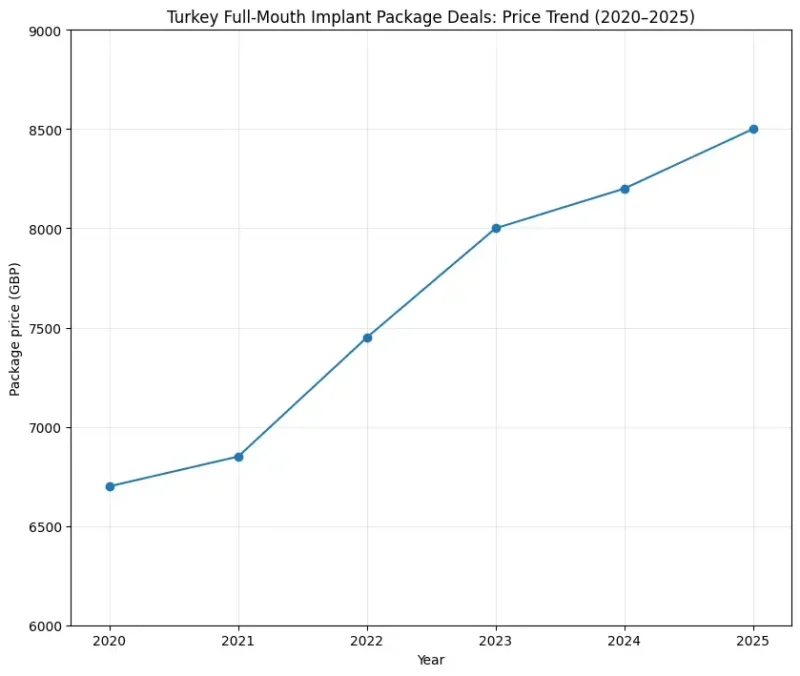
Expect to pay 15–25% less in Turkey than in Hungary for the same procedure — and 40–70% less than in the UK, US or Germany. A single dental implant is the clearest way to compare the two countries:
- Turkey: $400–$800 for a complete single implant, with premium Swiss brands at the upper end
- Hungary: $950–$1,400, with Alpha Bio and MIS at the lower end and Straumann or Nobel Biocare at the top
All-on-4 and Full-Mouth Implant Costs Compared
The price gap widens with full mouth dental implants, because you’re multiplying the savings across an entire arch:
- All-on-4 in Turkey: $2,500–$6,000 per arch; premium Nobel Biocare packages around $4,700
- All-on-4 in Hungary: typically from ~$5,000 to $6,500+ per arch, with premium options reaching higher
- Full-mouth dental implants price in Turkey: roughly $6,000–$12,400
- Full mouth implants in Hungary: $10,000–$20,000
What’s Actually Included in the Price?
Turkish clinics dominate the all-inclusive package model, while Hungarian clinics more often price treatment and travel separately. Demand a written, itemised treatment plan separating surgery, materials, prosthetics and travel before you book anything:
- Typical Turkish package: implants, 3D CBCT scans, temporary teeth, medications, 4–5 star hotel and VIP airport transfers
- Typical Hungarian package: treatment, consultation and imaging included; hotel sometimes bundled, often arranged separately
- Watch for exclusions in both countries: bone grafting, sinus lifts and premium zirconia upgrades are frequently quoted after your scan
Which Country Is Cheaper for Dental Implants and Why?
Turkey is 15–25% cheaper than Hungary for identical treatments and identical materials. The price difference does not reflect the titanium in your jaw. A Straumann implant is manufactured in Switzerland regardless of where it’s placed, and both countries’ top clinics buy from the same global suppliers. What you’re really comparing is the cost of the hands and the building.
Three structural factors explain Turkey’s price advantage:
- Labour and overhead costs: salaries, facility rent and operating expenses are significantly lower in Turkey than in Hungary
- Exchange rate: the favourable rate between the Turkish lira and the euro, pound or dollar amplifies your purchasing power
- EU compliance costs: as an EU member, Hungary carries higher minimum wages and regulatory compliance costs, which flow directly into treatment prices
Are Dental Implants Safer in Hungary or Turkey?
Both countries can be extremely safe if you choose the right provider. Hungary’s safety is enforced by EU law; Turkey’s by a national licensing system plus voluntary international accreditations.
How EU Regulation Shapes Hungarian Dental Standards
Hungary’s core safety argument is it’s an EU member state since 2004, its healthcare operates under full European regulations: patients benefit from the same consumer protections, quality standards and legal frameworks as in any Western European country, and all materials must meet strict EU certification requirements.
In practice, this means:
- Mandatory licensing of every dental practice by Hungary’s National Public Health Center (NNK)
- EU Medical Device Regulation governing every implant, abutment and crown placed
- Legal recourse within the EU framework if something goes wrong
- A deep talent pipeline: Semmelweis University, founded in 1769, is one of Europe’s oldest medical schools and trains many of the country’s implantologists
How Turkey’s Ministry of Health Regulates Dental Clinics
Turkey answers with a system built specifically around medical tourism. To operate legally, every clinic must hold the Health Tourism Authorization Certificate issued by the Ministry of Health of the Republic of Turkey. The Turkish Dental Association (TDB) additionally regulates the ethical conduct and pricing of its members.
On top of the legal baseline, elite Turkish clinics pursue voluntary international accreditations:
- ISO 9001: documented, repeatable protocols for every clinical step
- Temos: arguably the most relevant seal for travelling patients, as it specifically audits pre-operative transparency, continuity of care after you fly home, and informed consent in your language
- JCI accreditation: the international gold standard, which Turkey holds at scale (52 JCI-accredited hospitals, more than almost any country outside the USA)
Implant Success Rates in Hungary vs Turkey
Top-tier clinics in both countries report success rates of 95–97%, in line with international implantology statistics. Hungarian sources cite success rates up to 98% for standard implants; verified Turkish clinic data shows 93.2–96.1% across top facilities. In other words: the border matters less than the tier.
- Top-tier clinic (either country): 95–97% success, specialist surgeons, premium brands
- Low-cost operator (either country): success rates falling to 85–90%, driven by generalist dentists, generic implants and rushed planning
Is the Quality and Materials the Same in Both Countries?
At the top tier, yes. The implant brands, zirconia and digital technology are essentially identical in a premium Budapest clinic and a premium Istanbul clinic. A Grade 5 medical titanium implant integrates into your jawbonethe same way whether it’s placed in Budapest or Istanbul. What does vary between clinics is:
- The origin of the implant: globally certified Swiss/German/Korean systems vs unbranded “white label” screws
- The prosthetics: medical-grade zirconia milled in an in-house CAD/CAM lab
- The diagnostics: 3D CBCT scanning with digital surgical guides vs a basic panoramic X-ray
- Sterilization: Class B autoclave protocols vs cutting corners where you can’t see it
Premium Implant Brands You Should Always Ask For
Dentists at home are often reluctant to touch foreign implants without documentation. Your implant passport lets any clinician, anywhere, identify the exact components in your mouth and service them for life.
Brand transparency is your strongest quality filter. Global brands come with decades of clinical data and worldwide serviceability: any dentist at home can maintain them.
- Premium tier: Straumann (Switzerland) and Nobel Biocare (Sweden/USA) — 40+ years of clinical evidence and lifetime international warranties.
- Value tier: Osstem (South Korea), Alpha Bio and MIS (Israel), Bego (Germany) — excellent osseointegration at a lower price point
Full Mouth Dental Implants: All-on-4 vs All-on-6 in Each Country
Both Turkey and Hungary perform All-on-4 and All-on-6 at high volume and high standard. Turkey offers the lower price per arch; Hungary offers decades of full-arch experience under EU rules.
- Price reality (per arch, 2026): All-on-4 from ~$2,500–$6,000 in Turkey vs ~$5,000–$6,500+ in Hungary; All-on-6 runs roughly 15–25% above All-on-4 in both countries
When You Need Bone Grafting, Sinus Lift or Zygomatic Implants
The rule that protects you in Budapest and Istanbul alike is: the more complex your case, the more the surgeon’s credentials outweigh every other factor — including price and country. A maxillofacial surgeon undergoes 4–6 years of additional hospital-based residency beyond dental school, trains in complication management, and maps your nerves and sinus floors on 3D CBCT with sub-millimetre accuracy before the first incision.
If you need grafting, a sinus lift or zygomatic work, make one question your filter in either country: “Will an oral & maxillofacial surgeon perform my surgery — yes or no?”
- Bone grafting: rebuilds jawbone volume where teeth have been missing for years. Routine in top clinics of both countries
- Sinus lift: creates implant space in the upper jaw near the sinus cavity. Precision here is non-negotiable; proximity to the sinus floor is where inexperienced operators cause complications
- Zygomatic implants: the solution for severe upper-jaw bone loss, anchoring into the cheekbone instead. These are the domain of oral & maxillofacial surgeons exclusively
What Are the Red Flags to Avoid in Both Countries?
The warning signs are identical in Hungary and Turkey because “dental mills” follow the same playbook everywhere. If you can spot these six patterns, you’ve neutralised most of the risk of going abroad.
- The price trap: A quote ~70% below the local market average. That margin has to come from somewhere: generic unbranded implants, non-medical-grade prosthetics, or a generalist doing a surgeon’s job.
- No 3D CBCT scanner on-site: A flat panoramic X-ray cannot show bone volume, nerve position or sinus anatomy. If a clinic plans implant surgery without on-site CBCT imaging, they are quite literally operating with one eye closed.
- The “generalist” shortcut: Ask directly: “Will a maxillofacial surgeon perform my surgery?” For full-arch or complex cases, this single question filters out most high-risk providers
- No implant passport or brand transparency: A clinic that hesitates when you ask for the brand, REF and LOT numbers of your components is telling you everything. Traceable documentation is standard practice at every serious clinic in both countries
- “0% complications” and pressure tactics: Claims of perfection, expiring “today-only” discounts, and demands for large deposits before you’ve seen a written treatment plan are the sales tools of volume mills
- Permanent teeth in a week. Biology doesn’t negotiate. Osseointegration takes 3–6 months; any clinic promising fixed permanent full-arch teeth on your first visit is prioritising your booking over your bone
Hungary vs Turkey: Which Is Easier to Travel To?
Budapest sits ~2.5 hours from London or Frankfurt, while Turkey sits slightly longer at 3–4 hours, but Antalya has direct budget-carrier flights from 15+ UK and Irish airports, including Manchester, Birmingham, Edinburgh, Belfast and Liverpool.
- Cost of getting there: UK–Antalya returns run £80–£220; Budapest fares are comparable.
- On the ground: Turkish packages typically bundle VIP transfers and 4–5 star hotels into the fixed price; in Hungary you’ll more often book accommodation yourself
Flights, Recovery Time and the Two Visits
Whichever country you choose, plan around the same calendar:
- Visit 1 (5–7 days): consultation, CBCT scan, extractions if needed, implant placement, temporary teeth. You’ll fly home with a functional provisional smile
- Healing phase (3–6 months at home): osseointegration does its silent work. Reputable clinics in both countries offer remote aftercare and video check-ins during this window
- Visit 2 (5–7 days): final impressions and fitting of your permanent zirconia or porcelain teeth
How Do You Verify a Dental Clinic Before You Book?
Verification takes under an hour and costs nothing. Here is the exact checklist, adapted to each country.
Step 1: Verify the legal licence
- In Turkey: confirm the clinic holds the Health Tourism Authorization Certificate from the Turkish Ministry of Health, with its unique authorization code. Cross-check membership in Health Türkiye and the Turkish Society of Oral Implantology
- In Hungary: confirm registration with the National Public Health Center (NNK) — mandatory for every Hungarian dental practice — and membership in the Hungarian Dental Chamber
Step 2: Look for voluntary international accreditations
These are the seals that separate “legal” from “excellent,” and they mean the clinic invited external auditors to scrutinise it:
- Temos: the most relevant for travelling patients: it audits pre-operative transparency, aftercare once you’re home, and informed consent in your language
- ISO 9001: standardised, documented protocols for every clinical step
- JCI: the international gold standard, held by fewer clinics but a powerful signal in either country
Step 3: Interrogate the surgical credentials
Ask, in writing:
- Who exactly places my implants? For complex or full-arch cases, the answer should be an oral & maxillofacial surgeon
- Is the surgeon a member of international bodies? ITI (International Team for Implantology), EFP, or the American Dental Association? Top-tier providers in both countries usually are
Step 4: Demand material transparency
Request the implant brand, REF and LOT numbers in your written treatment plan, plus the warranty terms (premium brands carry lifetime international warranties). A clinic that supplies this instantly has nothing to hide.
Step 5: Test the treatment plan itself
Send your panoramic X-ray or CBCT to 2–3 clinics and compare:
- A serious plan is itemised: surgery, materials, prosthetics, travel, and possible extras like bone grafting listed separately
- A serious plan includes a complication protocol: what’s covered, what’s not, and what happens if an implant fails to integrate
- If one quote is dramatically below the others for the same plan, you’ve just watched a red flag identify itself
Step 6: Read reviews
Skip the five-star averages; read the negative and middling reviews and watch how the clinic responds to complications. Verified before-and-after cases of patients with your specific condition are worth more than a hundred generic testimonials.
So, Should You Choose Hungary or Turkey?
Whichever country you choose, never compromise on a named specialist surgeon, 3D CBCT planning, a traceable implant passport, premium or certified value-tier brands, and a written itemised plan with a complication protocol. The tier of the clinic will always matter more than the flag on the building.
Choose Turkey if:
- Maximum savings drive your decision
- You value the all-inclusive model: fixed price, hotel, transfers and a personal host
- You live outside a capital city: Turkey’s 15+ direct regional routes from the UK and Ireland often make it the easier journey
- Your case is complex and you’ve verified a clinic with a resident maxillofacial surgeon and on-site CBCT
Choose Hungary if:
- EU regulation and legal recourse are your priority
- You want the shortest flight and plan to handle follow-ups
- You prefer a mature, consistent market: 30 years of implantology tradition and a tighter quality baseline
- Paying a moderate premium for regulatory reassurance feels like money well spent