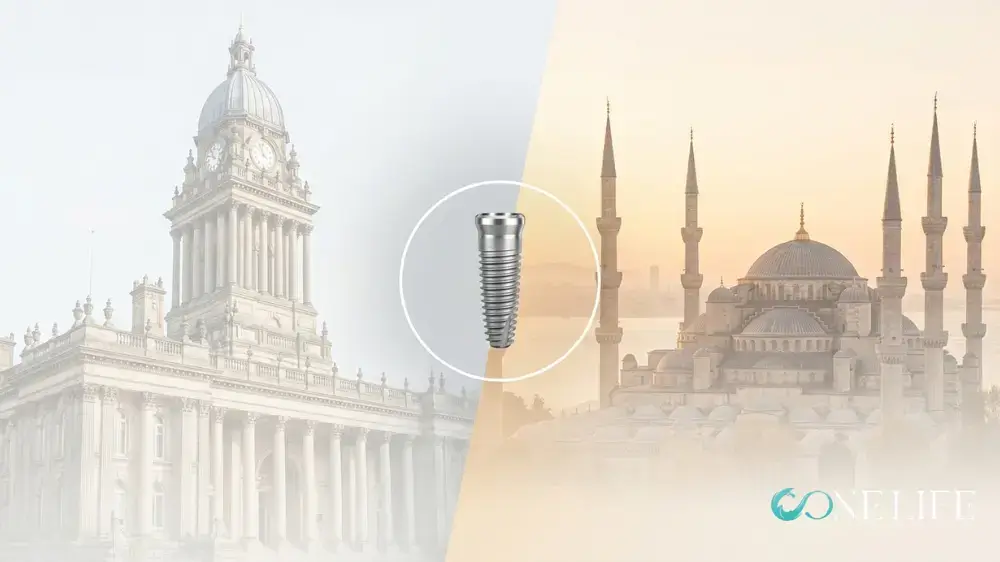
A single dental implant in Leeds costs around £2,000–£2,400. The identical Swiss product costs £500–£1,100 in Turkey with a maxillofacial surgeon. But that Price gap is only worth it if you land in the right clinic. This guide shows you exactly where the line sits between a world-class bargain and an expensive mistake.
Key takeaways in this article:
- NHS rarely funds implants; private Leeds prices run £1,595–£2,400 per tooth
- Turkish package pricing: £500–£1,100 per implant, all-inclusive
- Turkish clinics must hold a Health Tourism Authorisation Certificate from the Ministry of Health
- Demand an implant passport with REF and LOT codes (it is your only proof of material authenticity)
How Much Do Dental Implants Cost in Leeds vs Turkey?
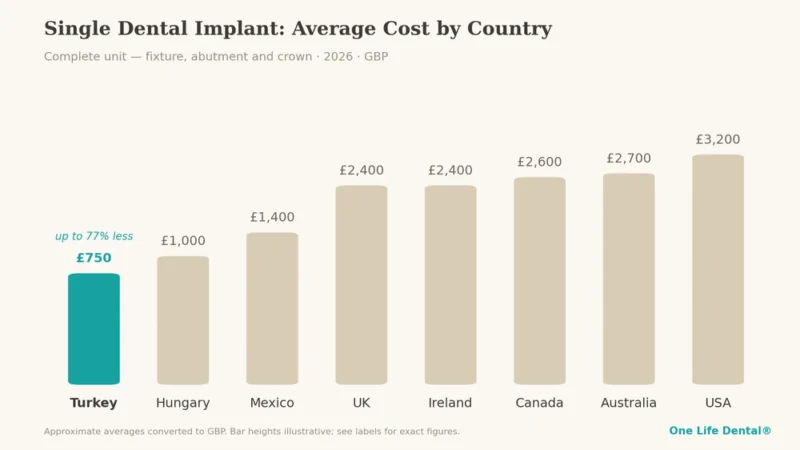
A single dental implant costs £1,595–£2,400 in Leeds and £500–£1,100 in Turkey: a saving rising to £10,000 or more on a full arch. That is the honest headline. The figures below are drawn from published Leeds dental implant prices in 2026 and all-inclusive dental implants in Turkey.
Dental Implant Cost Comparison (2026)
Treatment | Leeds (private) | Turkey (all-inclusive) |
Single implant (fixture, abutment, crown) | £1,595–£2,400 | £500–£1,100 |
All-on-4 (per arch) | £12,999–£16,000 | £2,450–£4,650 |
All-on-6 (per arch) | £16,000–£22,000 | £3,150–£5,950 |
Full mouth (both arches) | £30,000–£45,000+ | £4,950–£12,000 |
Always ask for a written itemised quote; any reputable practice will provide one without hesitation.
Full Mouth and All-on-4 Dental Implant Costs
For a single tooth, flying rarely justifies the journey to Turkey. You save perhaps £1,200 and spend a week of annual leave doing it. For the full mouth dental implants Turkey package price, the picture inverts completely.
A Leeds All-on-4 arch runs £12,999–£16,000 (only for the lower or upper mandible). The equivalent Turkish package starts around £2,450, including implants, zirconia bridge, hotel and transfers. On a double arch (upper and lower mandible), that is a £25,000–£30,000 difference.
How to Verify Authentic Swiss Implants in Turkey
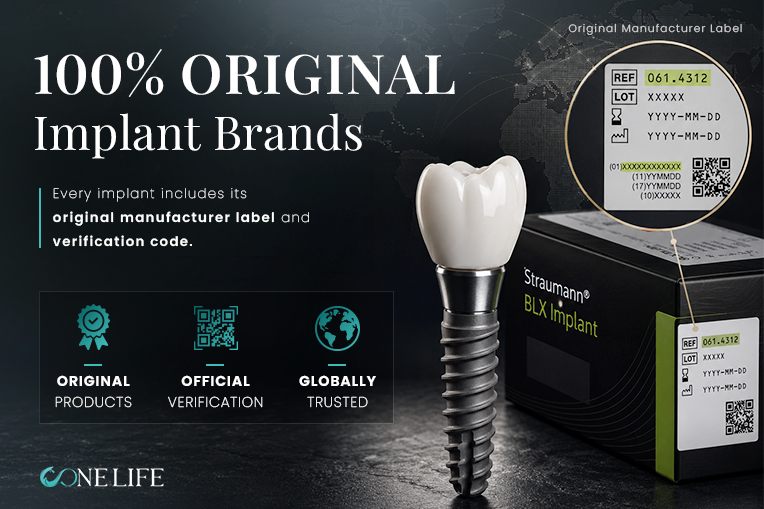
Ask for your implant’s REF and LOT codes in the original sealed packages. These two numbers are the proof that the fixture is the brand you were quoted, they take five minutes to verify directly with the manufacturer.
Premium clinics fit Straumann (Switzerland), Nobel Biocare (Sweden/USA), Bego (Germany) or Osstem (South Korea), brands with 40+ years of clinical data and international warranties.
Why Are Dental Implants So Much Cheaper in Turkey?
A premium Straumann or Nobel Biocare implants costs broadly the same in Istanbul as in Leeds. The manufacturer sells globally at global prices. What differs is everything wrapped around it. Three structural factors explain the price gap:
- Operating costs: Commercial rent, utilities, clinical salaries and laboratory fees in Turkey run a fraction of West Yorkshire.
- Government incentives: Turkey treats medical tourism as strategic industry, with reduced taxation, lower import duties on medical devices and direct sector support.
- Volume purchasing: A clinic placing thousands of implants annually buys them at bulk discount.
The True Total Cost: Flights, Time Off Work & Aftercare
Here is the realistic all-in comparison for a Leeds patient, including the costs most people discover late.
Cost element | Treat in Leeds | Travel to Turkey |
All-on-4, single arch | £12,999–£16,000 | £2,450–£4,650 |
Flights (Leeds Bradford, 2 trips) | £0 | £180–£400 return each trip |
Accommodation | £0 | Usually included (7–10 nights) |
Airport transfers | £0 | Usually included |
Complication insurance | N/A | Included (mandatory since Jan 2026) |
Time off work | 3–4 short appointments | 2 trips, 7–10 days each |
UK aftercare contingency | Covered by warranty | Budget £500–£1,000 |
Realistic total | £13,000–£16,000 | £3,300–£6,500 |
Direct flights from Leeds Bradford to Antalya take around 4h 30m; Istanbul is typically one stop, with returns from roughly £90–£206.
Are Dental Implants in Turkey Safe?
Yes, but only at surgeon-led, properly equipped clinics. Top-tier facilities in Istanbul and Antalya report implant success rates of 93% to 96%, matching International Team for Implantology (ITI) statistics in the UK. At low-cost, high-volume clinics that figure falls to 85–90%.
Three complications account for almost all dental implant failures, in Leeds and Istanbul alike:
Complication | What causes it | What prevents it |
Early failure(0–6 months) | Failed osseointegration — poor bone quality, smoking, bone overheating during drilling, premature loading | 3D CBCT torque analysis, guided surgery, strict two-stage protocol |
Peri-implantitis(year 1+) | Bacterial infection around the fixture; leading cause of long-term loss | Class B autoclave sterilisation, screw-retained crowns, lifelong hygiene |
Nerve damage | Fixture placed too close to the inferior alveolar nerve | Digital surgical guides and 3D nerve mapping — not freehand estimation |
Be suspicious of any clinic claiming a 0% complication rate. Complications occur in the best hands in the world.
New 2026 Mandatory Complication Insurance in Turkey
Since 1 January 2026, complication insurance is a legal requirement for international patients undergoing dental implants in Turkey. This is the most significant patient-protection reform the sector has seen.
What the policy covers:
- Revision surgery required as a result of a post-operative complication
- Hospitalisation, ICU admission and associated medical costs
- In many plans, return travel to Turkey
- Dental implant policies run 12 months from the date of treatment
Three limitations to understand:
- It is valid inside Turkey only: A repair carried out in Leeds is not covered.
- It does not replace your clinic’s warranty: Insurance funds the fix; the warranty commits someone to performing it. You want both.
- Enforcement varies by facility type: The Turkish Medical Association flagged inconsistencies in March 2026, so ask for your policy certificate and insurer contact details in writing before admission.
How to Verify a Turkish Dental Clinic
Every clinic legally treating international patients in Turkey must hold a Health Tourism Authorisation Certificateissued by the Turkish Ministry of Health. It carries a unique authorisation code, and it subjects the facility to unannounced inspections and enforced sterilisation protocols. Ask for the code. It is public.
And another pro tip: verify the surgeon separately from the clinic. A maxillofacial surgeon completes four to six years of hospital residency beyond dental school and is the only clinician licensed to place zygomatic implants.
Beyond the legal minimum sit voluntary accreditations that separate serious operators:
- ISO 9001:2015: documented, repeatable clinical processes that reduce human error
- Temos: audits the international patient journey specifically: pre-operative transparency, continuity of care after you fly home, protection against hidden costs
- Turkish Society of Oral Implantology / ADA membership: individual clinician credentials
Red Flags in Turkish Implant Packages
Turkey’s regulatory floor is high. Walk away if you see any of the following:
- A quote 70% below the Istanbul market average: usually means unbranded fixtures or non-medical-grade prosthetics.
- No on-site 3D CBCT scanner: A panoramic X-ray is 2D. It cannot map your nerve position or bone density, and freehand placement is how nerve damage happens.
- Ask: “Will a maxillofacial surgeon place my full-mouth implants?” Anything other than yes is a red flag.
- Permanent “teeth in a day”: A permanent crown fitted before osseointegration at 3–6 months disrupts fusion and causes rejection.
- No named surgeon, no written complication rate, no itemised quote.
- Pressure to pay a deposit before your scan has been reviewed.
Should You Treat in Leeds or Fly to Turkey?
The right answer depends on case complexity and your tolerance for logistics. Use this as a filter, not a verdict.
Stay in Leeds if:
- You need one or two implants
- You have complex medical history: uncontrolled diabetes, active periodontitis, bisphosphonate therapy or anticoagulant use
- You cannot take extended time off, or cannot fly twice within six months
- A GDC-registered clinician matters more than cost for you
Turkey makes sense if:
- You need full mouth dental implants, All-on-4 or All-on-6
- You can commit to two separate trips, three to six months apart
- You have verified the clinic’s Ministry of Health authorisation, surgeon credentials and implant brand
- You have a UK dentist willing to provide follow-up
Book Your Free Implant Consultation
Send us your X-ray or CBCT scan and receive a written, itemised treatment plan. Book your free consultation today.