
Every week, patients leave Manchester Airport on a four-hour flight to Istanbul for one reason: dental implants that cost £500–£1,100 abroad vs £2,300–£3,500 at home. That’s a bet on surgeons who place more implants in a month than many UK colleagues do in a year, at 60–75% lower prices.
But the bet only pays off if you know exactly what you’re buying: the right certifications, the right surgeon, and the red flags that separate world-class clinics from risky bargains.
Key takeaways:
- A single implant costs £2,300–£3,500 in Manchester vs £500–£1,100 in Turkey (all-inclusive)
- Full mouth restorations run £30,000–£45,000 in the UK vs £4,950–£12,000 in Turkey
- Premium implants achieve a 95–98% success rate in both countries, if placed by a qualified surgeon
- Verify the Turkish Ministry of Health licence, Temos accreditation and REF codes before booking (this guide shows you how)
How Much Do Dental Implants Cost in Manchester vs Turkey?
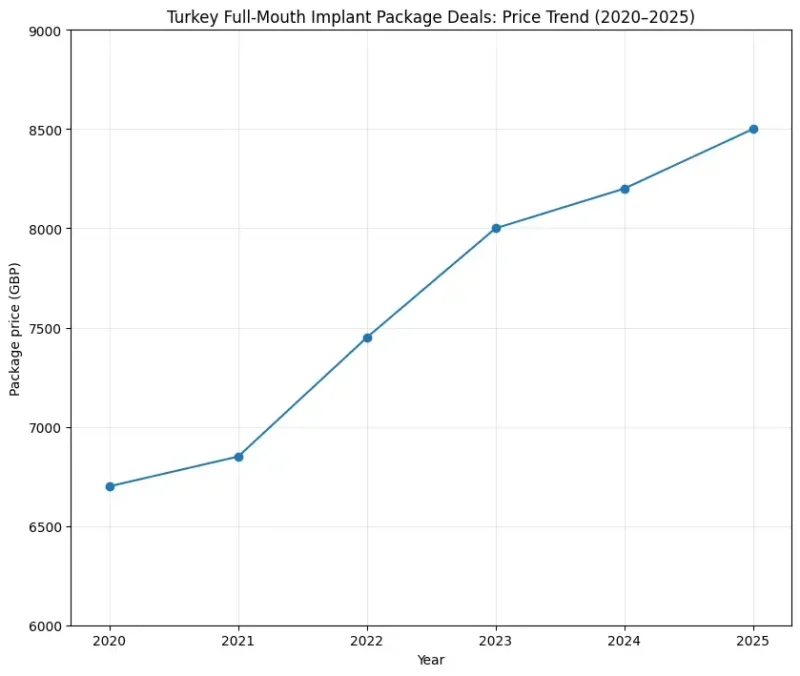
A single dental implant in Manchester costs £2,300–£3,500, while the same premium-brand implant in a certified Turkish clinic costs £500–£1,100 all-inclusive. For full mouth dental implants in Turkey, the gap widens dramatically: £30,000–£45,000 in the UK versus £4,950–£12,000, with flights, hotel and transfers included.
The key to comparing is looking at the all-inclusive price. Many UK adverts quote the implant post only, while the abutment, crown, surgeon’s fee and diagnostics are billed separately.
Single Dental Implant Cost in Manchester
Manchester clinics typically quote “from £2,300″. Realistically, most Manchester patients pay £2,800–£3,500 per tooth once everything is included. If bone grafting or a sinus lift is needed, add £400–£1,500. And since dental implants are almost never available on the NHS, the full amount is private.
- The implant fixture (the titanium root): £1,000–£2,000
- The abutment and crown: £1,500–£2,500
- Surgeon and clinic fees: £500–£1,500
- Diagnostics (CBCT scan, X-rays): £100–£300
Full Mouth Dental Implants Cost: All-on-4 and All-on-6
Full arch solutions (All-on-4, All-on-6) replace an entire jaw of teeth on four or six implants. Because Turkish packages bundle surgery, materials, hotel and transfers into one price, the more implants you need, the more you save.
Treatment | Manchester (2026) | Turkey — certified clinic (2026) |
Single implant (complete) | £2,300–£3,500 | £500–£1,100 |
All-on-4 (per arch) | £12,000–£18,000 | from £2,450–£4,500 |
All-on-6 (per arch) | £16,000–£22,000 | from £3,150–£5,500 |
Full mouth (both arches) | £30,000–£45,000+ | £4,950–£12,000 |
What’s included | Treatment only | Treatment + hotel + VIP transfers + CBCT scan + guarantee |
Two details worth underlining:
- The implant brand can be identical: Straumann, Nobel Biocare and Bego are global. A certified Istanbul clinic places the exact same Swiss fixture as a Deansgate practice.
- The guarantee often improves abroad: Top-tier Turkish clinics offer a written 10-year guarantee (lifetime on premium Straumann packages).
Why Are Dental Implants So Much Cheaper in Turkey?
Dental implants in Turkey are cheaper because of lower operating costs, government support for medical tourism and high patient volume. The Straumann fixture itself (or any other Swiss premium implant) costs roughly the same to manufacture anywhere in the world. What changes is everything around it.
- Staff and facility costs: clinical salaries, rent and utilities in Istanbul run dramatically lower than in central Manchester (in some categories by as much as 500%).
- Government incentives: Turkey treats health tourism as a strategic industry, with lower taxation and reduced import duties on medical materials.
- Volume purchasing: high-volume clinics buy hundreds of implants directly from Straumann or Nobel Biocare, securing bulk discounts.
- Integrated workflow: leading clinics operate theirown in-house dental laboratory, cutting out external lab fees and turnaround delays.
What Do Turkey Packages Include?
If a package is priced roughly 70% below the Istanbul market average, corners are being cut somewhere, usually on the implant brand or the person holding the drill. You should also add a £50–£150 return flight from Manchester to Istanbul (four hours, multiple daily departures).
This being said, Turkish package prices usually cover:
- All clinical costs: 3D CBCT scan, surgery, implants, abutments and final zirconia or e.max crowns
- 4- or 5-star hotel accommodation(typically 5–10 nights)
- VIP airport transfers and a patient coordinator in English
- A written 10-year guarantee on the fixture and restoration
Are Dental Implants in Turkey as Safe as in Manchester?
Yes, dental implants in Turkey are as safe as in Manchester when placed in a certified clinic by a qualified surgeon. The horror stories are real, but they cluster around uncertified, ultra-low-cost operators. The deciding factor is never the country. It’s the clinic.
Success Rates of 95–98% in Both Manchester & Turkey
Modern dental implantology is one of the most predictable disciplines in medicine. Across healthy patients, premium implants achieve a documented 95–98% success rate over 10 years:
- Top-tier Istanbul and Antalya clinics report success rates of 95–97%, aligned with the global benchmarks of the International Team for Implantology (ITI)
- Standard UK and European clinics report the same range: 95–97%
- Low-cost, uncertified clinics (in any country) drop to 85–90%, driven by generic implants, basic 2D X-rays instead of 3D planning, and generalist dentists performing surgery
Dental Failures Abroad that UK Dentists Report
The British Dental Association surveyed 1,000 UK dentists, with 86% reporting treating patients with complications after dental treatment abroad. Crowns and implants were the treatments most at risk, and remedial costs ranged from £500 to over £5,000 in one in five cases.
That’s a serious warning and it deserves context:
- The survey measures how many dentists have ever seen at least one complication case, not the failure rate of overseas treatment itself
- Patients whose treatment succeeded don’t book UK appointments to report good news, so successful cases are invisible in the data
- The legitimate concerns behind the figure are rushed treatment timelines, poor case selection and zero aftercare planning, indicative of high-volume “dental mills”
The Real Risk Factor: Clinic Selection
The single most protective question you can ask any clinic is: “Will a maxillofacial surgeon perform my surgery, and can I verify their credentials?” If the answer is a documented yes, you’ve eliminated the majority of the risk the BDA survey describes.
Get these right, and your statistical risk in Istanbul matches your risk in Manchester:
Risk factor | Safe (either country) | Risky (either country) |
Who operates | Oral & maxillofacial surgeon | General dentist doing volume surgery |
Planning | 3D CBCT scan + digital surgical guide | Basic panoramic X-ray |
Materials | Straumann, Nobel Biocare, Bego — with REF codes | Generic “white label” implants |
Sterilisation | Class B autoclave, documented protocols | Undisclosed |
Aftercare | Written guarantee + continuity-of-care plan | “Contact us on WhatsApp” |
Licences and Certifications a Turkish Dental Clinic Must Have
A legitimate Turkish dental clinic must hold a Health Tourism Authorization Certificate from the Turkish Ministry of Health. That’s the legal minimum. On top of it, look for international accreditations (Temos, ISO 9001) and a REF-code material guarantee for your implants.
Turkish Ministry of Health & Health Tourism Authorization Certificate
To legally treat international patients, every clinic in Turkey must be licensed and inspected by the Ministry of Health of the Republic of Turkey. This is a regulatory regime with:
- Unannounced inspections of hygiene, sterilisation and clinical protocols
- A unique authorization ID issued to every legal clinic
- Mandatory adherence to CE and ISO standards for materials, aligned with European guidelines
- Ethical and pricing oversight through theTurkish Dental Association (TDB)
Temos, ISO 9001 and International Accreditation
The Ministry licence tells you a clinic is legal. International accreditation tells you it’s excellent, because these certifications are voluntary, expensive, and involve external auditors actively trying to find weaknesses:
- Temos is the accreditation that matters most for travelling patients. It audits the entire international patient journey: realistic treatment plans before you fly, informed consent in your own language, protection against hidden costs, and continuity-of-care protocols for after you return to Manchester.
- ISO 9001 certifies standardised, documented processes: every step of your treatment follows a repeatable protocol, which drastically reduces the human-error factor behind infections and mechanical failures.
- JCI accreditation, where present, signals hospital-grade international standards.
REF Codes: How to Verify Your Implant in Turkey Is a Genuine Straumann
Every genuine premium implant ships in original, sealed manufacturer packaging carrying two identifiers: the REF code (the product reference) and the LOT code (the manufacturing batch). Here’s how to use them:
- Ask before booking whether you’ll receive the original sealed packaging with both codes
- On surgery day, the box should be opened in front of you
- Verify independently: enter the codes in the manufacturer’s official online verification tool (Straumann offers this on its website) and receive written confirmation of authenticity
- Keep your implant passport: the document recording brand, REF and LOT numbers. Any Manchester dentist can service your implant for life with this in hand
Red Flags: 7 Warning Signs of a Risky Dental Clinic
Risky clinics reveal themselves before you ever board a plane — through their prices, their answers and their silences. If you spot any two of the following seven signs, close the tab and move on. There are hundreds of clinics in Istanbul; you only need one good one.
- The price is dramatically below market average
If a full-mouth package costs roughly 70% less than the Istanbul average (not the UK average, the Istanbul average), something is being cut: generic unbranded implants, non-medical-grade prosthetics, or a rushed surgical protocol. - No 3D CBCT scan
Safe implant placement requires a 3D map of your bone density, nerve pathways and sinus boundaries. A flat 2D panoramic image cannot show any of that. If the clinic doesn’t operate a CBCT scanner on-site, the surgeon is navigating your jaw partially blind. - They won’t say who performs the surgery
You want a named oral & maxillofacial surgeon for dental implants, a specialist with 4–6 years of hospital-based surgical residency beyond dental school and verifiable credentials. Generalist dentists performing high-volume implant surgery are the single biggest driver of nerve damage and early implant failure. - No implant brand named in writing or no REF codes
“Premium European implants” means nothing without a name. Demand the brand (Straumann, Nobel Biocare, Bego, Osstem), the REF code and the sealed original packaging in your written treatment plan. - “Teeth in a day” promised as a permanent result
Same-day temporary teeth are legitimate. But osseointegration takes 3–6 months and cannot be accelerated. Any clinic offering a permanent, final bridge on freshly placed implants in one trip is trading your long-term bone health for a marketing slogan. - Zero complications claimed
Even the world’s best surgeons see complications; the honest ones show you their protocols for handling them. A clinic reporting a 100% success rate is either lying or hiding its failures. Ethical benchmark: 95–98%, disclosed in writing, with a written guarantee for the rare failure case. - No aftercare plan for when you’re back in Manchester
Your relationship with the clinic shouldn’t end at the airport. Ask: What happens if I have swelling in week two? Who do I call? Will you share my implant passport and clinical records with a UK dentist?
Manchester vs Turkey: Which Is Right for You?
Manchester wins on proximity and convenience while Turkey wins on price, specialist access and package value, especially for full-arch cases. The answer depends on the size of your treatment, your budget, and your willingness to do the verification homework.
When Manchester Is the Right Choice
Staying local is a rational decision and, for some patients, clearly the better one:
- Single implant: For one tooth, the saving abroad (£1,700–£2,500) is meaningful but not life-changing.
- Complex medical history: Uncontrolled diabetes, clotting disorders or heavy medication regimes benefit from a surgeon who can coordinate directly with your GP.
- Anxiety about travel or logistics: Healing 2,000 miles from your surgeon requires a calm temperament.
- You value walk-in reassurance: Minor concerns like a tender gum, a bite that feels off, get resolved in a 15-minute local appointment rather than a phone call.
When Turkey Is the Right Choice
- Full-arch or full-mouth cases: This is where the mathematics become undeniable: £30,000–£45,000 at home vs £4,950–£12,000 abroad for identical brands and protocols.
- Multiple implants on a real-world budget: For many patients, the choice is “Turkey vs no treatment at all”.
- You want a maxillofacial surgeon by default: In the UK, specialist surgical care commands premium fees. Top Turkish clinics offer surgeon-led treatment as standard, with 3D-guided placement included.
- You’ve done the verification: Ministry of Health licence checked, Temos accreditation confirmed, REF codes promised in writing, named surgeon verified.
The Side-by-Side Comparison
Factor | Manchester | Turkey (certified clinic) |
Single implant cost | £2,300–£3,500 | £500–£1,100 |
Full mouth cost | £30,000–£45,000+ | £4,950–£12,000 |
Implant brands | Straumann, Nobel Biocare | Identical — with REF verification |
Success rate | 95–98% | 95–98% (top-tier clinics) |
Surgeon access | Specialist = premium fee | Maxillofacial surgeon as standard |
Aftercare distance | Local | Remote + implant passport for UK dentists |
Travel required | None | 2 trips (4-hour flights) |
Guarantee | Varies; often clinical work only | Written 10-year (lifetime on premium packages) |
Hotel & transfers | — | Included |
What Does the Journey to Turkey Look Like? (Two Trips Required)
A standard implant treatment in Turkey takes two short trips, 3–6 months apart, around 5–7 days for surgery, then 3–5 days for your permanent teeth. The total time away from Manchester is roughly 10 days spread across half a year.
Trip 1 — Surgery Week (5–7 Days)
Day 1–2: Diagnostics and final plan: A 3D CBCT scan maps your bone, nerves and sinuses in high definition. Virtual surgery is performed on screen first, selecting implant size, angle and depth with sub-millimetre accuracy.
Day 2–3: Implant placement: Under local anaesthesia (sedation available), the surgeon places the implants using a 3D-printed surgical guide. A single implant often takes 20–30 minutes; a full arch, a few hours.
Day 3–5: Temporaries and recovery: For visible teeth and full-arch cases, a fixed temporary bridge is fitted. Expect 48–72 hours of swelling and mild soreness, managed with standard medication.
The Healing Months at Home (3–6 Months)
Back in Manchester, osseointegration does its silent work: your jawbone fuses with the titanium fixtures. Your job is: soft diet, meticulous hygiene, and no smoking. A good clinic checks in remotely and remains reachable for any concern.
Trip 2 — Your Permanent Teeth (3–5 Days)
Once an X-ray confirms full integration, the final restoration begins:
- Temporaries come off; final abutments are fitted
- Your permanent zirconia or e.max crowns/bridge are tried, adjusted and permanently secured
- You fly home with your implant passport, written guarantee and clinical records ready to hand to any Manchester dentist for lifelong maintenance