
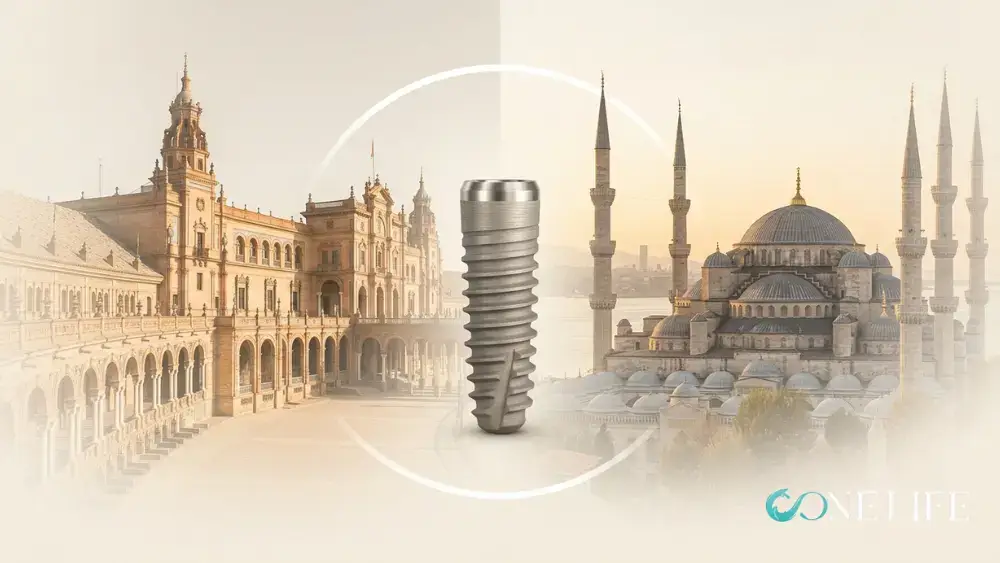
Every year, hundreds of thousands of British, American and Australian patients narrow their search down to two names: dental implants in Spain or Turkey. Both offer premium Swiss implants at a fraction of the cost. How to choose? The entire debate compresses into a single trade-off: distance versus discount.
Spain offers EU regulation two hours from London. Turkey offers double the savings, including hotel, transfers and a patient host. This guide compares both with no loyalty to either: only to the checklist that keeps you safe.
Key takeaways:
- A single premium implant costs £600–£1,550 in Spain vs £500–£1,100 in Turkey (vs £2,000–£6,300 in the UK)
- Full-mouth cases show the widest gap: Turkey saves £20,000+ vs UK prices; Spain roughly half that
- Turkey received an estimated 750,000+ international dental patients in the past year (more than any other country)
- Safety is a checklist, not a gamble: this guide shows you what to verify in each country
How Much Do Dental Implants Cost in Spain vs Turkey?
A single premium-brand implant costs £600–£1,550 ($760–$1,950) in Spain and £500–£1,100 ($650–$1,400) in Turkey, all-inclusive. The gap looks small at first, but it widens as treatment grows: full mouth dental implants in Turkey typically undercut Spain by 40–50%, including hotel accommodation and private transfers that Spanish clinics rarely include.
Against the £2,000–£6,300 charged per implant in the UK or the $3,500–$5,000+ in the US, either country delivers life-changing savings. The real question is how far those savings stretch.
Price comparison (premium brands: Straumann, Nobel Biocare):
Treatment | Spain | Turkey | UK | US |
Single implant | £600–£1,550 | £500–£1,100 | £2,000–£6,300 | $3,500–$5,000+ |
All-on-4 (per arch) | £5,500–£12,500 | £2,450–£4,500 | £12,000–£18,000 | $20,000–$30,000 |
All-on-6 (per arch) | £7,000–£15,000 | £3,150–£5,500 | £16,000–£22,000 | $24,000–$35,000 |
Full mouth | £10,000–£24,000 | £4,950–£12,000 | £30,000–£45,000+ | $60,000–$90,000+ |
- What’s included: Spanish quotes are usually treatment-only: flights, hotels and local transport come out of your pocket. Turkish packages bundle accommodation, VIP transfers and a personal patient host.
Why Is Turkey Cheaper Than Spain for Dental Implants?
Because the country’s economics are cheaper. Spain’s higher prices don’t buy you a better implant. A Straumann implant leaves the same Swiss factory whether it’s destined for Barcelona or Istanbul. What changes is everything around it, and Turkey compresses those costs harder:
- Operating costs: Clinic rent, staff salaries, laboratory fees and utilities in Turkey run at a fraction of Spanish levels
- Government incentives: Turkey treats health tourism as a strategic national industry, supporting it with lower taxation and reduced import duties on medical materials.
- Volume purchasing: High-throughput Turkish clinics place hundreds of premium implants per month, securing bulk discounts from Straumann and Nobel Biocare.
- Scale of experience: Turkey received an estimated 750,000+ international dental patients in the past year, with Istanbul alone hosting over 300,000. Surgeons in top-tier clinics routinely perform more dental implants in Turkey in a month than many European colleagues do in a year.
Are Dental Implants in Spain and Turkey the Same Quality?
Yes. Top clinics in both countries use exactly the same Swiss and German implants: Straumann, Nobel Biocare, with the same REF and LOT traceability codes. Modern implants carry a documented 95–98% success rate over 10 years in healthy patients, as per International Team for Implantology (ITI) data. Certified clinics in both Spain and Turkey meet it.
Licences & Certifications to Demand in Each Country
Both Spain and Turkey regulate dentistry seriously but through different systems. Every credential below can be verified before you book.
Spain: EU Regulation & the Colegio System
Spain’s framework is the one British and Irish patients will recognise most easily, because it mirrors EU-wide standards:
- Colegio Oficial de Dentistas registration: Every practising dentist in Spain must be registered with their regional professional college, which enforces qualifications, ethics and disciplinary standards. Ask for the dentist’s collegiate number (número de colegiado): it’s public and checkable online.
- EU Medical Device Regulation (MDR): All implants placed in Spain must comply with EU MDR traceability rules, meaning CE-marked fixtures with documented REF/LOT codes.
- Regional health authority licensing: Clinics are licensed and inspected by the health department of their autonomous community.
- EU consumer and malpractice law: If something goes wrong, you pursue recourse within the EU legal framework.
Turkey: Ministry of Health, Health Tourism Authorization & International Audits
Turkey regulates international dentistry as a dedicated industry, with a specific legal layer on top of standard licensing. Temos deserves special attention for British, American and Australian patients: unlike general certifications, it audits the international patient journey specifically, including continuity of care after you fly home:
Certification | Who issues it | What it guarantees |
Ministry of Health licence | Turkish government | Legal operation, sterilisation standards, unannounced inspections |
Health Tourism Authorization Certificate | Turkish government | Clinic is legally permitted to treat international patients — each holds a unique, checkable authorisation code |
ISO 9001 | Independent auditors | Documented, repeatable processes that minimise human error |
Temos accreditation | Independent medical-travel auditors | Transparent pre-op plans, informed consent in your language, and aftercare protocols for when you’re back home |
Why Your Surgeon Matters More Than Your Country
The single biggest predictor of implant success is the qualification of the person holding the drill. The professional you want for implant surgery (especially for full-mouth cases, bone loss or anything complex), is an oral & maxillofacial surgeon (OMS): a specialist with 4–6 years of hospital-based surgical residency beyond dental school.
The difference shows precisely where implants tend to fail:
- Complex anatomy: OMS are trained for low bone density, sinus proximity and advanced bone grafting.
- Complication management: If something goes wrong mid-surgery, OMS are qualified to resolve it on the spot, not refer you elsewhere.
- Exclusive procedures: Only maxillofacial surgeons may perform zygomatic implants, the last-resort solution for severe bone loss.
The second non-negotiable is planning technology
Demand 3D CBCT imaging (a scan that maps your bone volume and nerve positions in three dimensions), before anyone proposes a treatment plan. A clinic planning your surgery from a flat 2D panoramic X-ray is estimating where your nerve is.
Three questions that reveal everything (ask them in Spain, Turkey or anywhere):
- Who exactly places my implants, a general dentist or a maxillofacial surgeon? Ask for the name and credentials in writing.
- Will my case be planned on a CBCT scan? If the answer involves the word “panoramic” alone, that’s a red flag.
- How many cases like mine does the surgeon perform per month? Volume builds precision.
Real Risks & Red Flags That Predict Them
Implant complications are rare, predictable and preventable. So let’s name the actual risks. Three complications account for nearly every serious implant problem, in every country:
- Early implant failure (first 3–6 months): The fixture never fuses with the bone. Prevention: 3D CBCT planning, guided surgery, a strict healing protocol.
- Peri-implantitis (years later): The leading cause of long-term implant loss: a quiet bacterial infection that destroys the bone around the fixture. Prevention: Class B autoclave sterilisation, screw-retained restorations that allow deep cleaning, and disciplined home care.
- Nerve damage: The most feared. Permanent numbness or tingling in the lip, chin or jaw when a fixture sits too close to the inferior alveolar nerve. Almost always a planning failure.
Red flags: how to spot a dental mill (Spain or Turkey)
- Packages priced far below the local market average
- Vague answers about implant brands; no REF/LOT codes, no Implant Passport
- A general dentist performing surgery on complex or full-mouth cases
- No CBCT scanner on-site
- A “100% success rate” claim, or refusal to discuss complications in writing
- Pressure tactics (“this offer expires today”)
- Permanent teeth promised in one visit. Osseointegration takes 3–6 months; biology doesn’t do discounts.
Travel, Trips & Aftercare Comparison for Dental Implants in Spain vs Turkey
Whichever country you choose, plan for two trips, 3–6 months apart: the first (5–7 days) for implant placement and temporary teeth, the second (3–5 days) to fit the permanent restoration once the bone has fused.
Where the two destinations differ is the journey around the treatment:
- Flight time & cost (from the UK): Spain wins on proximity: 2–2.5 hours and often £50–£150 return. Turkey: 4 hours and £150–£400 return. For Irish patients, the picture is nearly identical.
- From the US, Canada, Australia & New Zealand: The gap narrows to irrelevance: both destinations mean a long-haul flight, and Istanbul’s global hub status often makes it the easier connection.
- On-the-ground logistics: Spanish clinics treat you as a private walk-in patient: hotels, taxis and scheduling are your job. Turkish top-tier packages include hotel, VIP airport transfers and a personal patient host who manages your entire stay.
- Aftercare & warranties: This is where paperwork replaces proximity. Reputable Turkish clinics offer 10-year or lifetime written warranties covering free replacement of a failed fixture. In Spain, warranties exist but vary widely by clinic. In both countries, insist on your Implant Passport: the document listing brand, REF and LOT codes of every component, which lets any dentist at home service your implants routinely.
- Legal recourse: Spain’s quiet advantage: disputes fall under EU consumer and malpractice law. With Turkey, cross-border claims are more complex, which is precisely why written warranties and Ministry of Health certification carry more weight there, and why Temos-audited aftercare protocols matter.
Spain vs Turkey for Dental Implants at a Glance: Which Should You Choose?
On cost, Turkey wins decisively; on proximity and EU legal simplicity, Spain wins; on clinical quality at the certified tier, it’s a draw. Everything you’ve read compresses into one table:
Factor | Spain | Turkey (top-tier clinic) |
Cost (single implant) | £600–£1,550 | £500–£1,100 |
Cost (full mouth) | £10,000–£24,000 | £4,950–£12,000 |
Implant brands | Straumann, Nobel Biocare | Identical (verifiable via REF codes) |
Success rate (certified tier) | 95–97% | 95–97% |
Regulation | EU MDR, Colegio system, regional licensing | Ministry of Health + Health Tourism Authorization + ISO/Temos |
What’s included | Treatment only | Treatment + hotel + transfers + patient host |
Flight from UK | 2–2.5 hrs, £50–£150 | 4 hrs, £150–£400 |
Legal recourse | EU consumer law | Cross-border (written warranties essential) |
Warranties | Vary by clinic | 10-year / lifetime standard at top tier |
Surgical volume | Moderate | Highest in the world (750,000+ intl. patients/year) |
Spain makes more sense if:
- You need a single implant and live in the UK or Ireland
- EU legal recourse is non-negotiable for your peace of mind
- You prefer organising your own trip and treating the visit as a private appointment abroad
Turkey makes compelling sense if:
- You need multiple implants or full-mouth restoration
- You’re flying long-haul (US, Canada, Australia, NZ)
- You value maximum surgical volume and experience for a complex case
- You want your budget to include the hotel, the transfers and a host
FAQs
Is it cheaper to get dental implants in Spain or Turkey?
Turkey is cheaper across every treatment type. A single premium implant costs £500–£1,100 in Turkey versus £600–£1,550 in Spain, and the gap widens sharply for full-mouth cases: £4,950–£12,000 in Turkey against £10,000–£24,000 in Spain.
Is Turkey safe for dental implants compared to Spain?
Yes, at certified clinics, both countries deliver identical 95–97% success rates. Spain protects patients through EU regulation and the Colegio system; Turkey through Ministry of Health licensing, the Health Tourism Authorization Certificate and voluntary audits like ISO 9001 and Temos.
Do Spain and Turkey use the same implant brands?
Yes. Top-tier clinics in both countries place the same Swiss systems made in the same factories. The price difference reflects each country’s economics, not the product.
How many trips do I need for dental implants abroad?
Two trips in either country: 5–7 days for placement, then 3–5 days after 3–6 months of healing for the permanent teeth. The waiting period cannot be rushed. Distrust any clinic promising permanent teeth in a single visit.
What happens if my implant fails after I get home?
Your written warranty is your safety net. Reputable Turkish clinics offer 10-year or lifetime guarantees covering free fixture replacement; Spanish warranties vary widely by clinic. Confirm coverage in writing before booking, wherever you go, and keep your Implant Passport so any local dentist can maintain your implants.
Which is better for full-mouth dental implants: Spain or Turkey?
For full-mouth cases, Turkey offers the strongest value in global dentistry: identical premium materials at roughly half Spain’s prices, with savings of £20,000–£30,000 versus the UK. The more implants you need, the more the economics favour Turkey, provided you choose a Ministry of Health-certified clinic with a maxillofacial surgeon.
Who should not travel abroad for dental implants?
Patients with uncontrolled diabetes, active gum disease, severe untreated bone loss or conditions requiring closely monitored medical care face higher risks anywhere. An ethical clinic screens you honestly after reviewing your CBCT scans. If a clinic never asks about your health history, that silence is your answer.