
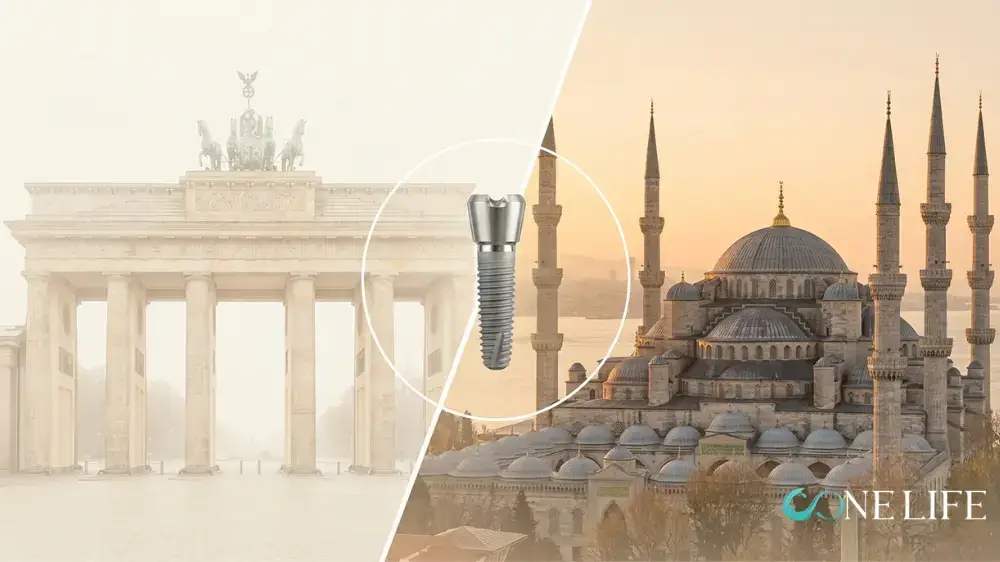
Every week, hundreds of German patients board a 3-hour flight from Frankfurt, Munich or Berlin for one reason: dental implants in Turkey. It’s not a decision anyone makes lightly. It’s a calculated bet on surgeons who place more implants in a month than many German colleagues do in a year.
But the bet only pays off if you know exactly what you’re buying: the right certifications, the right brands, and the red flags that separate world-class clinics from dangerous bargains.
Key takeaways:
- A single implant costs €1,800–€3,500 in Germany vs €500–€1,200 in Turkey
- German statutory insurance (GKV) covers only a fixed subsidy of around €460
- Full-arch All-on-4 runs€15,000–€24,000 per jaw in Germany vs €3,700–€6,600 all-inclusive in Istanbul
- Demand REF and LOT codes, Turkish Ministry of Health licensing and a named lead surgeon before booking
Which Certifications Should a Turkish Clinic Have?
Turkey’s dental market has digitally-planned surgery that rivals German university clinics, but also high-volume “dental mills” cutting corners on materials and hygiene. The good news is safety is verifiable. You just need to check documents.
Before paying any deposit, confirm this checklist in writing:
- Turkish Ministry of Health license: Licensed clinics must comply with national hygiene and facility standards and are subject to inspection.
- CE and ISO: All implants and prosthetic materials must meet the same CE marking standards required in the EU.
- International accreditation (JCI or TEMOS): A strong quality signal. JCI accreditation is recognised by US, UK and EU medical boards.
- A named lead surgeon with verifiable credentials: You should know before you fly who operates on you, their specialisation (oral surgery / implantology) and their case history.
- Independent patient reviews: Cross-check on platforms the clinic cannot edit (Trustpilot, Google).
Dental Implants Cost in Turkey vs Germany
Identical implant brands cost 60–70% less in Turkey than in Germany, even after adding flights, hotel and medicalinsurance. Two details matter before you read on:
- German prices are surgery-only. Consultations, CT scans and aftercare are usually billed separately.
- Turkish package prices typically include the implants, zirconia bridges, hotel, VIP transfers and follow-up care.
Treatment | Germany (private) | Turkey (all-inclusive) |
Implant + crown | €1,800 – €3,500 | €500 – €1,200 |
All-on-4 (per jaw) | €15,000 – €24,000 | €3,700 – €6,600 |
All-on-6 (per jaw) | €18,000 – €28,000 | €4,500 – €8,300 |
Full mouth | €30,000 – €45,000+ | €9,000 – €14,000 |
How Much Do Dental Implants Cost in Germany in 2026?
A single implant with crown in Germany costs €1,800 to €3,500, depending on the region, the implant brand and the complexity of your case. For full-arch restorations, German quotes routinely reach €20,000+ per jaw before diagnostics.
What you get for that price is tightly regulated clinics, short travel distances and easy follow-up visits. German implantology is among the best in the world.
What Does German Insurance (GKV) Cover?
Very little. Implants are classified as a Privatleistung (private service). The GKV pays only the fixed subsidy (Festzuschuss) for the standard alternative (typically a simple bridge), which amounts to roughly €460.
In practice, this means:
- Single implant: you pay around €2,500+ out of pocket after the subsidy
- Full arch: the subsidy barely registers against a €20,000 quote
- Supplemental dental insurance (Zahnzusatzversicherung): can help, but only if you took out the policy before the tooth loss was diagnosed, and waiting periods of 8+ months are common
How Much Do Dental Implants Cost in Turkey?
A single premium dental implant in Turkey costs €500 to €1,200, including the abutment, the crown, the surgeon’s fee and diagnostics. The same Straumann® or German-made Bego® implant is used. What changes is everything around it: Turkish rent, salaries, taxes and a government that subsidises the sector.
Savings really start to escalate with full mouth implant cases:
- All-on-4: from ~€3,700 per jaw (value-tier brands) to ~€6,600 (A+ Straumann®)
- All-on-6: from ~€4,500 to ~€8,300 per jaw
- Full mouth implants: €9,000 – €14,000 all-inclusive
What’s Included in Turkish Implant Packages?
All regular medical and travel expenses are usually included. What is usually not included are extra requirements such as bone grafting (if needed, ~€400 per unit), sinus lifts (€170–€290 per side), IV sedation (€230–€460) and a protective night guard (~€170). You should also add a Frankfurt–Istanbul return flight (€150–€300, ~3 hours) and the mandatory 2026 complication insurance (covered below).
Full mouth dental implants package deals in Turkey usually include:
- Surgery and all prosthetics (implants, abutments, temporary bridge, final zirconia bridge)
- 3D CBCT diagnostics and computer-guided surgical planning
- 4–5 star hotel accommodation (typically 7–10 nights)
- VIP airport transfers and a dedicated multilingual host
- Post-operative medication and a written 10-year guarantee
Why Are Dental Implants So Much Cheaper in Turkey?
Because the cost of running a clinic is radically lower. The factory price of a premium implant is similar worldwide. A Straumann® implant is milled in Switzerland whether it ends up in Düsseldorf or Istanbul. You are not paying less for the titanium, but for the overhead around it.
Four structural factors explain the entire gap:
- Lower operating costs: Rent, staff salaries and laboratory fees in Istanbul are a fraction of those in Munich or Hamburg.
- Government incentives: Turkey treats health tourism as a strategic industry: clinics serving international patients benefit from tax breaks and subsidies.
- High volume: Istanbul is the busiest dental destination on earth. Clinics purchase hundreds of Straumann® and Nobel Biocare® implants at bulk prices
- Currency advantage: The strength of the euro against the Turkish lira gives German patients a purchasing-power edge.
How to Verify Your Implant Is Authentic
Every premium implant comes in sealed packaging carrying two identifiers: the REF code (the exact product reference), and the LOT code (the production batch number). Ask your clinic to hand you the sealed boxes before surgery. Then enter both codes into the manufacturer’s official online verification tool (Straumann® and Nobel Biocare® both provide one).
Medical Insurance for International Patients (New Turkish Regulation)
Since 1 January 2026, Turkey requires every international patient undergoing dental implant surgery to hold complication insurance, under a regulation issued by the Turkish Ministry of Health within its “Heal in Türkiye” framework.
What it covers. The policy funds the treatment of unforeseen post-operative complications: revision surgery, hospitalisation, intensive care and, in many policies, return travel to Turkey. For dental implant plans, coverage typically runs for 12 months from the procedure date.
What it means for you as a German patient:
- It is a legal requirement: Clinics are responsible for verifying that your policy is in place before admission. Aclinic that ignores it is operating outside the law.
- Your German insurance does not replace it: The Turkish policy specifically covers complications from procedures performed in accredited Turkish facilities; your GKV or private policy operates separately.
- Coverage is valid within Turkey: Revision treatment must generally take place in Turkey to be reimbursed.
What About Aftercare and Warranty Back in Germany?
What happens if something goes wrong when I’m home? A serious Turkish clinic answers it with structure:
- Written 10-year guarantee: signed before you leave. Elite brands (Straumann®, Nobel Biocare®) add themanufacturer’s own lifetime warranty on the fixture — valid worldwide.
- Virtual follow-ups: During healing, your clinic monitors progress through photos and video calls at set intervals.
- 2026 complication insurance: covers revision treatment for a full 12 months, including flights and accommodation back to Istanbul
- Routine care stays local: Cleanings and check-ups at your German dentist proceed exactly as with domestically placed implants. Bring your implant passport (brand, REF, LOT, position); any implantologist can work with it.
When a Turkish Clinic Is Too Cheap to Be True
Extremely low quotes are the biggest warning sign in Turkish dentistry. If one clinic quotes €4,000 for an All-on-6 and another quotes €11,000, the difference is rarely generosity.
Pay close attention when you see any of the following:
- “Permanent teeth in one day.” A fixed temporary bridge on surgery day is standard and safe. A permanent bridge loaded immediately invites implant failure.
- No named surgeon: technicians may be doing surgeons’ work.
- No REF codes offered: Refusal to document implant authenticity is disqualifying
- Acrylic sold as a final restoration: PMMA acrylic is a temporary material. Your permanent bridge should be monolithic zirconia or layered porcelain.
- No written, itemised quote: Every extraction, graft, sinus lift and scan should appear in writing before you fly.
- Pressure tactics: “This price expires tonight” is not medicine.
- No guarantee document: A serious clinic issues a signed 10-year guarantee.
Turkey or Germany: Which Is Right for You?
The deciding factor was never the country. It was always the clinic. Germany makes sense if you need a singleimplant, your insurance covers a good share, or medical conditions require close monitoring.
Turkey makes sense if you need full mouth implants, you are paying out of pocket and you are willing to invest a few hours in verification: Ministry of Health license, named surgeon, REF codes, written quote, complication insurance.
FAQs
How much do dental implants cost in Turkey compared to Germany?
A single implant costs €500–€1,200 in Turkey versus €1,800–€3,500 in Germany. Full-mouth restorations run €9,000–€14,000 all-inclusive in Istanbul versus €30,000–€45,000+ in Germany.
Does German health insurance pay for implants in Turkey?
No. The GKV pays only its fixed subsidy (~€460) toward the standard care alternative, regardless of where you’re treated. Since implants are a private service either way, most patients pay nearly the full amount out of pocket in both countries — which is precisely why the price gap matters.
Is it safe for German patients to get dental implants in Turkey?
Yes, at a licensed, verifiable clinic. Confirm the Turkish Ministry of Health license, a named lead surgeon, REF-code implant verification and the mandatory 2026 complication insurance. Success rates at accredited clinics match international standards of 95–98%.
What is the new 2026 complication insurance in Turkey?
Since 1 January 2026, all international patients undergoing surgical procedures in Turkey must hold complication insurance. It covers revision surgery and hospitalisation for complications (for dental implants, typically 12 months), and clinics must verify it before treatment.
Are the implant brands in Turkey the same as in Germany?
At reputable clinics, yes: Straumann®, Nobel Biocare® and German-made Bego® are standard. Always verify authenticity via the REF and LOT codes on the original sealed packaging using the manufacturer’s online tool.
How long do dental implants last?
The titanium fixture can last a lifetime with good hygiene and regular check-ups. The visible crown or bridge typically lasts 10–15 years before normal wear calls for replacement.