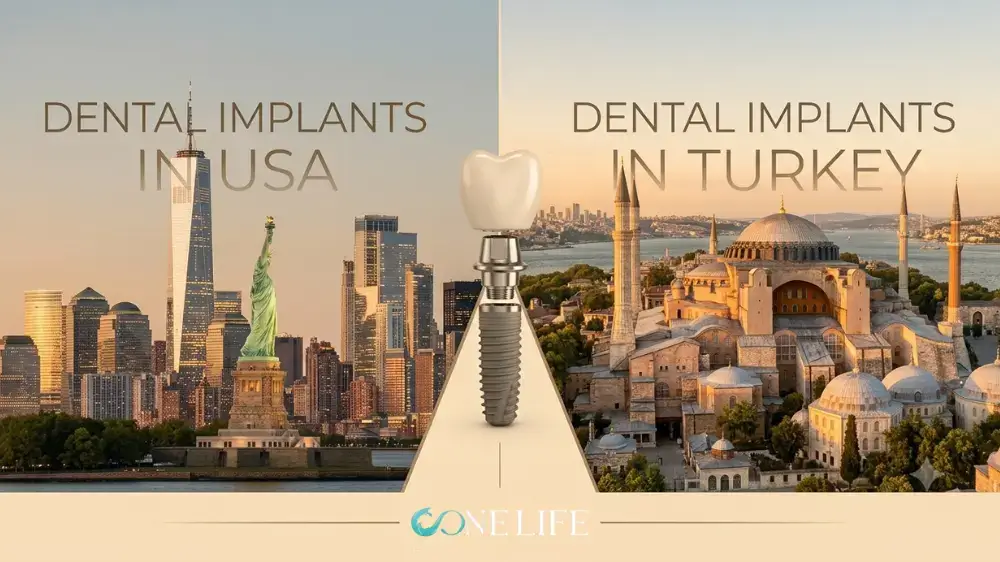
Every year, over 750,000 international patients board flights to Istanbul for dental treatment, plenty of them coming from the USA or even from Australia. That’s not a decision anyone makes lightly. It’s a calculated bet on dentists that operate on more teeth than most Western peers for 65-83% cheaper.
But the bet only pays off if you know exactly what you’re buying: the right certifications, the right questions and REF-code verifications that separate world-class dental implants from risky bargains.
Key takeaways for dental implants in Turkey vs US:
- Full mouth implants in Turkey cost an average $7,450–$12,200 (all-inclusive)
- Full mouth implants in USA cost $40,000–$90,000 (surgery only)
- Success rate (both destinations) stands at8% when criteria are met
- The real decision isn’t Turkey vs USA: it’swhich clinic in each country
How Much Do Dental Implants Cost in Turkey vs the US?
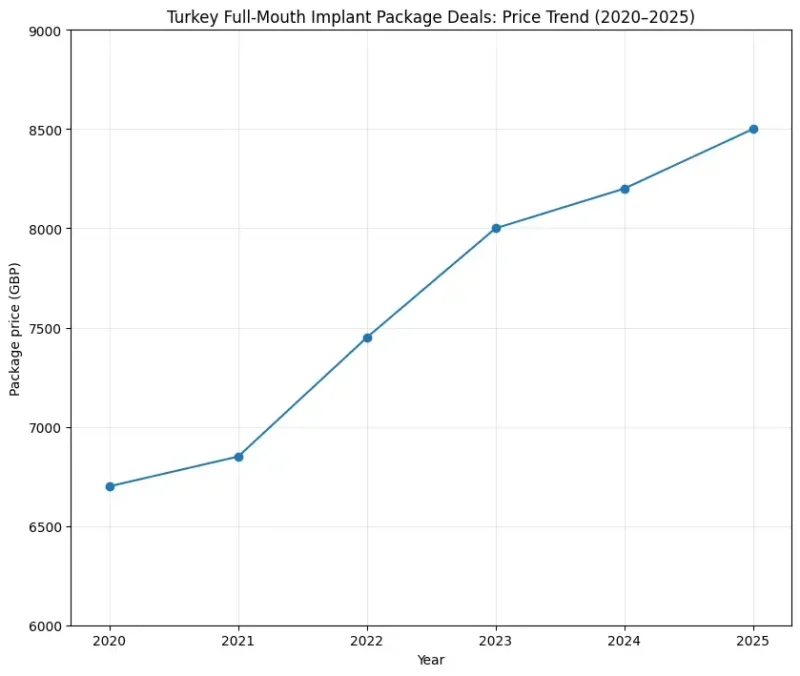
Dental implants in Turkey cost 65–83% less than in the United States. A single implant that costs $3,000–$6,500 in the US averages £400–£1,050 ($500–$1,300) in Istanbul. A full mouth restoration priced at $40,000–$90,000 in America costs £6,450–£12,200 ($8,700–$16,500) in Turkey, with hotel, transfers and aftercare included.
The gap holds even when both clinics use the identical implant brand: a sealed Straumann fixture is the same product whether it is placed in Manhattan or Istanbul.
Treatment | USA (Surgery Only) | UK (Surgery Only) | Turkey (All-Inclusive) |
Single Implant | $3,000 – $6,500 | £1,800 – £3,500 | £400 – £1,050 ($500 – $1,300) |
All-on-4 (Per Arch) | $18,000 – $35,000 | £12,000 – £18,000 | £3,200 – £5,750 ($4,300 – $7,800) |
All-on-6 (Per Arch) | $18,000 – $40,000 | £15,000 – £22,000 | £3,950 – £7,250 ($5,300 – $9,800) |
Full Mouth (Both Arches) | $40,000 – $90,000 | £25,000 – £40,000 | £6,450 – £12,200 ($8,700 – $16,500) |
Sources: ADA fee data, FAIR Health cost studies (2024–2026), UK private clinic averages, verified Istanbul clinic packages.
Single Tooth Implant Cost: Turkey vs USA
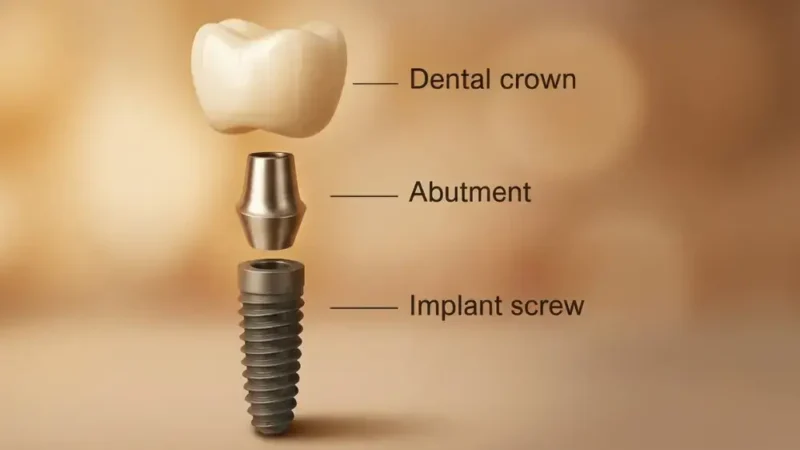
A complete single implant (fixture, abutment and crown) averages $4,200 in the US, with metropolitan areas like New York and California running 37% above that. In Turkey, the same three components with a premium European brand cost $450–$1,200.
Why does the US charge 4–6 times more for identical hardware? Because you are paying for real estate, staff salaries and clinical overhead. The implants represents less than 20% of your final bill in either country.
Full Mouth Dental Implants Cost Comparison (All-on-4 & All-on-6)
With full mouth dental implant package deals in Turkey, savings compound dramatically. For example, a US patient requiring All-on-6 on both arches with premium Straumann implants pays roughly $48,000 at a Manhattan clinic, surgery only. The same treatment at a certified Istanbul clinic costs $14,200 all-inclusive.
- All-on-4: US average: $18,000–$35,000 per arch. Turkey: from $4,200 per arch with value-tier brands.
- All-on-6: US average: $18,000–$40,000 per arch. Turkey: $5,350–$8,950 depending on brand tier.
- Both arches (full mouth): an American patient quoted $70,000 in Los Angeles can receive the same Straumann-based restoration in Istanbul for under $17,000, flights and hotel included.
How do you verify authentic implant brands in Turkey?
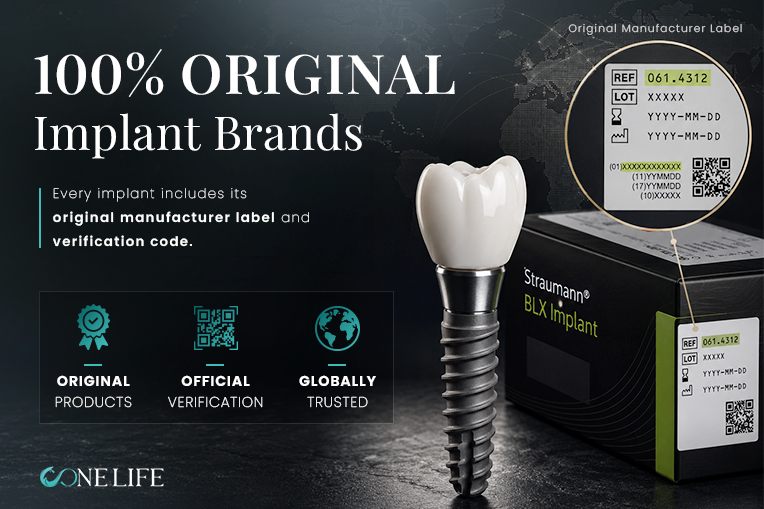
Every Straumann or Nobel Biocare implant carries two identifiers printed on its original sealed packaging: a REF code and a LOT number. Verifying these codes directly with the manufacturer takes two minutes on their websites.
How the verification works, step by step:
- Before surgery, ask the clinic to present each implant in its original, factory-sealed packaging.
- Locate the two codes: the REF code (the product reference identifying the exact implant model and size) and the LOT number (the manufacturing batch).
- Photograph both codes.
- Verify with the manufacturer: Straumann and Nobel Biocare both offer verification through their official channels, confirming the product’s authenticity and origin.
- Request an implant passport: a written document listing the brand, model, REF and LOT numbers of every component placed in your mouth.
What the codes protect you from:
- Counterfeit or “white label” implants sold as premium brands
- Reused or repackaged surgical components
- Void warranties: authentic Straumann implants carry a lifetime manufacturer guarantee; copies carry nothing
- Untreatable failures, where no dentist can identify the hardware in your jaw
What’s Actually Included in the Price?
A typical US quote does not cover imaging, extractions, temporary prosthetics, sedation upgrades and revision visits.Each are billed separately, often adding $3,000–$8,000. Turkish packages are all-inclusive. What a Turkish implant package covers is:
- Surgery, implants and final zirconia or e.max prosthetics
- 3D CBCT diagnostic scan (a $200–$400 extra in the US)
- 4–5 star hotel accommodation (typically 10 nights)
- VIP airport transfers and a dedicated translator
- Post-operative medications and aftercare kit
- Written 10-year to lifetime guarantee
Component | USA | Turkey |
Surgery | $18,000–$35,000 | Included |
Implant Fixture (Straumann) | Included | Included |
Crown (Zirconia) | Included | Included |
3D CBCT Scan | $200–$400 extra | Included |
Hotel Accommodation | Not included | 5-star (10 nights) |
Airport Transfers | Not included | VIP Mercedes transfers |
Post-Op Medications | Included | Included + aftercare kit |
Follow-Up Appointments | Often charged per visit | Included (virtual + in-person) |
Total (All-on-4 per jaw) | $40,000–$45,000 | £5,200–£7,800 |
Why Are Dental Implants So Cheap in Turkey?
Dental implants are cheap in Turkey because of structural reasons. The implant from Straumann or Nobel Biocare costs roughly the same worldwide. What changes is everything around it: rent, salaries, taxes and currency.
- Operating costs are 60–70% lower in Turkey
Clinic rent, staff salaries, laboratory fees and utilities in Istanbul are a fraction of what they cost in New York, Los Angeles or London. In the US, these overheads represent the majority of your bill. A Manhattan practice paying $30,000 monthly rent must recover that cost from every patient. An Istanbul clinic simply doesn’t carry that burden.
- Currency exchange works in your favour
The strength of the US dollar and the British pound against the Turkish lira gives international patients an immediate 70–80% purchasing power advantage. You earn in a strong currency and pay in a weak one — the arithmetic does the saving for you.
- The Turkish government actively subsidises health tourism
Medical tourism is a strategic national industry for Turkey. Certified clinics benefit from tax breaks, reduced import duties on medical materials and streamlined licensing. This is state policy, not a loophole: the Ministry of Health regulates and promotes the sector because it generates billions in annual revenue.
- Volume creates bulk pricing
Istanbul is the highest-volume dental destination in the world. Top clinics perform hundreds of full-arch cases per month and purchase implants directly from Straumann and Nobel Biocare in bulk. That purchasing power translates into lower material costs — and, crucially, into surgeons who accumulate more full-mouth experience in a year than many Western colleagues do in a decade.
Are dental implants in Turkey as safe as in the US?
Yes, provided the clinic meets verifiable criteria: a certified maxillofacial surgeon, authentic branded implants and Ministry of Health licensing. Top-tier Istanbul clinics report success rates of 95–97%, matching US clinics. The safety gap is not between countries. It is between clinics.
Dental implant success rates: the real data
The clinical evidence is consistent across borders. A large-scale 2026 analysis of 158,824 implants published in peer-reviewed journals found an overall failure rate of just 2.21%: a survival rate of 97.79%.
Even complex cases hold up. The same dataset showed implants placed with simultaneous bone grafting achieved a 97.83% success rate, statistically indistinguishable from implants in healthy native bone.
How the numbers compare in practice:
- Certified top-tier Turkish clinics: 95–97% success
- Standard European and US clinics: 95–97% success
- Low-cost, uncertified clinics (anywhere): 85–90% success
Surgeon expertise matters more than geography
For a single, straightforward implant, an experienced implantologist may be sufficient. For full mouth dental implants, the question to ask any clinic is: “Will a maxillofacial surgeon perform my surgery?”
An oral and maxillofacial surgeon completes 4–6 years of hospital-based surgical residency beyond dental school. A general dentist can legally place implants after far shorter training, sometimes a weekend certification course.
The difference shows in the data:
- Nerve mapping: maxillofacial surgeons plan around the inferior alveolar nerve using 3D CBCT imaging
- Complication management: they are trained to handle surgical emergencies, advanced bone grafting and sinus proximity
- Complex cases: full-mouth restorations, severe bone loss and zygomatic implants belong exclusively in surgical hands.
Which certifications should a Turkish dental clinic have?
A legitimate Turkish dental clinic must hold, at minimum, a Health Tourism Authorization Certificate from the Turkish Ministry of Health. Above that baseline, voluntary accreditations like Temos, JCI and ISO 9001 separate merely legal clinics from genuinely excellent ones.
The certification hierarchy, from mandatory to elite:
1. Turkish Ministry of Health authorization
Every clinic treating international patients must hold this certificate and a unique authorization ID. It guarantees the facility undergoes unannounced inspections and meets national sterilization protocols. Ask for the authorization code and verify it. A clinic without it is operating illegally.
2. Turkish Dental Association (TDB) membership
The TDB regulates the ethical conduct of its members, including pricing practices. It is a useful secondary signal that a clinic operates within professional norms rather than pure sales tactics.
3. ISO 9001
ISO certification means every step of your treatment follows a documented, repeatable protocol, from your airport pickup to your final X-ray. It doesn’t measure clinical brilliance; it measures consistency.
4. Temos
For medical tourists, Temos is arguably the most relevant seal of all. Unlike general health certifications, Temos specifically audits the international patient journey: pre-operative transparency (a realistic treatment plan before you fly), continuity of care after you return home, informed consent in your own language, and protection against hidden costs.
5. JCI accreditation
Joint Commission International is the most rigorous global healthcare accreditation, recognised by US, UK and EU medical boards. JCI-accredited facilities voluntarily submit to exhaustive external audits. Few clinics reach this bar; those that do advertise it prominently.
Red flags: how to spot a dental mill
High-volume, low-standard clinics in Turkey reveal themselves through patterns: prices far below market average, vague surgeon identities, missing 3D imaging and pressure tactics. If a clinic shows two or more of these signs, no discount justifies the risk:
Red flag 1: the price trap
If a clinic quotes full mouth implants for 40% or more below the Istanbul market average (say, £3,500 when certified competitors charge £7,000+) the difference is coming out of something invisible to you: unbranded implants, acrylic instead of zirconia, outsourced labs, or technicians doing a surgeon’s work.
Red flag 2: no 3D CBCT imaging
A simple panoramic X-ray cannot map your bone density or locate the inferior alveolar nerve. Safe implant placement without a CBCT scan is guesswork, and nerve damage is what guesswork looks like three weeks later.
Red flag 3: the anonymous surgeon
You ask who will perform your surgery and receive answers like “our specialist team” or “one of our experienced doctors.” Legitimate clinics name the surgeon upfront, publish their credentials, and let you speak to them before you fly.
Red flag 4: no written guarantee
Serious providers back their work with a signed 10-year to lifetime warranty covering both fixture and restoration, plus a documented complication protocol. “Don’t worry, we take care of our patients” is not a warranty.
Red flag 5: pressure to book now
“This price is only valid today.” “We have one slot left this month.” Clinical decisions deserve reflection; sales tactics manufacture urgency. A confident surgeon respects your due diligence.
Red flag 6: reviews that are too clean
A wall of five-star reviews with no critical feedback, no mention of waiting times or discomfort, and no clinic responses to complaints suggests curation, not satisfaction. Cross-check reviews on independent platforms like Trustpilot, and read the three-star ones: that’s where the truth lives.
Red flag 7: zero mention of complications
Any clinic claiming a 100% success rate is either not counting or not telling. Implants fail in 2–5% of cases even in the world’s best hands. Ethical providers discuss risks unprompted
Do you need to travel to Turkey twice for dental implants?
Yes, full mouth dental implants require two separate trips to Turkey: one for surgery (5–7 days) and one for the final prosthesis (7–10 days), separated by a 3–6 month healing period.
The reason is bone fuses with titanium implants at its own pace. If a permanent bridge is fitted before fusion is complete, every bite transmits micromovement into the healing bone. The result is the implant loosens and is rejected.
Trip 1: surgery and temporary teeth (5–7 days)
- Day 1: arrival, consultation and 3D CBCT scan
- Day 2: extractions if required, and placement of the implants
- Day 3: fitting of a fixed temporary bridge (you leave the clinic with teeth, fixed)
- Days 4–5: recovery monitoring and post-operative check-up
- Days 6–7: final instructions, medications, departure
The healing months at home (3–6 months)
While the bone fuses, quality clinics maintain contact through virtual photos and video calls reviewing your progress. This is also where your aftercare discipline (soft diet at first, strict hygiene, no smoking) directly shapes the outcome.
Trip 2: the permanent prosthesis (7–10 days)
- Days 1–2: a new scan confirms osseointegration is complete
- Days 3–5: removal of the temporary bridge, precision impressions, and fabrication of the final monolithic zirconia bridge
- Days 6–10: fitting, bite adjustments, aesthetic refinements, night guard if needed — and departure with your warranty documentation
TURKEY VS USA IS THE WRONG QUESTION
The real question is: Which certified, experienced, transparent surgeon using authentic materials offers the best value for my situation?
Turkey’s reputation for dental tourism is earned: specialized surgeons, state-of-the-art technology, government regulation, and dramatic cost differences. But the risks are identical to any location: choosing an inexperienced clinic, accepting counterfeit materials, or skipping post-operative care.
Get a free consultation
If you are weighing Turkey against the US for your dental implants, send your details and, if available, a recent X-ray or CT scan. A specialist will review your case, confirm which treatment fits you, and give you a transparent, all-inclusive quote. Book your free consultation today.