
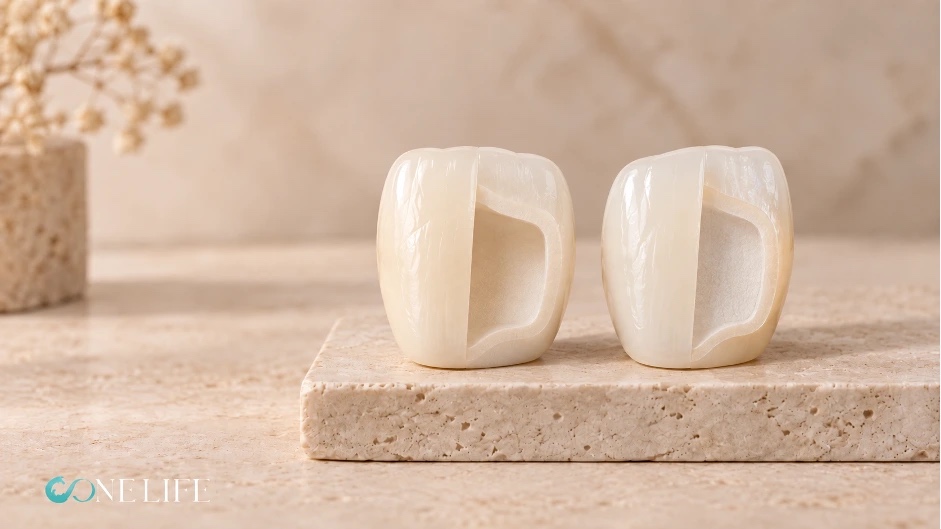
When comparing zirconia crowns, you encounter two main options: monolithic and layered zirconia. As a general rule, the former is recommended for back molar teeth, whereas layered zirconia is preferred for frontal incisor teeth. Neither is the best choice for all cases. Layered zirconia reflects light more naturally, but it introduces a weaker layer that can chip more easily.
Key distinctions:
- Monolithic zirconia: a single zirconia block without any porcelain coating.
- Layered zirconia: adds an outer layer of veneering porcelain around the zirconia core.
What is monolithic zirconia?
A monolithic zirconia crown is made with its full shape in zirconia. It is commonly designed digitally and milled from a manufactured zirconia block.
The laboratory can customize its color and finish through techniques such as staining, glazing, and polishing.
Monolithic restorations can be made from different zirconia materials, with different optical and mechanical properties. The term alone therefore cannot tell you exactly how strong or translucent a crown will be.
What is layered zirconia?
Layered zirconia, also called porcelain-veneered zirconia, has a zirconia core beneath an outer porcelain covering.
The sore supports the restoration, while the porcelain helps create its final shape and visual aesthetic. A dental technician can use the veneering ceramic to adjust features such as color depth, translucency, and the appearance of the biting edge.
However, the porcelain covering introduces the possibility of chipping or separation from the zirconia core. A porcelain-veneered zirconia crown and a zirconia dental veneer are different restorations.
Monolithic vs. layered zirconia at a glance
This table provides a starting point. It cannot replace an assessment of the individual tooth, bite, and design.
Feature | Monolithic zirconia | Layered zirconia |
Construction | Zirconia forms the full restoration body | Zirconia framework with veneering porcelain |
Appearance | Depends on the zirconia formulation and finishing | Porcelain allows additional optical customization |
Typical consideration | Reducing complications associated with veneering porcelain | Matching detailed characteristics of visible teeth |
Material selection | Specific zirconia formulation still matters | Both the framework and porcelain system matter |
Is layered zirconia the same as multilayer zirconia?
These terms can mean different things, so it’s worth an explanation. In this article, layered zirconia means a zirconia core covered with porcelain coating.
Multilayer zirconia usually refers to gradients within the material. Those gradients may involve color, translucency, composition, or a combination. A restoration milled from a multilayer zirconia disc can still be monolithic if no porcelain coating is added. In other words, a crown can be both monolithic in construction and multilayer.
Which option looks more natural?
Layered zirconia reproduces natural tooth characteristics through the veneering porcelain. However, a natural-looking crown also depends on brightness, translucency, shape, texture, and relationship to surrounding teeth.
On the other ahnd, the idea that monolithic zirconia always looks opaque or artificial is just inaccurate. Zirconia materials have evolved, and more translucent and polychromatic options have expanded the possibilities, including anterior crowns.
Why greater translucency is not always better
Translucency means allowing some light to pass through a material. It can contribute to a natural appearance, but the underlying tooth color also affects the result.
Research has investigated how monolithic and layered zirconia crowns mask discolored backgrounds. This illustrates why the appearance of a restoration must be assessed together with what lies beneath it.
Which option is stronger?
When talking about zirconia crowns, “stronger” means resistance to bending and resisting cracks. One advantage of monolithic zirconia is avoiding a separate porcelain layer, which is weaker and can crack more easily. Nevertheless, that does not mean every monolithic crown is equally resistant to fracture.
Zirconia is labeled 3Y, 4Y, and 5Y depending to its core strength; when comparing options, your dentist therefore needs to consider both how the restoration is built and which material is used.
Chipping and fracture
With layered zirconia, a piece of veneering porcelain may chip while the zirconia framework remains intact. A monolithic crown avoids that porcelain layer, although it can still develop other problems.
Systematic reviews consistently find more complications in porcelain-veneered restorations, particularly chipping. However, neither option should be described as unbreakable. Equally, statistic findings do not mean that every layered crown will fail.
Monolithic or layered zirconia for front teeth
Front teeth are highly visible, making appearance an important part of treatment planning. Layered zirconia is usually preferred for detailed customization and matching neighboring teeth.
At One Life Dental, we stress the need of discussing case by case rather than assuming that all visible teeth require full porcelain layering. A useful consultation should explore how visible the tooth is, what needs to be matched, and how the crown will function in your bite.
Monolithic or layered zirconia for back teeth
For premolars and molars, resistance and strength is by far the most important consideration. For this reason, monolithic zirconia crowns are the go-to option in the vast majority of cases. However, “monolithic for every back tooth” is too simplistic. Appearance can also matter for posterior teeth, particularly when they show during smiling. The decision should reflect the actual tooth and patient rather than a rigid front-versus-back rule.
What about partially layered zirconia?
Some restorations combine monolithic areas with porcelain applied to selected surfaces only. For example, porcelain may be added to the visible facial surface while other areas remain zirconia.
Partially veneered zirconia crowns represent a clinically studied approach, although their suitability still depends on the case.
How long do monolithic and layered zirconia last?
There is no single lifespan that can be promised for either option. For patients, the more useful discussion concerns the expected risks in their own case and the follow-up their dentist recommends.
This is because studies differ in the materials, restoration designs, patients, and observation periods they include. A honest review of monolithic and layered zirconia must conclude that further evidence is needed to clarify differences in longevity and clinical success.
Note: when reading research, distinguish survival from success. A restoration may remain in use after a complication or intervention.
Does this comparison also apply to zirconia veneers?
A crown and a veneer cover different amounts of tooth structure and have different design and requirements. They do not have equivalent outcomes. If you are considering zirconia veneers, ask for an explanation specific to veneers, including the proposed material and bonding approach.
Questions to ask your dentist
Before deciding, consider asking:
- Is the proposed restoration monolithic, porcelain-layered, or partially layered?
- Does “multilayer” describe the zirconia block or added porcelain?
- Why does this design suit my tooth and bite?
- How will it match the neighboring teeth?
- What complications are most relevant to my case?
- What follow-up will I need?
FAQs
Is monolithic zirconia better than layered zirconia?
There is no universal winner. Monolithic construction avoids a separate veneering porcelain layer, while layered construction offers additional appearance customization. The individual case determines which advantages matter most.
Can monolithic zirconia look natural?
Yes. Modern zirconia options have expanded the appearance possibilities for monolithic restorations. The specific material, shade, design, and finishing remain important.
Does layered zirconia always chip?
No. Chipping is a possible complication, not an inevitable outcome. It is important to discuss this risk without portraying every layered restoration as fragile.
Is multilayer zirconia monolithic?
It can be. A crown milled from a graded zirconia disc remains monolithic when no separate veneering porcelain covering is added.
Is 3Y zirconia the same as monolithic zirconia?
No. “3Y” identifies a zirconia formulation. “Monolithic” describes construction. They answer different questions about the restoration.
Which zirconia crown should I choose?
Ask your dentist to explain the proposed material and design in relation to your tooth, bite, and appearance goals. The label alone is insufficient to select treatment.
Scientific and medical references
- Shihabi S, Chrcanovic BR. Clinical outcomes of tooth-supported monolithic zirconia vs. porcelain-veneered zirconia fixed dental prosthesis, with an additional focus on the cement type: a systematic review and meta-analysis. Clinical Oral Investigations. 2023.
https://pmc.ncbi.nlm.nih.gov/articles/PMC10560185/ - Five-year clinical performance of monolithic and partially veneered zirconia single crowns—a prospective observational study.
https://pubmed.ncbi.nlm.nih.gov/34556602/ - Short-term prospective clinical evaluation of monolithic and partially veneered zirconia single crowns.
https://pubmed.ncbi.nlm.nih.gov/27679981/ - Randomized clinical study of wear of enamel antagonists against polished monolithic zirconia crowns.
https://pubmed.ncbi.nlm.nih.gov/29042241/ - Gundugollu Y, et al. Comparison of the effect of monolithic and layered zirconia on natural teeth wear: an in vitro study. Journal of Indian Prosthodontic Society. 2018.
https://pmc.ncbi.nlm.nih.gov/articles/PMC6180733/ - Classification and properties of dental zirconia as implant fixtures and superstructures.
https://pmc.ncbi.nlm.nih.gov/articles/PMC8432657/ - Zirconia restoration types, properties, tooth preparation design, and bonding: a narrative review.
https://pmc.ncbi.nlm.nih.gov/articles/PMC10842315/