
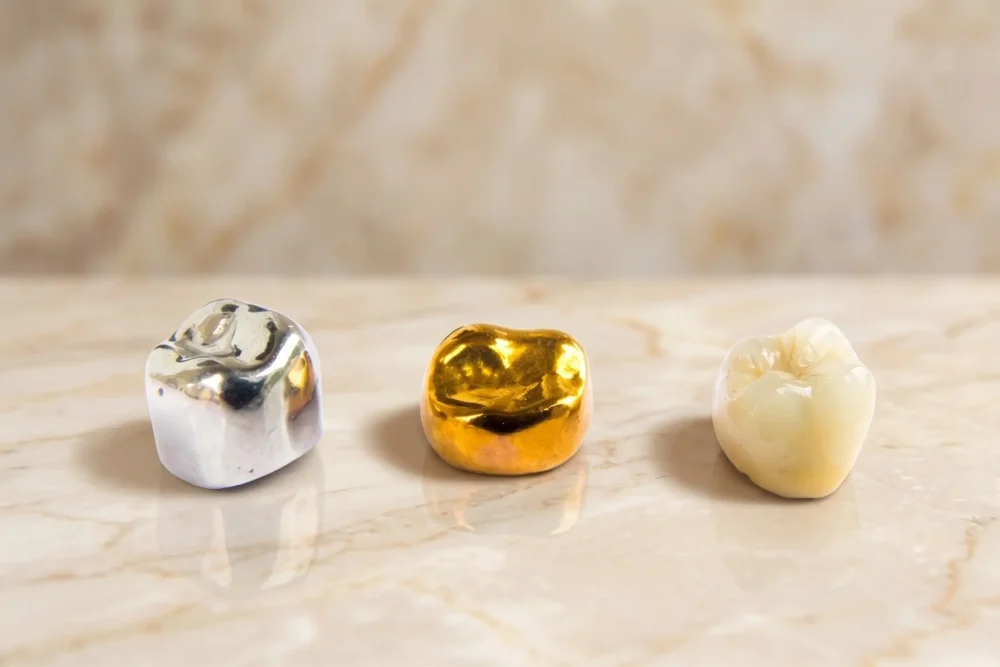
A dental crown permanently removes 60 to 72% of the tooth it saves, which is why the material you choose has lifelong consequences. Zirconia, E.max, PFM, gold, all-porcelain, and composite are the 6 types of dental crowns and costdiffers from £332.10 on the NHS to £1,500 in London. You must algo account for crown preparation and correct bitealignment, not just the prosthetic.
Key takeaways from this article:
- NHS Band 3 costs £332.10 (April 2026); UK private £400–£1,500
- Zirconia is nearly three times stronger than max lithium disilicate glass
- Gold crowns remain the longest-lasting option (20–30+ years)
- Emax crowns show a5% survival rate at 5 years
Do you actually need a dental crown?
Crown preparation removes approximately 63% to 72% of the visible tooth. For context, a veneer removes only 3–30%in comparison, and an onlay 35–47%. Which is why careful medical evaluation is required before determining crowns are the best solution for you.
At One Life Dental, we usually recommend dental crowns when:
- A tooth has had root canal treatment, particularly a molar or premolar
- A cusp has fractured, or a crack extends below the level of the filling
- More than half the crown of the tooth is already filling material
- A large filling has failed repeatedly and there is insufficient thickness left
- You are restoring a dental implant, which always requires a crown
- A tooth is an abutment for a conventional bridge
- Severe erosion or bruxism has shortened a tooth and vertical height must be rebuilt
- A molar is structurally sound but severely discoloured and inaccessible to whitening
What are the types of dental crowns?
A dental crown is a custom-made prosthesis that covers a tooth 360°, restoring shape, bite height and strength. Six materials dominate the UK market in 2026.
1. Zirconia crowns
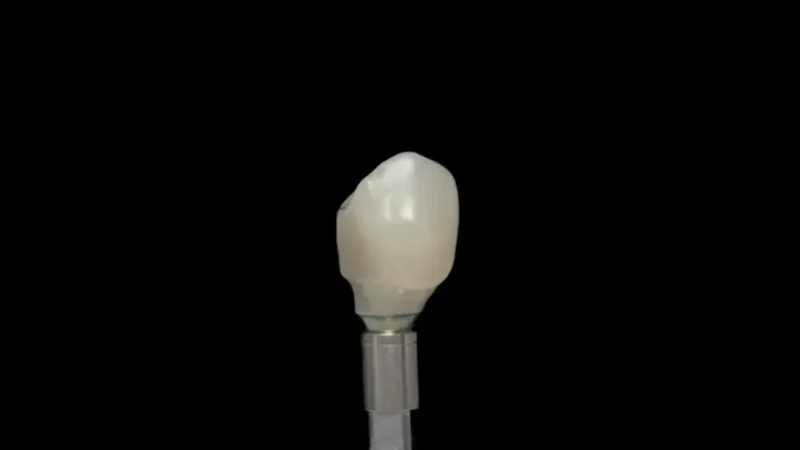
Zirconium dioxide is the strongest material in dentistry, milled from a solid block under computer control. A modern zirconia crown delivers around 1,000–1,200 MPa of flexural strength. Monolithic designs, milled from a single block with no porcelain overlay, have essentially eliminated chipping.
Key facts:
- Five-year survival for monolithic zirconia crowns sits at 8%.
- Zirconia is the first choice for molars, bruxists and dental implants
- Newer high-translucency and multilayer grades (4Y and 5Y) trade toughness for better translucency and aesthetics
- High-translucency 5Y grades are less suitable for heavy posterior teeth
Zirconia variant | UK cost per unit | Best for |
Monolithic (full-contour 3Y-TZP) | £550–£1,000 | Molars, bruxism, implant crowns |
Multilayer high-translucency (4Y/5Y) | £650–£1,100 | Premolars, aesthetic posterior zone |
Layered (porcelain-veneered) zirconia | £700–£1,400 | Front teeth needing maximum aesthetics |
2. E.max (lithium disilicate) crowns
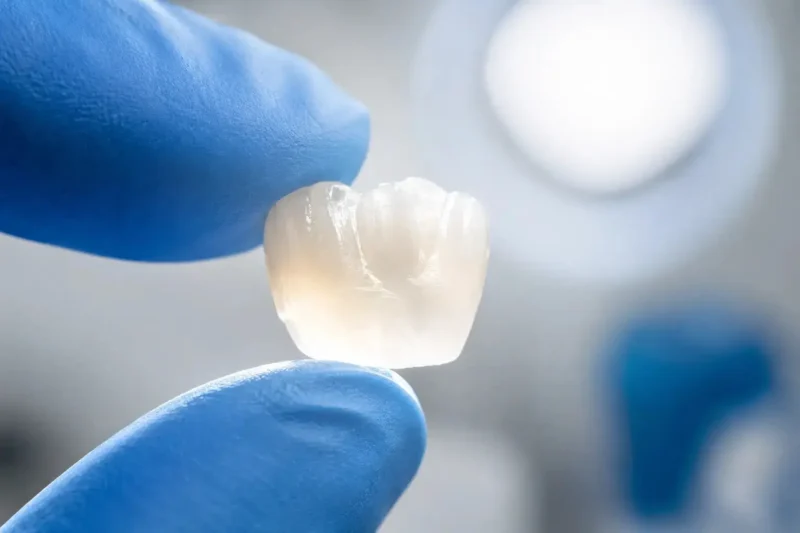
IPS e.max is a lithium disilicate glass-ceramic manufactured by Ivoclar, which transmits light almost exactly as natural enamel does. In a word, an emax crown is the most natural looking dental ceramic. At roughly 400 MPa it is weaker than zirconia, but hard enough for incisor (front) teeth.
Key facts:
- Best match for front teeth and premolars
- Highest five-year survival of the six materials (zirconia sustains harder pressures)
- Not indicated for full arches or severe grinding
- Adhesive bonding requires good enamel and a dry field
E.max variant | UK cost per unit | Best for |
E.max CAD (milled) | £550–£1,300 | Single anterior and premolar crowns |
E.max Press (pressed) | £650–£1,500 | Complex shade work, thin sections |
3. Porcelain-fused-to-metal (PFM) crowns
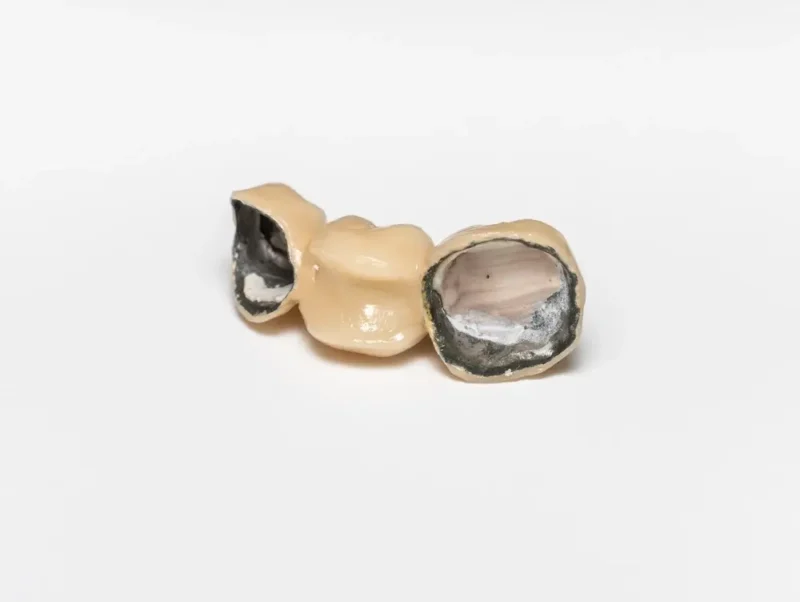
PFM crowns were the default for forty years: a cast metal coping for strength with porcelain fired over it for appearance. It still performs but the porcelain layer can chip, and the metal can be seen through when porcelain wears off. Over time, as gums recede, a grey line becomes visible at the margin.
Key facts:
- Lowest cost among all types of dental crowns in UK private practices
- Still widely used on the NHS
- Porcelain chipping and gum-line greying are the main failures
- Base-metal alloys can contain nickel, allergy-prone patients beware
PFM variant | UK private cost per crown | Best for |
Base metal alloy (non-precious) | £400–£650 | Posterior teeth, budget cases |
Semi-precious alloy | £550–£800 | Improved marginal fit and biocompatibility |
Precious (high-noble) alloy | £700–£1,000 | Best long-term response |
4. Gold and precious alloy crowns
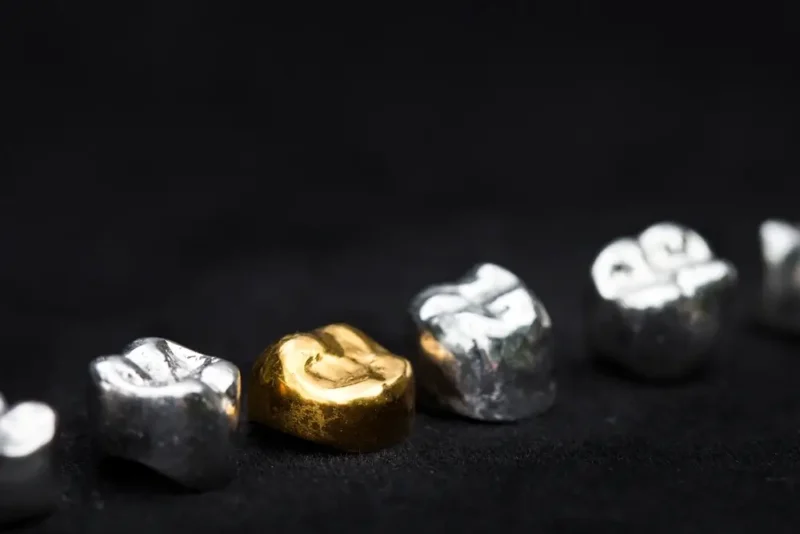
Clinically, gold is the finest crown material ever used. It is ductile, so it deforms instead of fracturing; it preserves more tooth than any other full crown (less teeth shaving required); and it does not destroy the opposing tooth. Its problem is entirely visual.
Key facts:
- Longest lifespan of any crown type: 20–30+ years is routine
- Least destructive crown preparation
- Protects the opposing tooth from abrasive wear
- Price fluctuates with the gold market; appearance rules it out for visible teeth
Gold variant | UK cost per unit | Best for |
Full cast high-noble (≥60% gold) | £600–£1,100 | Lower molars, heavy bruxism |
Noble alloy (lower gold content) | £450–£800 | Same indication, reduced cost |
Gold with porcelain facing | £700–£1,100 | Upper premolars |
5. All-porcelain (feldspathic) crowns
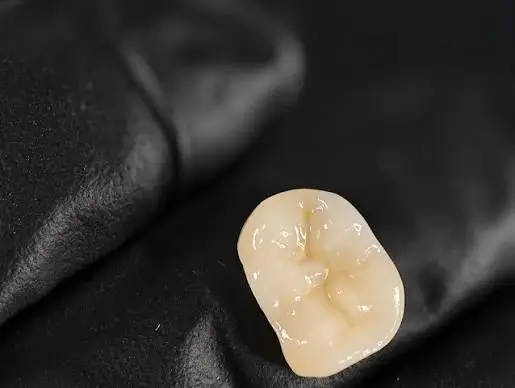
Feldspathic porcelain is hand-layered by an artisan rather than milled, which allows shade effects no machine can reproduce. It is also the weakest of all types of dental crowns at roughly 60–90 MPa. It survives as a specialist option for single upper incisors in low-load bites.
Key facts:
- Highest artistic ceiling of any crown
- Requires an experienced ceramist
- Brittle, and unsuitable for any tooth carrying significant load
- Largely superseded by lithium disilicate emax crowns
All-porcelain variant | UK cost per unit | Best for |
Feldspathic hand-layered | £600–£1,200 | Single upper incisor, light bite |
Leucite-reinforced (Empress-type) | £500–£900 | Anterior crowns, moderate strength |
6. Composite resin crowns
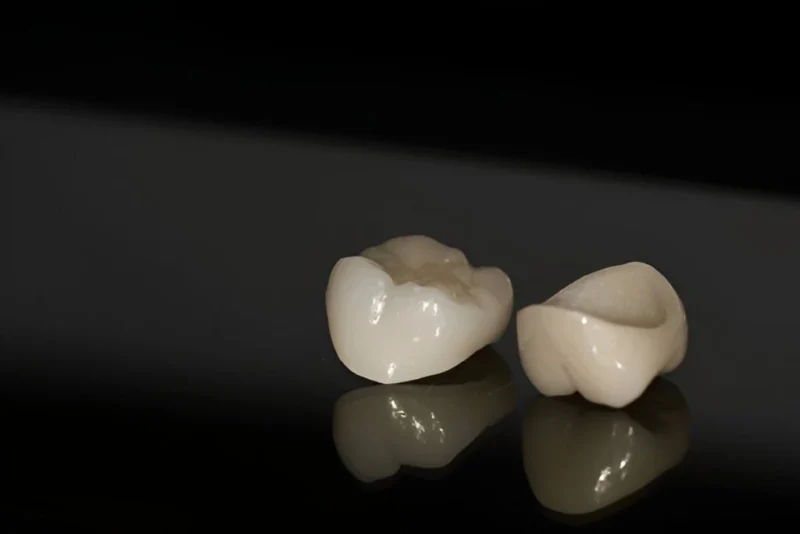
Composite crowns are built from the same resin used for white fillings. They are the cheapest option and the most easily repaired, but they absorb stain, wear against opposing teeth and fracture under load. They are a medium-term restoration, not a definitive one.
Key facts:
- Lowest upfront cost and often completed in a single visit
- Repairable chairside without remaking the crown
- Wears, stains and discolours within a few years
- Best used as an interim step, or on a low-load tooth
Composite variant | UK private cost per crown | Best for |
Direct chairside composite | £250–£400 | Short-term or interim restoration |
Indirect (laboratory-made) composite | £350–£550 | Slightly better strength and polish |
How much does a full set of crowns cost in the UK?
A full set of 20 upper and lower crowns costs approximately £8,000 to £30,000 in UK private practice, depending on material and location.
Most “full sets” are not 32 crowns. The visible smile zone is 20 teeth (ten upper and ten lower) and this is the figure quoted in almost every full-mouth case. Molars at the very back are usually left untouched unless they are damaged.
Crown type | Per crown (UK private) | 10 crowns (one arch) | 20 crowns (full set) |
Composite resin | £250–£550 | £2,500–£5,500 | £5,000–£11,000 |
PFM | £400–£1,000 | £4,000–£10,000 | £8,000–£20,000 |
Gold / noble alloy | £450–£1,100 | £4,500–£11,000 | £9,000–£22,000 |
All-porcelain | £500–£1,200 | £5,000–£12,000 | £10,000–£24,000 |
Monolithic zirconia | £550–£1,100 | £5,500–£11,000 | £11,000–£22,000 |
E.max (lithium disilicate) | £550–£1,500 | £5,500–£15,000 | £11,000–£30,000 |
Patients travelling for dental crowns in Turkey with One Life Dental typically pay £200–£350 per unit for the same zirconia or E.max crown, or £4,000–£7,000 for a full set of 20.
How much are dental crowns on the NHS?
NHS dental charges in England rose 1.7% in April 2026. Band 1 is £27.90, Band 2 is £76.60 and Band 3 (which covers anything made in a laboratory, including crowns, bridges and dentures) is £332.10. This is a single charge for an entire course of treatment. If you need a check-up, two fillings and two crowns within the same treatment plan, the total remains £332.10.
NHS crowns are provided only where clinically necessary, never cosmetically, and the material is chosen by the dentist on clinical grounds, typically PFM or full metal for posterior teeth. You cannot pay an NHS patient charge and request E.max.
Private crowns vs NHS crowns
A well-prepared NHS PFM crown on a lower molar is a good restoration and the value is unbeatable. The gap opens in the aesthetic aspect, where laboratory time and material choice change the result. Private crowns buy material choice, laboratory quality and chair time.
Factor | NHS | Private |
Cost | £332.10 per course of treatment | £400–£1,500 per crown |
Material choice | Clinician’s decision | Yours, with clinical guidance |
Availability | Clinical necessity only | Any indicated case |
Laboratory | Contracted, cost-controlled | Chosen by the practice |
Appointment length | Shorter, higher throughput | Longer, more refinement |
Aesthetic customisation | Standard shade matching | Characterisation, layering, shade mapping |
Waiting time | Often months for registration | Usually days |
Dental crown preparation and procedure
The placement of dental crowns usually takes two appointments, roughly one to two weeks apart, with a temporary crown in between.
Step 1: Assessment
Nothing should be drilled before the tooth has been examined and radiographed. Your dentist checks the extent of decay or fracture, tests pulp vitality, measures how much sound tooth wall remains, assesses gum health and records your bite. If the remaining tooth is too short or broken, a core build-up is planned. If the pulp is inflamed or necrotic, root canal treatment comes first.
First appointment: preparation and impression
During the first appointment, the tooth is numbed with local anaesthesia. Decay and fillings are removed, and the tooth is reduced by roughly 1.5 to 2 mm to create space for the crown. A margin is prepared at or just above the gum line. A digital scan is taken, the shade is recorded, and a temporary crown is cemented. All in 60 to 90 minutes.
Second appointment: fitting
The temporary crown is removed and the definitive crown is tried in. Your dentist checks marginal fit, contact points with the neighbouring teeth, shade, and occlusion. The bite check matters: a crown even 0.2 mm too tall causes sensitivity, jaw pain and eventual fracture. Zirconia and PFM crowns are usually cemented; E.max is adhesively bonded. Expect 30 to 60 minutes.
Are dental crowns painful?
The preparation and fitting are carried out under local anaesthetic, and you should feel, no pain whatsoever. However,cutting into dentine inflames the pulp, and for 48 to 72 hours a freshly prepared tooth can ache, throb, and react sharply to cold and to biting. This is normal, it peaks within the first two days, and over-the-counter ibuprofen or paracetamol manages it effectively.
When to consult your dentist
If pain that intensifies after day four, a throbbing that wakes you at night, swelling, a bad taste, or a tooth that stays tender to bite on for weeks. Those signs point to pulp necrosis, an occlusal high spot, or an infection under the crown, and all three need to be seen promptly.
How long do dental crowns last?
Longevity dependo n several factors, some depending on the dentist, others on the ceramist and others, on the patient. The main 3 ones are:
- How much sound tooth remained before preparation
- How accurately the margin seals
- Whether you grind your teeth (bruxism)
Crown type | Typical lifespan | 5-year survival (published) |
Gold / noble alloy | 20–30+ years | Very high |
Monolithic zirconia | 15–25 years | 96.8% |
E.max (lithium disilicate) | 10–20 years | 98.5% |
PFM | 10–15 years | 97.1% |
All-porcelain | 10–15 years | Lower than the above |
Composite resin | 3–7 years | Not comparable |
Essential aftercare tips
This is the part under the patient’s control, so, if you want your crowns to last as long as possible, carefully follow the instructions below:
- Brush twice daily for two minutes with a soft brush and fluoride toothpaste
- Clean interdentally every day with floss or interdental brushes
- Wear a night guard if you grind
- Avoid opening packaging with your teeth, chewing ice, or biting into hard nuts
- Attend appointments once or twice yearly
- Report new sensitivity to cold, tenderness on biting, or a change in how your teeth meet
What type of crowns do most dentists use?
Monolithic zirconia is now the most commonly private crown in the UK, with PFM still dominant on the NHS. The shift happened over roughly a decade. Monolithic zirconia gives near-metal strength, needs less tooth reduction than PFM, andcontains no metal to show at the gum line.
For anterior teeth, lithium disilicate remains the professional consensus. NHS dentistry continues to rely on PFM and full metal crowns, because the Band 3 fee structure makes material cost a constraint.
What is the newest material used for dental crowns?
Multilayer zirconia is the newest material in clinical use. Multilayer systems blend grades, so the crown is strong at the margin and translucent at the incisal edge, with better stress distribution than single-layer blocks. The trade-off is highly translucent 5Y and 6Y multilayer zirconia crowns have lower toughness and should not be used for high-load posterior molars.
The actual frontier is manufacturing. In August 2026, researchers at the University of Texas at Dallas reported a method that cuts the post-printing debinding stage for 3D-printed zirconia from as much as 100 hours to under 30 minutes, with commercialisation supported by the National Science Foundation. If it reaches clinics, permanent zirconia crowns printed and fitted in a single appointment become realistic.
What are the best alternatives to dental crowns?
There is no reason why a dentist would propose crowns on multiple healthy teeth without first discussing onlays, bonding or veneers. If the tooth still is healthy, an onlay, these alternatives will preserve far more of it.
- Onlay or partial crown: covers the biting surface and weakened cusps while removing only 35–47% of tooth structure.
- Inlay: a laboratory-made filling for a large cavity with intact cusps
- Composite bonding: reshapes and rebuilds chips and worn edges in a single visit.
- Porcelain veneers: for anterior teeth only; removes 3–30% of tooth structure
- Composite filling: appropriate where enough thickness remains
- Extraction and implant: when the tooth is unrestorable
- Root canal treatment and crown: not an alternative, but the correct sequence when the pulp is involved