
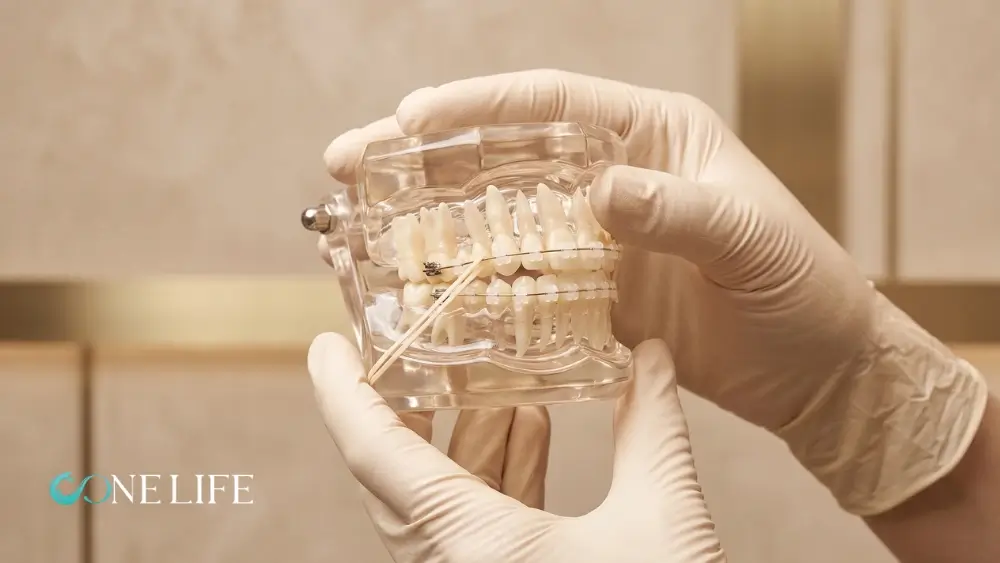
An underbite is easy to recognize when the mouth closes: the lower front teeth sit in front of the upper front teeth. Why it happens? The upper and lower jaws may have developed in different proportions, or an early tooth contact may force the lower jaw forward.
A mild underbite may cause no difficulties. A more pronounced one, however, can affect biting, chewing, speech, tooth wear and facial balance. Identifying its cause helps determine which treatment options may be appropriate.
What Is an Underbite (Prognathism)?
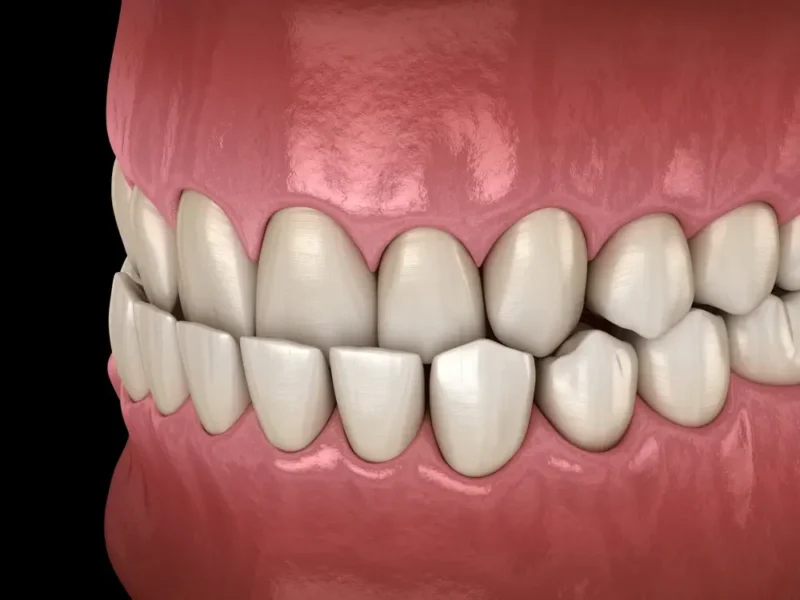
An underbite is a type of malocclusion in which the lower front teeth or lower jaw sit ahead of the upper front teeth or upper jaw when the teeth come together.
Underbites are commonly associated with a Class III malocclusion, meaning that the lower teeth and/or jaw are positioned forward relative to the upper teeth and/or jaw.
Dental, Skeletal and Functional Underbites
An underbite can be dental, skeletal, functional or a combination of these types. This distinction directly influences treatment.
Feature | Dental underbite | Skeletal underbite | Functional underbite |
Primary cause | Position or angle of the teeth | Size, position or growth relationship of the jawbones | Early tooth contact that makes the lower jaw shift |
Typical finding | Upper incisors lean inward, lower incisors lean outward, or both | The lower jaw is prominent, the upper jaw is deficient, or both | The bite looks less pronounced when the jaw is guided into a relaxed position |
Possible treatment | Braces or clear aligners, sometimes with elastics | Growth-guiding treatment in children, orthodontic camouflage or jaw surgery | Removal of the dental interference and orthodontic correction |
Can braces alone correct it? | Often, depending on the required movements | Sometimes in mild cases, but not when mature jawbones need substantial repositioning | Often possible when diagnosed and treated appropriately |
What Causes an Underbite?
Below, we list the different causations behind underbite malocclusion.
1. Genetics and jaw development
Genetics can influence facial structure, jaw size and growth. A person may inherit a prominent lower jaw, a smaller or backward upper jaw, or a combination of both. The lower jaw can continue growing through adolescence, so an underbite may become more noticeable.
Cleft lip and palate and certain craniofacial conditions can also affect jaw development and may require multidisciplinary care.
2. Tooth position and eruption
An anterior crossbite can develop when an upper tooth erupts behind a lower tooth. Crowding, limited space, missing teeth or unusual eruption paths may also affect the bite.
3. Habits, injury and other influences
Certain oral habits may influence developing teeth and arches, although thumb-sucking and pacifier use are more frequently associated with open bite than with a skeletal Class III underbite. Injury to the teeth, jaw or facial growth during childhood may also disrupt development.
Can an Untreated Underbite Cause Health Problems?
An underbite is not automatically harmful. Some mild cases cause no pain or important limitations. But more pronounced cases can affect oral function and dental health.
Uneven tooth wear and damage
When teeth do not meet evenly, excessive pressure may fall on a limited number of teeth. This can contribute to worn enamel, flattened edges, sensitivity, chipping or cracks. Lost enamel does not regenerate.
Difficulty biting and chewing
A reverse bite can make it difficult to bite through foods with the front teeth. A more substantial malocclusion may also distribute chewing pressure unevenly.
Gum and oral-hygiene concerns
Crowded or incorrectly angled teeth can be harder to clean and may place unfavorable pressure on the gums and supporting bone. An underbite does not directly cause gum disease, but associated crowding can create oral-hygiene challenges.
Speech and jaw discomfort
Some people experience difficulty producing particular sounds, jaw-muscle fatigue or temporomandibular joint symptoms. However, speech differences and jaw pain have multiple possible causes. Orthodontic treatment cannot be expected to resolve every speech or jaw-joint problem.
How to Fix an Underbite
Underbite treatment depends on age, cause, severity, oral health, remaining growth and whether the condition affects function or quality of life.
Can braces fix an underbite?
Braces can correct many underbites caused primarily by tooth position. Brackets and wires move the upper and lower teeth into improved alignment, while Class III elastics may help adjust how the arches meet.
Braces may also provide orthodontic camouflage in selected mild skeletal cases. This repositions the teeth to compensate for an underlying jaw discrepancy without changing the jawbones themselves. Braces cannot shorten an adult lower jaw or substantially bring an underdeveloped adult upper jaw forward.
Can Invisalign fix an underbite?
Invisalign® is one brand of clear-aligner therapy. Invisalign or another professionally supervised clear-aligner system may correct selected mild-to-moderate dental underbites. Attachments, elastics or other components may also be needed.
Suitability depends on the tooth movements required, jaw relationship, oral health and consistent wear. Clear trays alone cannot correct a substantial adult skeletal discrepancy.
Growth-guiding treatment for children
Treatment for a growing child may include a palatal expander, reverse-pull headgear, fixed or removable appliances, braces or elastics. The appliance must be selected according to the child’s anatomy, developmental stage and growth pattern. Consistent wear is essential when removable or external appliances are prescribed.
Tooth extraction
Extraction may occasionally create space for crowded teeth or support orthodontic camouflage. It does not correct an underbite by itself and is not appropriate for every patient.
Orthognathic jaw surgery
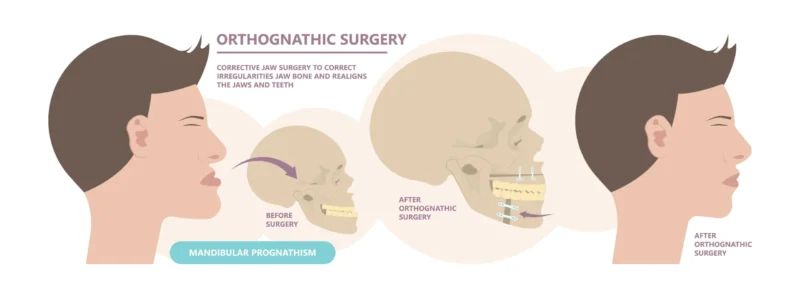
Orthognathic surgery, or corrective jaw surgery, may be considered after facial growth is complete. Depending on the anatomy, surgery may reposition the upper jaw, lower jaw or both. Treatment commonly includes orthodontics before surgery.
The decision considers function, skeletal measurements, facial balance, treatment stability, general health and the patient’s goals. An individualized assessment is necessary before a reliable timeline can be provided.
What Is the Best Age to Treat an Underbite?
The American Association of Orthodontists recommends an orthodontic evaluation no later than age seven, when enough permanent teeth have usually erupted to identify jaw-growth problems.
Early treatment can produce useful improvements, but it cannot guarantee that further orthodontics or surgery will never be required. Some children benefit from interceptive or Phase I orthodontics, while others may need a palatal expander or a reverse-pull headgear (also called a protraction facemask).
Adults can also receive effective underbite treatment. However, once facial growth is complete, orthodontics can move teeth but generally cannot correct jawbone without surgery.
Underbite Treatment in Children vs. Adults
Treatment factor | Children and adolescents | Adults |
Jaw growth | Remaining growth may be used in selected patients | Skeletal growth is generally complete |
Main assessment | Tooth eruption, growth pattern, jaw relationship and functional shifts | Dental versus skeletal cause, oral health, function and goals |
Common options | Monitoring, expansion, facemask therapy, braces and elastics | Braces, clear aligners, camouflage or combined orthodontic-surgical treatment |
Ability to influence jaw development | Sometimes possible while growth remains | Conventional appliances cannot substantially alter mature jawbones |
Surgery | Usually postponed until facial growth is complete | May be considered for significant skeletal discrepancies |
Retention is normally required after orthodontic tooth movement in both age groups. Continued growth may influence long-term stability in younger patients with a Class III growth pattern.
How to Fix an Underbite Naturally
There is no scientifically established exercise, massage, chewing technique or home device that can reliably correct a true underbite. “Mewing,” manually pushing the teeth and using unsupervised aligners cannot safely reposition a skeletal jaw discrepancy and may damage the teeth, gums, bite or jaw joints.
Children’s jaws change as they grow, but this does not mean an underbite will correct itself. Good oral hygiene, regular dental examinations and avoiding damaging habits can protect the teeth, but they cannot replace necessary orthodontic treatment.
Underbite vs. Overbite: What Is the Difference?
A small vertical overlap of the upper teeth over the lower teeth is normal. Excessive horizontal projection of the upper front teeth is called overjet, not overbite.
Feature | Underbite | Overbite |
Definition | Lower front teeth or jaw sit ahead of the upper teeth or jaw | Upper front teeth overlap the lower front teeth excessively vertically |
Direction | Reversed front-to-back relationship | Excessive vertical overlap |
Typical appearance | The lower jaw may look prominent or the middle face less projected | The lower front teeth may be partly or almost completely covered |
Treatment | Depends on dental or skeletal cause, severity and remaining growth | Depends on bite depth, tooth position, jaw relationship, age and severity |
Signs of an Underbite and When to Seek Assessment
A child may not report pain when the underbite is mild. An evaluation is advisable when the bite becomes more pronounced, the jaw shifts while closing, a permanent tooth erupts into crossbite, or tooth wear, chewing difficulty, speech concerns or discomfort develops.
Possible underbite symptoms include:
- Difficulty biting through food with the front teeth
- An upper permanent tooth erupting behind a lower tooth
- A forward or sideways jaw movement when closing
- Uneven contact between the upper and lower teeth
- Increasing wear along the front-tooth edges
- A lower jaw or chin that appears progressively prominent
- Difficulty producing certain speech sounds
- Jaw-muscle fatigue or discomfort while chewing
- Chipping, sensitivity or gum irritation around heavily loaded teeth