
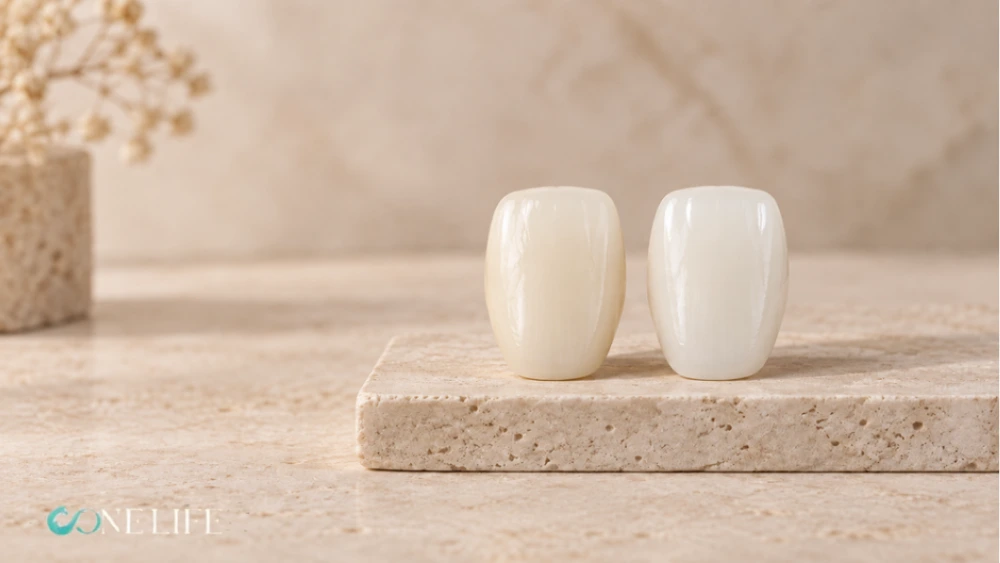
A1 and B1 are two of the lightest shades in the VITA tooth shade guide. They may look almost identical, but they can create very different impressions across a smile. This guide compares A1 vs B1 tooth shades , helping you evaluate which color may work better for whitening, veneers, crowns or a full smile makeover.
A1 vs B1 tooth shade at a glance
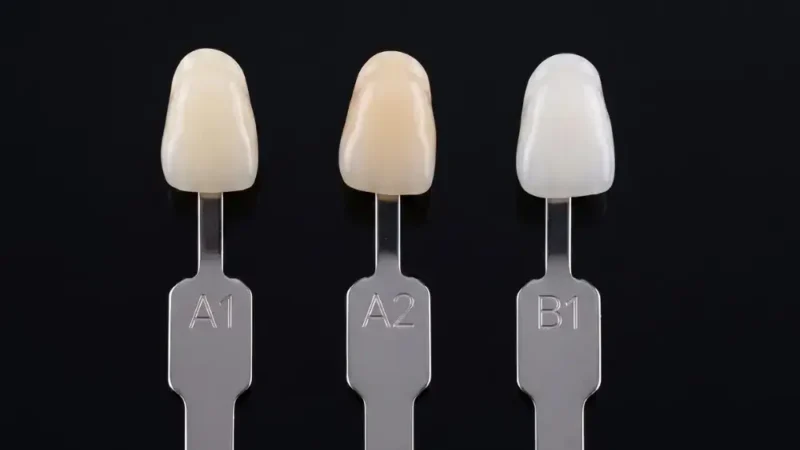
A1 and B1 are color codes within the VITA A1–D4 tooth shade guide. The number differentiates color intensity. The letters describes the general color families (these refer to subtle undertones. An A1 tooth does not look brown, and B1 does not look yellow):
- A shades: reddish-brownish
- B shades: reddish-yellowish
- C shades: grayish
- D shades: reddish-grayish
A1 | B1 | |
VITA color family | A: reddish-brownish | B: reddish-yellowish |
Appearance | Light, warm and gently creamy | Light, bright and clean |
Brightness | Very light | Slightly brighter |
Effect | Subtle and softly warm | More luminous and noticeable |
Lighter than bleach shades? | No | No |
How to choose between A1 and B1
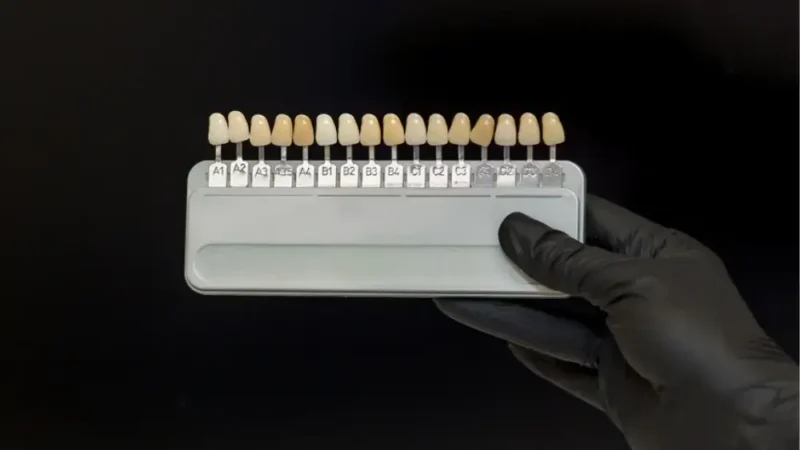
Patients should compare the A1 tooth shade and the B1 tooth shade beside their teeth and face. When dental restorations are planned, try-ons can show how brightness looks.
In general:
- A1 has a softly warm, creamy or slightly muted character.
- B1 has a brighter, clearer appearance with a subtle warmth.
- Neither shade is a completely neutral or artificial white.
Question | A1 may be appropriate when… | B1 may be appropriate when… |
How bright should the result be? | You prefer softly bright teeth | You want more visible brightness |
What color are untreated teeth? | They are moderately light or warm | They are already very light or will be whitened |
What style do you prefer? | Subtle and understated | Clean and luminous |
Are bleach shades being considered? | You want to remain clearly softer | You want brightness without moving into bleach shades |
Is discoloration present? | Minimal masking may be needed | Material selection—not B1 alone—must provide masking |
Careful: online comparisons can be misleading
Online photographs can demonstrate that A1 and B1 are different, but they cannot reproduce their shades accurately. A physical comparison, with standardized lighting provides a more reliable basis than a photograph viewed on a screen.
Their appearance may be altered by:
- Camera settings
- Flash or studio lighting
- White balance
- Image editing and filters
- Screen calibration
- Surrounding colors
Is A1 or B1 whiter?
The B1 tooth shade is whiter than A1 in the VITA tooth shade guide. The difference is indeed subtle. The A1 tooth shade is still a very light shade. Across several teeth, however, B1 creates a visibly brighter impression, while A1 looks slightly softer and creamier.
How we perceive their whiteness also depends on factors such as lighting, translucency, gloss and contrast.
Is A1 or B1 more natural?
At One Life Dental, we believe that A1 integrates more easily with natural teeth, but both shades can produce natural-looking results. B1’s greater brightness becomes artificial-looking only when it conflicts with the rest of the smile.
When assessing suitability, our dentists and dental technicians consider:
- Changes in color from the gumline
- Enamel translucency
- Surface texture
- Reflection and gloss
- Tooth shape and proportions
- Small variations among different teeth
Skin tone and facial features affect the choice?
No reliable rule assigns A1 or B1 to a particular skin tone. B1 appears more luminous against a darker complexion because of increased contrast, while A1 may produce a softer transition in some smiles, but the opposite can also be true depending on the individual. Both shades should be evaluated directly beside the patient’s face.
Shade selection may consider:
- Lip and gum color
- Facial contrast
- Existing tooth color
- Tooth size and shape
- Personal preferences
- Intended appearance in photographs
When A1 may be the better choice
A1 can be especially useful to blend a restoration into an existing smile. However, the dentist must still reproduce the translucency, brightness and characteristics of the neighboring teeth.
A1 may be worth considering when:
- You want a light but subtle result.
- Your neighboring teeth are warm or creamy.
- Only one or two teeth will be restored.
- You want to avoid a visibly whitened appearance.
When B1 may be the better choice
B1 is brighter than A and it may look artificial in isolation among darker teeth.
B1 may be considered when:
- Teeth whitening has created a similar surrounding shade.
- Your natural teeth are already light.
- Several veneers or crowns are being planned together.
- You want noticeable brightness without a bleach shade.
A1 vs B1 for a single crown or veneer
For a single veneer or crown, matching adjacent teeth is more important than choosing the lightest shade. A B1 crown placed between A2 natural teeth stands out immediately. An A1 crown can also look mismatched.
If the patient wants the complete smile to become lighter, whitening may be performed before the crown or veneer is manufactured. The definitive restoration can then be matched after the natural color stabilizes.
A1 vs B1 for several veneers
When several veneers are planned, there is greater freedom to select the shade. A1 may produce a softer transformation, while B1 may make the result look more luminous. Provisional restorations or try-in materials can help patients evaluate the brightness before the veneers are permanently bonded.
Factor | Effect on final color |
Original tooth shade | A dark foundation may show through translucent ceramic |
Ceramic thickness | Thin veneers reveal more underlying color |
Translucency | Creates natural depth but offers less masking |
Opacity | Conceals discoloration but may look flat if excessive |
Resin cement | Can subtly modify the color of thin veneers |
Surface texture | Alters reflection and perceived brightness |
Research shows that the underlying tooth, ceramic thickness, translucency and resin cement can all influence the final shade. Selecting an A1 or B1 ceramic does not guarantee that the bonded veneer will look exactly like its shade tab.
A1 vs B1 for dental crowns
Dental crowns cover more of the underlying tooth than veneers and may provide greater control when masking discoloration. The chosen material still affects how A1 vs B1 tooth shade is reproduced.
More translucent materials create depth but allow the foundation to influence the result. More opaque materials can conceal discoloration but appear less natural if they block too much light.
Different optical results can occur with:
- Zirconia crowns
- Emax crowns (Lithium disilicate ceramic)
- Layered porcelain
- Porcelain-fused-to-metal restorations
- Composite resin
Can teeth whitening reach A1 or B1?
Professional whitening may help natural teeth reach or approach A1 or B1, but a precise final shade cannot be guaranteed. Natural teeth may finish darker than A1, close to either shade or lighter than B1.
The result depends on:
- Starting tooth color
- Cause and depth of discoloration
- Enamel and dentin characteristics
- Age-related changes
- Previous dental treatment
- Individual response to whitening
Final verdict: is A1 or B1 better?
B1 generally appears slightly whiter and more luminous, while A1 tends to look softer and more understated. Both shades can produce natural results. The best option is the one that produces the desired effect while remaining balanced with the complete smile.
One Life Dental can assess your existing tooth color and demonstrate how A1, B1 or another shade may work with your planned treatment. A personalized evaluation can help you choose confidently before veneers or crowns are completed.