
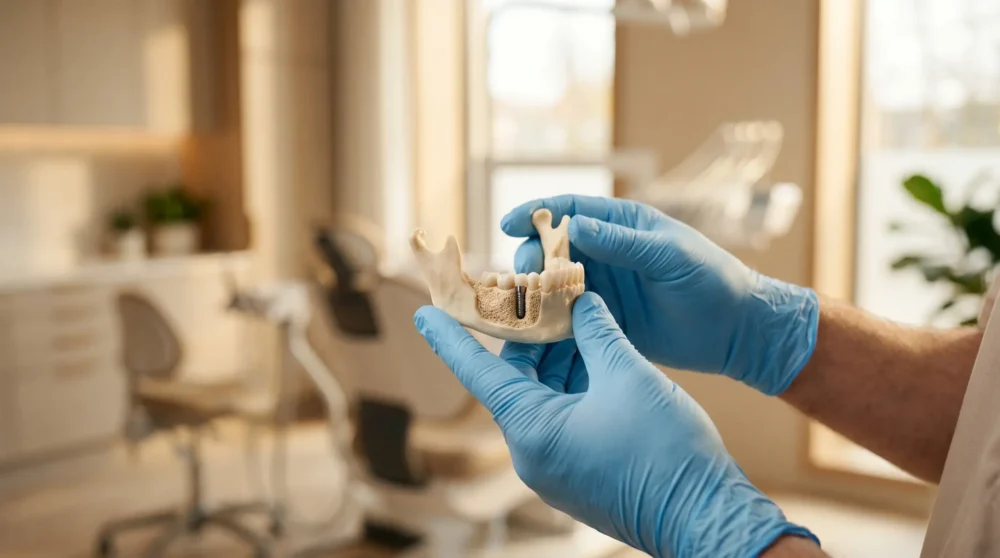
Can the body reject a dental bone graft? Dental bone grafts can fail, but what patients describe as dental bone graft rejection is more often an infection, loss of graft material, or failure to produce enough new bone, not a rejection like in organ transplants.
The cause must first be identified and treated. Another graft or a new dental implant plan may be possible after healing. In the following article, we address dental bone graft rejection in detail.
What is a dental bone graft?
Bone grafting can rebuild areas of the jaw that have lost volume following tooth loss, gum disease, trauma, or infection. It may be recommended before or during implant treatment to:
Depending on the graft’s size, location, material, and individual healing, maturation may require several months. Our dental bone graft guide explains the general procedure and its role in restoring lost jawbone.
Types of bone graft material
Dental grafts can come from several sources:
Graft type | Source |
Autograft | The patient’s own body |
Allograft | Human donor tissue |
Xenograft | Animal-derived |
Alloplast | Synthetic or lab-made |
Can your body reject a dental bone graft?
Graft materials are specially processed to be fully compatible with the human body. The body is therefore not usually rejecting a dental bone graft. Instead, a graft may fail because it:
- Lacks sufficient blood supply
- Becomes infected
- Is exposed through an opening in the gum
- Moves before it has stabilized
- Loses material during healing
- Resorbs more quickly than expected
- Produces insufficient new bone
- Is affected by health factors
Can human or animal-derived material cause rejection?
Human donor and animal-derived dental bone grafts are processed for clinical use according to medical standards. They are not comparable to transplanting a living organ from another person or animal.
The source of a graft does not by itself determine whether treatment will succeed. The selected material, surgical technique, tissue closure, blood supply, oral hygiene, and health factors all influence surgical healing.
Anyone with known allergies, immune conditions, personal concerns, or dietary or religious restrictions should discuss the material’s origin and composition before treatment.
What is the difference between normal healing and graft failure?
Some inflammation is part of normal wound healing, but normal symptoms should generally improve. Pain, swelling, drainage, or an unpleasant taste that worsens instead of improving requires a medical check-up as soon as possible.
Common early healing experiences | Possible warning signs |
Mild to moderate swelling | Swelling that continues to increase |
Tenderness near the surgical site | Severe or worsening pain |
Minor bruising | Pus or persistent drainage |
Light bleeding or blood-tinged saliva | Persistent or heavy bleeding |
A few sand-like graft particles | Loss of a large amount of graft material |
Gradual improvement over several days | Symptoms that improve and then return |
Temporary difficulty chewing near the area | Wound opening or visible membrane |
Signs of dental bone graft failure
A failed dental bone graft may be evident right after surgery or only after several months. During that time, the gums may appear healed while the area underneath develops less new bone than needed.
Possible signs of graft failure may include:
- Severe or increasing pain
- Swelling that worsens after the initial recovery
- Redness and tenderness
- Pus, persistent drainage, or an unpleasant taste
- Fever
- Gum tissue pulling away
- Exposure of the graft
- Graft particle leakage
- Persistent numbness
- Altered sensation
- Little or no increase in bone volume
Why do dental bone grafts fail?
Bone-graft failure rarely has one universal cause. It can result from surgical, biological, mechanical, or behavioral factors. The most common causes include:
Infection
Bacteria may enter the surgical site and interfere with healing. Infection can lead to pain, swelling, drainage, tissue breakdown, or loss of graft material. That is why cleaning and control of active disease are important parts of treatment planning.
Poor blood supply
New bone formation depends on blood vessels reaching the grafted area. Defects, scarring, previous surgery, radiation treatment, or compromised tissue may reduce the blood supply needed.
Wound opening and membrane exposure
The gum tissue is usually closed over the graft, and a membrane may be used to protect it. If the incision opens, the membrane or graft material can become exposed to the mouth. Exposure can also increase contamination and material loss.
Graft movement
A graft needs stability during early healing. Movement can disrupt blood-vessel formation and the connection between the graft and the recipient bone. Pressure from chewing, a removable denture, or repeated disturbance of the surgical area may affect stability.
Smoking and vaping
Nicotine reduces blood flow and can interfere with soft-tissue and bone healing. Smoking is consistently recognized as an important risk factor in oral surgery and implant treatment.
Uncontrolled medical conditions
Conditions that interfere with circulation, immunity, or tissue repair may increase surgical risk. Examples can include poorly controlled diabetes, certain immune disorders, and conditions or treatments that affect bone metabolism.
Poor oral hygiene or active gum disease
Plaque accumulation and untreated periodontal infection increase bacterial exposure around a healing site. Existing gum disease should be assessed and controlled as part of implant planning.
Mechanical pressure or premature trauma
Touching the wound, chewing hard food over it, vigorous rinsing, or wearing an appliance that presses on the site may disturb the graft.
Graft resorption or insufficient bone formation
Not every graft produces the exact amount of bone initially expected. Some material may resorb during remodeling, and the remaining volume may be insufficient for the planned implant.
Who may have a higher risk of bone-graft failure?
Patients should give the clinician a complete list of medications, supplements, medical conditions, previous surgeries, allergies, and tobacco use. Some medications should never be stopped without guidance from the prescribing clinician.
Risk should be evaluated individually, but factors that may influence healing include:
- Smoking or vaping
- Poorly controlled diabetes
- Active gum disease
- Poor oral hygiene
- Untreated infection at the grafting site
- Significant immune suppression
- Previous radiation in the jaw area
- Certain medications affecting bone turnover or immunity
- Severe nutritional deficiency
- Repeated pressure on the surgical site
- Failure to follow postoperative instructions
- Complex or extensive bone defects
- Previous unsuccessful grafting
What happens if a dental bone graft fails?
Treatment depends on the severity and timing of the problem. Here is the usual protocol applied by One Life Dental’s partners:
1. The site is examined
The clinician assesses pain, swelling, wound closure, drainage, graft exposure, and tissue health. Dental imaging may be used to evaluate the grafted area.
2. Infection and unstable material are managed
The area may require professional cleaning, drainage, removal of loose or infected graft material, or another procedure. Antibiotics may be prescribed when clinically indicated, but they cannot correct every mechanical or structural cause of failure.
3. The area is allowed to heal
If graft material must be removed, the soft tissue and underlying bone may need time to recover before another regenerative procedure is considered.
4. Risk factors are addressed
Before repeating treatment, the team may need to manage infection, periodontal disease, smoking, appliance pressure, medical control, or another contributing factor.
5. The implant plan is reassessed
Depending on the remaining bone and treatment goals, options may include:
- Repeating the graft with the same or a different material
- Using a different grafting technique
- Performing a smaller additional graft
- Modifying the implant’s size or position
- Combining grafting and implant placement in a suitable case
- Considering an alternative restoration if predictable grafting is not possible
Does graft failure mean a dental implant cannot be placed?
Not necessarily. Dental implants with bone loss are viable treatment. They just require enough healthy bone in the right position. If a graft fails completely or produces inadequate bone, implant placement may need to be delayed, modified, or reconsidered.
The next step depends on:
- Why the graft failed
- Whether infection is present
- How much healthy bone remains
- The location and size of the defect
- The condition of the gum tissue
- The implant size and position originally planned
- Whether another grafting method is feasible
- The patient’s health and risk factors
Can a failed bone graft be repeated?
In many cases, yes. Repeat grafting may be possible once infection and inflammation have resolved and the tissues are healthy enough for another procedure.
The clinician may adjust:
- The graft material
- Membrane type
- Stabilization method
- Soft-tissue closure
- Size of the graft
- Healing period
- Timing of implant placement
- Management of patient-related risk factors
How long after a bone graft can an implant be placed?
In selected cases, a graft and dental implant can be placed during the same procedure. In others, the graft must mature for several months before implant surgery. Only clinical examination help determine whether sufficient mature bone is available.
If the first graft fails, the timeline becomes longer because the complication must be treated and the site allowed to recover. A new graft may then require its own healing period before implant placement.
How can the risk of bone graft failure be reduced?
Not every complication can be prevented, but careful planning and postoperative care can reduce avoidable risks. However, instructions vary according to the procedure. Advice provided by the treating clinician should take priority over general online guidance.
Before surgery
- Provide a complete medical and medication history.
- Inform the clinician about allergies and previous graft reactions.
- Treat active dental or gum infection.
- Discuss smoking or vaping cessation.
- Improve blood-glucose control when applicable.
- Ask which graft material will be used and why.
- Discuss any removable dental appliance that may press on the site.
After surgery
- Take prescribed medication exactly as directed.
- Avoid touching the graft with fingers or the tongue.
- Do not pull the lip or cheek repeatedly to inspect the wound.
- Follow instructions for cleaning the mouth and surgical area.
- Avoid vigorous rinsing or spitting during the initial period.
- Eat soft foods and avoid chewing over the site.
- Avoid smoking and vaping.
- Limit strenuous activity for the recommended period.
- Attend all follow-up appointments.
- Report worsening symptoms rather than waiting for them to become severe.
When should you contact the dentist?
Rapidly increasing facial swelling, difficulty swallowing, or difficulty breathing requires urgent medical or dental attention.
Contact the dental team if you notice:
- Pain or swelling that becomes worse rather than better
- Pus, persistent drainage, or a strong unpleasant taste
- Fever or general illness
- Heavy or persistent bleeding
- Opening of the surgical wound
- Visible graft material or membrane exposure
- Loss of a substantial amount of graft particles
- Persistent numbness
- Pressure from a denture or temporary restoration
- Any symptom that concerns you during recovery
FAQs
Can your body reject a dental bone graft?
Dental graft failure is possible, but it is rarely equivalent to organ-transplant rejection. Infection, poor blood supply, graft movement, wound opening, material loss, or insufficient bone formation are more common explanations.
How do I know whether my bone graft is healing?
Pain and swelling should generally improve, and the gum should gradually close over the site. The formation of adequate new bone cannot always be judged by appearance, so follow-up examination and imaging may be necessary.
Is it normal for bone-graft particles to fall out?
A few small, sand-like particles may escape during early healing and do not necessarily indicate failure. Loss of a large amount, especially with pain, bleeding, swelling, or wound opening, should be reported.
Can an infected dental bone graft be saved?
Some complications can be managed without losing the entire graft, particularly when identified early. Other cases require partial or complete removal. The decision depends on the extent of infection, graft stability, tissue condition, and timing.
How soon can a failed dental bone graft be repeated?
There is no standard waiting period. Infection and inflammation must first resolve, and the tissues must become suitable for another procedure. The clinician will determine the timing through examination and imaging.
Will a failed bone graft prevent me from getting dental implants?
Not necessarily. Many patients can undergo repeat grafting or receive a modified treatment plan. Implant placement may be delayed until adequate healthy bone has formed.
Is swelling a sign that the bone graft has been rejected?
Swelling is common during early recovery. Swelling that increases, returns, or occurs with severe pain, pus, fever, or wound opening may indicate a complication and requires assessment.
References
- Cleveland Clinic. “Dental Bone Graft: Process, Purpose and Healing.”
https://my.clevelandclinic.org/health/treatments/21727-dental-bone-graft - Sanz-Sánchez I, Sanz-Martín I, Ortiz-Vigón A, Molina A, Sanz M. “Complications in Bone-Grafting Procedures: Classification and Management.” Periodontology 2000.
https://pubmed.ncbi.nlm.nih.gov/35103322/ - Zhao R, Yang R, Cooper PR, Khurshid Z, Shavandi A, Ratnayake J. “Bone Grafts and Substitutes in Dentistry: A Review of Current Trends and Developments.” Molecules.
https://pmc.ncbi.nlm.nih.gov/articles/PMC8158510/ - American Academy of Periodontology. “Ridge Modification.”
https://www.perio.org/for-patients/periodontal-treatments-and-procedures/dental-implant-procedures/ridge-modification/