

Hyperdontia is a dental condition in which a person develops one or more extra teeth beyond the normal count. Most adults have 32 permanent teeth, but people with hyperdontia grow additional ones, known as supernumerary teeth. These extra teeth can appear anywhere in the mouth, be visible or stay hidden beneath the gum (impacted), and range from a single extra tooth to, in extremely rare cases, dozens.
Hyperdontia is not a disease in itself. In most cases, it is a harmless developmental variation. However, it can sometimes cause crowding, misalignment, or delayed eruption of nearby teeth, which is why dentists recommend monitoring it closely, especially in children. The condition affects both primary (baby) teeth and permanent (adult) teeth, though it is roughly twice as common in the permanent set.
Why Does Hyperdontia Happen?
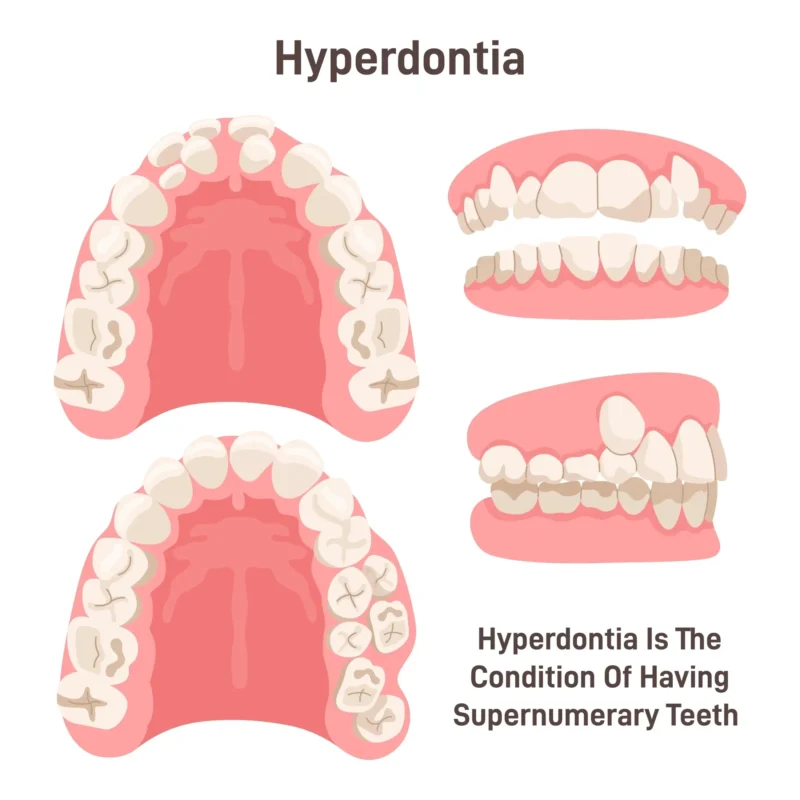
In short: hyperdontia is mostly genetic. It develops when the dental lamina — the tissue band responsible for forming tooth buds — stays active for longer than it should, producing one or more extra tooth germs. Researchers have not pinpointed a single cause, but genetics, inherited syndromes, and evolutionary leftovers all play a role.
Most cases follow an autosomal dominant inheritance pattern, meaning a child only needs to inherit the trait from one parent to develop extra teeth. This is why hyperdontia often runs in families, even when no other health condition is present.
What Genes Are Linked to Hyperdontia?
Scientists have identified several genes involved in tooth development that, when mutated, can trigger supernumerary teeth. The two most studied are:
- RUNX2: a master gene for bone and tooth formation. Mutations cause cleidocranial dysplasia, a rare skeletal disorder in which multiple supernumerary teeth are a hallmark feature.
- APC: associated with Gardner syndrome, an inherited condition that also raises the risk of colorectal tumors.
Other regulatory genes such as MSX1, MSX2, PAX9, and DLX5 are involved in normal tooth number and position, and disruptions to this genetic signalling network are believed to contribute to hyperdontia.
When Does Hyperdontia Develop?
Most cases of hyperdontia are diagnosed in childhood, typically between the ages of 7 and 10, when permanent teeth begin replacing baby teeth. Extra teeth are far more likely to appear in the permanent dentition than in primary (baby) teeth, since the process of tooth budding is more active and prolonged during this later developmental stage. That said, every mouth tells its own timeline — some extra teeth wait years before making themselves known.
Baby teeth with hyperdontia often go unnoticed, since they tend to be normally shaped and properly aligned. It’s usually when permanent teeth become crowded, delayed, or misaligned that parents and dentists first suspect an extra tooth is hiding beneath the gum line.
Why Early Detection with X-Rays Matters
Because impacted supernumerary teeth can stay completely invisible to the naked eye, routine dental X-rays (panoramic radiographs) are the most reliable way to catch hyperdontia early — often before it causes any damage to neighboring teeth. Early diagnosis allows a dentist to:
- Monitor the tooth’s position without unnecessary intervention
- Plan extraction before it disrupts permanent tooth eruption
- Prevent complications like cysts, root resorption, or crowding
Can Hyperdontia Appear in Adults?
Yes. While it’s usually caught in childhood, hyperdontia can also be discovered in adulthood — sometimes for the first time, when a routine X-ray reveals a fully formed impacted tooth that never erupted. In rarer cases, a supernumerary tooth can remain buried and asymptomatic for decades before it causes crowding, pain, or a cyst that finally prompts a dental visit.
How Does Hyperdontia Appear? Types and Symptoms
Not all supernumerary teeth look or behave the same way. Dentists classify them according to where they appear in the mouth and what shape they take, which directly affects how they’re treated.
Types of Supernumerary Teeth by Location and Shape
By location, extra teeth are grouped into four main categories:
- Mesiodens: the most common type, growing between the two upper front teeth
- Paramolars: appear beside the molars, usually toward the cheek or tongue
- Distomolars: grow directly behind the last molar, sometimes called a “fourth molar”
- Parapremolars: form near the premolars, more often in the lower jaw
By shape, supernumerary teeth are classified as:
- Conical: small and cone-shaped; the most common form of mesiodens
- Tuberculate: barrel-shaped, often paired, and rarely erupts through the gum
- Supplemental: shaped like a normal tooth, usually found at the end of a row
- Odontoma: an unusual mass of disorganized dental tissue rather than a true tooth
Around 85–90% of hyperdontia cases occur in the upper jaw (maxilla). The vast majority of patients have just one extra tooth, though rare documented cases have involved more than 30 supernumerary teeth in a single person.
What Are the Treatment Options for Hyperdontia?
Not every extra tooth needs to be removed. The right approach depends on the tooth’s location, shape, and whether it’s causing (or is likely to cause) any real problems.
When Is Monitoring Enough?
If a supernumerary tooth is impacted, asymptomatic, and not disrupting neighboring teeth, dentists often choose to simply monitor it with periodic X-rays rather than intervene. This is especially common when the extra tooth is fully erupted, properly aligned, and functioning normally — in these cases, the tooth is left in place and simply becomes part of the patient’s normal bite.
When Is Tooth Extraction Necessary?
Extraction becomes the recommended path when the extra tooth is causing, or is likely to cause, one of the following:
- Crowding or displacement of permanent teeth
- Delayed or blocked eruption
- A cyst or other pathology around an impacted tooth
- Noticeable aesthetic concerns the patient wants addressed
Early Tooth Extraction
For visible mesiodens in particular, early extraction — often before other permanent teeth fully erupt — helps guide the remaining teeth into proper alignment naturally, sometimes avoiding the need for orthodontics altogether. In more complex cases, extraction is followed by braces, aligners, or restorative work (such as crowns or veneers) to correct the smile fully.
Costs vary by country and case complexity, but as a general guide:
Treatment | UK (Average) | US (Average) |
Single tooth extraction | £80 – £300 | $150 – $400 |
Surgical extraction (impacted tooth) | £150 – £550 | $225 – $650 |
Follow-up orthodontics (if needed) | £2,000 – £6,000 | $3,000 – $8,000 |
These are general estimates; your dentist will confirm exact pricing after diagnosis.
The Emotional and Social Impact of Extra Teeth
Beyond the clinical picture, hyperdontia can carry a real psychological and social weight, particularly for children and teenagers. Visible extra teeth, crowding, or an altered smile can affect self-confidence, invite unwanted comments at school, or make a person self-conscious in photos and social situations.
To put the condition’s range into perspective: while most people with hyperdontia have just one extra tooth, medical literature has documented truly extreme cases — including an 11-year-old girl found to have 81 teeth in a single mouth, combining her baby teeth, permanent teeth, and 31 supernumerary teeth. Cases like this are exceptionally rare, but they show just how unpredictable this condition can be.
For adults, the impact often shows up differently — in professional settings, dating, or simply everyday comfort with one’s own smile. This is one of the most common reasons patients ultimately choose treatment: not medical necessity, but quality of life.
How Common Is Hyperdontia Worldwide?
According to a comprehensive review by dental researcher Anthonappa et al., most published studies converge on a prevalence of roughly 1.2% to 3% worldwide, though findings vary by population and diagnostic method. More broadly, hyperdontia is considered relatively rare, affecting an estimated 1% to 4% of the world’s population, with a male-to-female ratio of about 2:1, and most cases limited to a single tooth. In permanent teeth specifically, prevalence estimates range from 0.1% to 3.8%, compared with just 0.3% to 0.6% in baby teeth.
Population Studied | Hyperdontia Prevalence |
General worldwide average | 1% – 4% |
Permanent (adult) teeth | 0.1% – 3.8% |
Primary (baby) teeth | 0.3% – 0.6% |
Qatari sample (radiographic study) | 1.6% |
US dental-clinic patients (UNLV study) | Hyperdontia made up 87.7% of all dental number anomalies seen |
Ethnic background also appears to influence prevalence: one U.S. clinical study found hyperdontia was most common among Hispanic patients (39.24% of cases).
Is Hyperdontia More Common in Boys or Girls?
Hyperdontia is roughly twice as common in males as in females. Most studies report a male-to-female ratio of approximately 2:1. The exact biological reason for this gender gap isn’t fully understood, but it’s consistent across most populations studied worldwide.
Famous People Who Had Hyperdontia
Hyperdontia isn’t just a clinical footnote — it has quietly shaped a few well-known smiles throughout history.
The most famous case is Freddie Mercury, the legendary Queen frontman, who was born with four extra upper incisors. He refused treatment throughout his life, famously believing the extra teeth gave his voice its distinctive power and range. His hyperdontia became an inseparable part of his iconic look.
The condition even has a place in folklore: extra or unusually arranged teeth were historically seen in some cultures as an ominous or supernatural sign, a superstition sometimes linked to old Eastern European vampire legends, long before dentistry could explain the science behind it.
More recently, Kalpana Balan, a woman from India, set a Guinness World Record for the most teeth in a human mouth after her hyperdontia produced a total of 38 teeth: two extra maxillary and four extra mandibular teeth. She ultimately chose to keep them rather than undergo extraction.
These stories are a reminder that hyperdontia sits on a spectrum: for some, it’s a minor dental note; for others, part of their identity. The right decision is always personal — and best made with proper diagnosis.
Could Hyperdontia Be an Evolutionary Leftover?
One popular theory calls hyperdontia an “atavism” — the reappearance of an ancestral trait that evolution had otherwise phased out. The idea suggests our early ancestors needed more teeth to grind tougher, raw plant material before cooking and tools existed.
However, most modern researchers dispute the strict atavism label. Evolutionary biologists point out that early human ancestors never actually had extra, unpaired teeth to begin with — meaning hyperdontia can’t technically be the “return” of a lost structure, which is why it’s not considered a true atavism in the strict biological sense.
What is well documented is the opposite trend: over the past 2.5 to 5 million years, human jaws and tooth size have steadily shrunk, largely thanks to cooking, tools, and softer diets reducing the need for heavy chewing power. Missing teeth (tooth agenesis) is now far more common than extra teeth, and some scientists believe it may reflect an ongoingevolutionary reduction in human dentition.
In other words: hyperdontia is best explained today as a genetic and developmental “glitch” — the dental lamina simply staying switched on a little too long — rather than a literal throwback to our ancestors’ mouths.
Which Conditions Are Associated with Hyperdontia?
Hyperdontia can appear on its own (non-syndromic), or as part of a broader genetic condition (syndromic). The most common associated conditions include:
Condition | Key Feature | Gene Involved |
Cleidocranial dysplasia | Underdeveloped collarbones, delayed tooth eruption | RUNX2 |
Gardner syndrome | Increased risk of colorectal polyps/cancer | APC |
Cleft lip and palate | Structural jaw irregularities affecting tooth budding | Multiple |
Down syndrome | Delayed dental development, extra or missing teeth | Chromosomal |
It’s worth noting that most people with hyperdontia have no underlying syndrome at all. In the majority of cases, it’s an isolated, harmless trait.
Do Animals Get Hyperdontia Too?
Not in the way humans do. Many animals — sharks, crocodiles, geckos, and even elephants — are polyphyodonts, meaning they continuously regrow entire new sets of teeth throughout their lives, unlike diphyodonts (like humans), which only have two successive sets of teeth. This isn’t hyperdontia; it’s a completely different, ongoing regenerative process that humans don’t share.
However, true hyperdontia-like anomalies — an occasional genuine extra tooth, rather than a full regenerated set — have been documented in other diphyodont mammals such as dogs and cats, and even in fossil records of extinct sharks, where researchers have found evidence of double-tooth pathologies believed to result from developmental disturbances in tooth bud formation across multiple vertebrate species.
What Are the Symptoms of Hyperdontia?
Many cases of hyperdontia are completely symptom-free and are only discovered during a routine dental X-ray. When symptoms do appear, the most common ones include:
- Crowding or overlapping of nearby teeth
- Delayed or blocked eruption of permanent teeth
- Misalignment or visible gaps
- Formation of a cyst around an impacted tooth
- Mild discomfort or pain, especially when overcrowding puts pressure on the jaw
In most documented cases, hyperdontia causes no pain or dysfunction at all and is picked up incidentally, with the majority of cases requiring no intervention beyond monitoring.
Considering Treatment?
If an extra tooth is affecting your smile, your bite, or your confidence, a proper diagnosis is the first step. The specialists at One Life Dental use advanced digital imaging to assess supernumerary teeth accurately and recommend the safest path forward — whether that’s simple monitoring, extraction, or a full smile restoration. Book your free consultation today and get clarity on your options.