
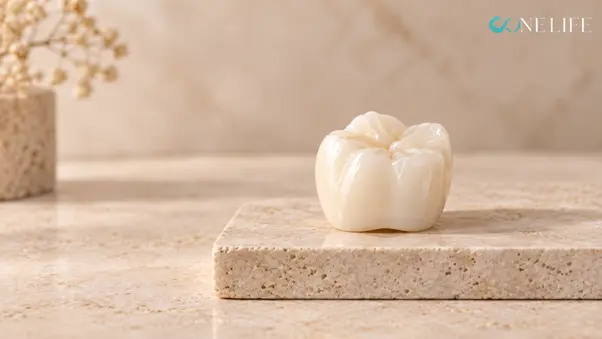
Monolithic zirconia crowns combine a ceramic hardware with a design that avoids porcelain covering. The condition of your teeth, their position and your bite all matter when choosing this option; all of these will be carefully assessed by your dentist.
This guide explains how monolithic zirconia crowns are made, when they are suitable, their limitations, and practical advice for long-term care.
What are monolithic zirconia crowns?
A monolithic zirconia crown is a full-coverage tooth cap whose main body is made from zirconia ceramic. Its basic goa lis to restore the shape and chewing surface of a damaged tooth. A thin coating or glaze can be added to refine its appearance, yet monolithic zirconia comes without a separate porcelain veneering layer.
Monolithic vs multilayer zirconia
A porcelain-layered zirconia crown has a different construction: porcelain is added over a zirconia framework to create some or all of the visible surface. Our separate comparison article explores the two designs in more detail.
When is a monolithic zirconia crown recommended?
Dentists consider crowns for teeth with extensive damage, large filling, or a fracture that can be restored. A crown may also form the visible replacement tooth over a dental implant. Before discussing zirconia, the dentist needs to establish whether a full crown is appropriate. Healthy teeth do not need crowns simply to improve their color.
Back teeth and chewing demands
Molars and premolars are common locations for monolithic zirconia crowns. These teeth carry heavy chewing loads, making the strength of monolithic zirconia an important consideration.
Front teeth and smile appearance
Monolithic zirconia can also be considered for visible teeth, even though monolithic zirconia is usually considered less natural-looking than layered zirconia crowns.
The monolithic zirconia crown procedure
Your dentist should explain the plan and any additional treatment before starting. Here is the usual protocol, such as it is performed by One Life Dental’s doctors.
1. Examination and treatment planning
The dentist assesses the tooth, gums, existing restorations, and bite. Relevant imaging helps establish whether the tooth can be restored and whether another problem needs treatment first.
As a patient, you should use this appointment to discuss appearance, previous crown experiences, and any concerns about grinding or clenching.
2. Tooth preparation and records
When treatment proceeds, the tooth is shaped to provide space for the crown. The dental team records the prepared tooth and neighboring teeth with an impression or digital scan. Shade records and information about how the teeth meet help guide the design.
3. Crown design and manufacture
The crown is designed digitally and milled from a zirconia block. Depending on the system, further processing includes sintering, followed by finishing and characterization. A temporary restoration may be used while the definitive crown is being made.
4. Try-in and placement
Before final placement, the dentist checks the crown’s seating, contacts, appearance, and bite. Cementation follows the clinical requirements and the material’s instructions.
Benefits of monolithic zirconia crowns
A major advantage is the absence of a separate porcelain veneering. That removes the problem of porcelain chipping away. It also allows the dental team to adapt the crown to the smile.
Overall, the main advantages are:
- Strongest configuration
- No separate porcelain veneer to chip
- Potential to preserve tooth structure
- Customizable appearance
Limitations and Risks
Before proceeding with monolithic zirconia crowns, discuss the following with your dentist.
Appearance | The zirconia and underlying tooth can affect the final result. |
Tooth preparation | Full coverage involves removing tooth structure. |
Crown retention | The crown can loosen even if the ceramic remains intact. |
Tooth health | The supporting tooth can develop biological complications. |
Surface condition | Bite adjustments should be followed by appropriate finishing. |
How long do monolithic zirconia crowns last?
There is no guaranteed lifespan. Longevity depends on the quality of the zirconia, supporting tooth, oral health, and forces acting on the crown. However, overall, zirconia crowns in general show amazing survival qualities, with most studies pointing at 98% survival at five years.
Caring for a monolithic zirconia crown
Care should focus on the whole restored tooth, including the gum line and the spaces beside it.
Brush twice daily for two minutes with fluoride toothpaste and clean between your teeth every day. Floss or another suitable interdental tool helps remove plaque from areas a toothbrush cannot fully reach. Ask your dentist which method suits your crown and neighboring teeth.
Keep the review schedule recommended for your oral health. These appointments provide an opportunity to discuss changes in comfort, cleaning, and chewing.
Do not test a crown’s strength by biting hard objects or using your teeth to open packaging. If you grind or clench, ask whether a protective appliance is appropriate for your situation.
Contact the dental team if the crown feels loose, develops a sharp edge, or causes persistent discomfort.
Are all monolithic zirconia crowns the same?
No. “Monolithic” describes the crown’s construction, rather than a single standardized material.
Dental zirconia formulations differ in their composition and optical properties. Some emphasize mechanical performance; others allow more light through to improve appearance. Increasing translucency can involve a trade-off in mechanical properties, so a more translucent product is not automatically the best option for every tooth.
Dentists and technicians must also consider the manufacturer’s indications and required material thickness. This is why one universal strength figure or preparation measurement can be misleading.
FAQs
Are monolithic zirconia crowns suitable for molars?
They are commonly considered for molars because mechanical performance matters in these areas. The dentist still needs to assess the remaining tooth, bite, space, and selected zirconia system before recommending treatment.
Can a monolithic zirconia crown look natural?
Yes, a natural-looking result is possible. It depends on the material’s optical properties, shade, shape, finishing, and the surrounding teeth. Discuss appearance carefully when restoring a prominent front tooth.
Can monolithic zirconia crowns break?
Yes. Their construction avoids a separate porcelain veneer, but it does not eliminate all damage or complications. Crown design, material selection, and the condition of the supporting tooth remain important.
Do I need a root canal before getting one?
A crown does not automatically mean a root canal is required. The need for root canal treatment depends on the tooth’s pulp and diagnosis. Ask your dentist to explain the reason if both procedures are proposed.
Can I get a monolithic zirconia crown in one visit?
Some practices have workflows that can provide a crown in one visit. Others use a laboratory and multiple appointments. Confirm the actual schedule with your dentist, including any treatment needed before crown placement.
Are monolithic zirconia crowns permanent?
They are intended as long-term restorations, but they are not guaranteed to last forever. The crown or supporting tooth may eventually need further treatment, so ongoing care and reviews remain important.
References
- https://www.mouthhealthy.org/all-topics-a-z/crowns American Dental Association, MouthHealthy
- https://pubmed.ncbi.nlm.nih.gov/31577743/ Medicine, 2019.
- https://pubmed.ncbi.nlm.nih.gov/33581910/ Dental Materials, 2021.
- https://pubmed.ncbi.nlm.nih.gov/37626273/ Clinical Oral Investigations, 2023.
- https://pmc.ncbi.nlm.nih.gov/articles/PMC6784470/ Dentistry Journal, 2019.
- https://pubmed.ncbi.nlm.nih.gov/39221297/ Cureus, 2024.
- https://pubmed.ncbi.nlm.nih.gov/33041280/ Journal of Prosthodontic Research, 2021.
- https://www.mouthhealthy.org/all-topics-a-z/flossing American Dental Association, MouthHealthy.