
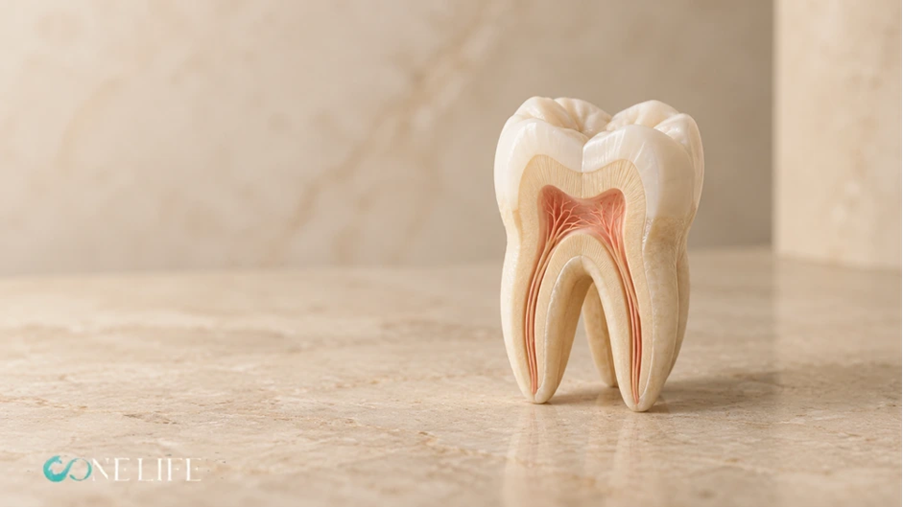
Root canal treatment removes inflamed, infected, or dead pulp from inside a tooth. The internal canals are then cleaned, disinfected, filled, and sealed to reduce the risk of reinfection. Modern anesthesia means the procedure itself is entirely painless.
What is root canal treatment?
Every tooth has several layers. Enamel forms the outer surface, while dentin lies underneath it. At the center is the dental pulp. The pulp extends into the roots, through narrow passages known as root canals.
When the pulp becomes irreversibly inflamed, infected, or dead, root canal treatment may be performed to:
- Remove the affected pulp
- Reduce bacteria inside the tooth
- Clean and shape the root canals
- Preserve the natural tooth structure
- Prepare the tooth for a protective final restoration
Why is root canal treatment necessary?
Pulp inflammation can sometimes be reversible when the cause is treated early. Once the pulp becomes irreversibly inflamed or infected, however, it cannot recover by itself.
Without appropriate treatment, bacteria may travel through the root canals and reach the surrounding bone. This can result in a dental abscess, swelling, bone loss, or eventual tooth loss.
Common reasons for needing root canal treatment include:
- Deep tooth decay
- A cracked, chipped, or fractured tooth
- A damaged or leaking restoration
- Repeated procedures on the same tooth
- Trauma, even when no visible crack is present
- Severe wear that exposes deeper tooth tissue
- Infection around the end of the tooth’s root
Symptoms that require assessment
An inflamed or infected pulp does not produce exactly the same symptoms in every patient. Some teeth become extremely painful, while others cause little discomfort.
Possible warning signs include:
- Persistent or spontaneous toothache
- Pain that interrupts sleep
- Lingering sensitivity after consuming something hot or cold
- Pain when biting or chewing
- Tenderness when the tooth is touched
- Swelling around the tooth, gum, face, or jaw
- A pimple-like bump on the gum
- Darkening or discoloration of a tooth
- A visibly cracked, broken, or deeply decayed tooth
- An unpleasant taste caused by drainage
How do dentists diagnose pulp damage?
Before recommending root canal treatment, a dentist examines the affected tooth and evaluates whether it can be restored. An X-ray alone cannot determine every pulpal condition. The final diagnosis is based on symptoms, clinical examination, sensibility tests, and imaging together.
The assessment may include:
- Discussing when the pain started and how long it lasts
- Examining the tooth for decay, cracks, trauma, or previous restorations
- Checking the surrounding gum for swelling or drainage
- Applying cold to assess response
- Gently tapping the tooth
- Testing whether biting causes pain
- Taking dental X-rays
Root canal treatment step by step
The details of a root canal procedure vary according to the tooth, the number and shape of its canals, the severity of infection, and whether it has been treated previously.
1. Treatment Planning
Dental images help the clinician evaluate the roots and surrounding bone. Front teeth commonly have simpler internal anatomy, while premolars and molars may contain several narrow, curved, or branching canals.
Straightforward cases may be treated by a general dentist. Teeth with complex anatomy, previous root canal treatment, difficult-to-locate canals, or persistent infection may be referred to an endodontist.
2. Local Anesthesia
Local anesthesia is administered to numb the tooth and nearby tissues. It may still be used when the pulp is no longer vital because the tissues surrounding the root remain sensitive.
The patient is normally awake throughout the procedure. Anxiety-management options may be considered according to individual needs and the services available.
3. Dental-Dam Isolation
A thin protective sheet called a rubber dam or dental dam is placed around the tooth. Dental-dam isolation is an important part of infection control during endodontic treatment.
This barrier:
- Keeps saliva away from the treatment area
- Helps prevent oral bacteria from entering the open tooth
- Protects the mouth from small instruments and cleaning solutions
- Allows the clinician to work in a clean, dry environment
4. Creating the Access Opening
The dentist creates a small opening through the biting surface or back of the tooth to reach the pulp chamber and canal entrances.
Its position and size must provide sufficient access for cleaning while preserving as much useful tooth structure as possible.
5. Removing the Damaged Pulp
Fine endodontic instruments are used to remove inflamed, infected, or dead pulp tissue from the central chamber and canals.
A tooth’s internal system is not always a collection of straight, identical tubes. Canals may curve, divide, merge, or contain small branches. Identifying and treating this anatomy is one of the most technically demanding parts of the procedure.
6. Cleaning and Shaping the Canals
The canals are gradually shaped with specialized instruments. Irrigating solutions help remove tissue remnants, bacteria, and debris that instruments alone cannot eliminate.
The clinician also measures the working length of each canal. Cleaning must extend sufficiently close to the root end without unnecessarily damaging the surrounding tissues.
7. Filling and Sealing the Root Canals
After the canals have been cleaned, they are dried and filled. A biocompatible, rubber-like material called gutta-percha is commonly used together with a dental sealer.
The purpose is to fill the prepared canal space and create a barrier against bacterial re-entry. The opening in the tooth is then closed with a temporary or permanent restorative material.
8. Completing the Final Restoration
Removing the pulp addresses the internal disease, but it does not completely restore the tooth’s strength or function.
Depending on the condition and position of the tooth, the final restoration may be:
- A bonded filling
- An inlay or onlay
- A dental crown
- Another restoration selected for the remaining tooth structure
Can a root canal be completed in one appointment?
Some root canal procedures can be completed in one visit, while others require two or more appointments. Requiring more than one appointment does not necessarily indicate a complication. Appointments commonly last approximately 60 to 90 minutes but may be shorter or longer depending on complexity.
Additional visits may be appropriate when:
- The tooth has multiple or unusually curved canals
- A substantial infection is present
- The canals are difficult to locate or clean
- Drainage or symptoms require monitoring
- Previous root canal material must be removed
- A temporary medication is placed inside the tooth
- The final restoration is completed separately
Does root canal treatment hurt?
With effective local anesthesia, patients should not experience sharp pain during treatment. Pressure, movement, vibration, or the sensation of instruments being used may still be noticeable.
A severely inflamed tooth can sometimes be more difficult to numb. Patients should tell the clinician immediately if they experience pain so that anesthesia can be reassessed or supplemented.
What to expect after root canal treatment
The mouth may remain numb for several hours. Eating should generally be postponed until sensation returns to reduce the risk of accidentally biting the lip, cheek, or tongue. These sensations should gradually improve. Many patients can return to work or their normal routine the same day or the following day.
During the first few days, the treated area may feel:
- Mildly tender when biting
- Sensitive around the gum
- Different from neighboring teeth
- Sore because the mouth remained open during treatment
Root canal aftercare
Good aftercare protects the tooth while the surrounding tissues recover and the final restoration is completed.
Immediately after treatment
- Wait for the numbness to wear off before eating.
- Follow the dentist’s instructions for managing discomfort.
- Avoid very hard or sticky foods.
- Chew on the opposite side if the tooth has a temporary restoration.
- Do not use the treated tooth to bite ice, packaging, pens, or other hard objects.
During long-term care
- Brush twice daily with fluoride toothpaste.
- Clean between the teeth every day.
- Attend all follow-up and restorative appointments.
- Have the final filling, onlay, or crown placed as advised.
- Attend regular dental examinations.
- Address teeth grinding or clenching if recommended.
- Avoid smoking because it can negatively affect oral health and healing.
Are antibiotics needed after a root canal?
Antibiotics are not required after every root canal procedure. A dentist may consider them when an infection is spreading or when systemic signs are present, such as fever, malaise, or certain patterns of facial swelling. The patient’s medical history also influences the decision.
Patients should only use antibiotics prescribed for their current condition and follow the instructions provided.
Risks and possible complications
Root canal treatment is a well-established procedure, but every dental intervention has limitations and possible complications.
Possible complication | What it may involve |
Persistent infection | Bacteria may remain in complex areas of the canal system |
Missed canal | An additional canal may not be identified during initial treatment |
Instrument separation | A fine instrument may fracture inside a narrow or curved canal |
Perforation | An unintended opening may develop between the canal and surrounding tissues |
Leakage | Bacteria may re-enter through a damaged or poorly sealed restoration |
Tooth fracture | A structurally weakened tooth may crack under pressure |
Discoloration | The treated tooth may gradually appear darker |
Recurrent decay | A new cavity may develop around the restoration |
Return of symptoms | Inflammation or infection may recur months or years later |
What is root canal retreatment?
During root canal retreatment, the clinician reopens the tooth and removes the previous filling materials. The canals are then reassessed, cleaned, disinfected, refilled, and resealed.
Possible causes include:
- Complicated anatomy that was not detected initially
- A canal that could not be fully treated
- Delayed placement of the final restoration
- Leakage beneath a filling or crown
- New tooth decay
- A fractured tooth or restoration
Root canal treatment or tooth extraction?
Extraction may be more appropriate when a tooth has a severe fracture or lacks periodontal support. Root canal treatment is intended to preserve the natural tooth, while extraction removes it completely.
Root canal treatment | Tooth extraction |
Preserves the natural root and tooth structure | Removes the entire tooth |
Maintains the tooth’s position | Leaves a space after healing |
Requires a suitable final restoration | May require later tooth replacement |
May preserve natural chewing function | Replacement may involve an implant, bridge, or denture |
Requires the tooth to be restorable | May be necessary when restoration is not predictable |
How long does a root canal-treated tooth last?
A properly treated and restored tooth can remain functional for many years and potentially for life. However, no treatment has identical results for every patient. The tooth can still develop decay, gum disease, restoration problems, or fractures, so continued care is essential.
Long-term survival depends on:
- The original condition of the tooth
- Complexity of the root canal anatomy
- Quality of cleaning and sealing
- Amount of healthy structure remaining
- Quality and timing of the final restoration
- Gum and supporting bone health
- Oral hygiene
- New decay
- Grinding or clenching
- Regular dental monitoring
Can root canal treatment be prevented?
Not every case is preventable. Dental trauma and hidden cracks, for example, may damage the pulp unexpectedly. Nevertheless, preventive care can reduce the risk of deep decay and avoidable infection.
Early problems often require less extensive treatment. Persistent pain, swelling, dental trauma, or a cracked tooth should therefore be evaluated promptly.
Helpful measures include:
- Brushing twice a day with fluoride toothpaste
- Cleaning between the teeth daily
- Limiting frequent sugary snacks and drinks
- Treating cavities before they become deeper
- Replacing leaking or damaged restorations
- Wearing a mouthguard during contact sports
- Seeking dental assessment after an injury
- Using a night guard if prescribed for bruxism
- Attending regular dental examinations
FAQs
Is root canal treatment the same as removing the tooth’s nerve?
Not exactly. The procedure removes the affected dental pulp, which contains nerves, blood vessels, and connective tissue. The exterior of the tooth and its roots remain in the mouth.
Can an infected tooth heal without root canal treatment?
Once the pulp becomes irreversibly inflamed, infected, or dead, it does not predictably heal by itself. Root canal treatment or extraction may be required, depending on whether the tooth can be restored.
Can a root canal be completed in one visit?
Yes. Some cases can be completed in one appointment, while complex anatomy, significant infection, previous treatment, or restorative needs may require additional visits.
Will I always need a crown after root canal treatment?
No. The final restoration depends on the tooth’s position and remaining structure. Back teeth frequently need cuspal protection, while some front teeth may be restored differently. The dentist must evaluate each tooth individually.
Why does my tooth hurt when I bite after a root canal?
Temporary inflammation around the root can cause tenderness after treatment. The bite may also need adjustment if the restoration contacts too heavily. Persistent or worsening pain should be evaluated.
Can a root canal-treated tooth become infected again?
Yes, although this is not expected in every case. Reinfection may result from untreated anatomy, new decay, restoration leakage, or fracture. Retreatment or endodontic surgery may sometimes preserve the tooth.
Can I drive after root canal treatment?
Most patients can drive after treatment performed with local anesthesia alone. If sedative medication was used, driving may not be safe, and the patient should follow the clinic’s specific instructions.
Preserve Your Natural Tooth With Timely Care
Root canal treatment can eliminate infection from inside a tooth while preserving its natural position, appearance, and chewing function. Diagnosis, careful canal cleaning, and an appropriate final restoration all contribute to the long-term result.
If you have persistent tooth pain, swelling, or sensitivity, contact the clinic for an individual assessment. Timely diagnosis may provide more opportunities to preserve the natural tooth.
References
- American Association of Endodontists. “What Is a Root Canal?”
https://www.aae.org/patients/root-canal-treatment/what-is-a-root-canal/ - National Health Service. “Root Canal Treatment.” NHS.
https://www.nhs.uk/tests-and-treatments/root-canal-treatment/ - Cleveland Clinic. “Root Canal: Procedure and Recovery.”
https://my.clevelandclinic.org/health/treatments/21759-root-canal