
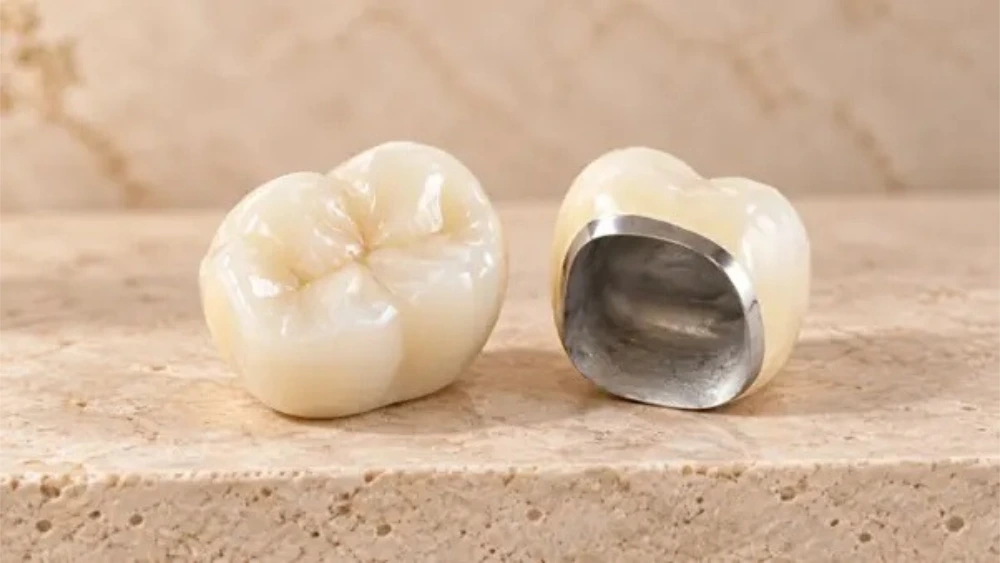
A porcelain-fused-to-metal (PFM) crown combines a metal core with a porcelain outer layer. Often called a PFM crown or metal-ceramic crown, it has been used for decades to restore damaged teeth. While modern alternatives such as emax crowns or zirconia crowns represent compelling alternatives, the clinical history of PFM crowns make them suitable for selected cases.
A PFM crown is a custom-made cap that covers the visible part of a tooth. Its inner metal shell (known as a coping), fits over the remaining tooth structure. Porcelain covers the framework to recreate the tooth’s shape and colour. PFM crowns can be used on front and back teeth.
PFM crowns consist of two compatible components: a dental metal alloy and a ceramic designed to bond to it during laboratory firing.
An alloy is a mixture of metals chosen to provide suitable strength, corrosion resistance and processing characteristics. Patients with a known metal allergy should ask which specific alloy is proposed.
Common PFM alloy families include:
Alloy type | Possible composition | Main consideration |
High noble | Gold with platinum-group metals and other alloying elements | At least 60% noble metals overall, including at least 40% gold by weight of the whole alloy. |
Noble | Palladium-based or other noble-metal combinations | At least 25% noble metals overall. No minimum gold content is required. |
Predominantly base metal | Cobalt-chromium or nickel-chromium formulations | Contains less than 25% noble metals; exact composition requires confirmation |
PFM crowns achieve their natural look through porcelain layering. A first, opaque layer masks the metal. Further porcelain layers provide the main tooth shade and surface detail.
“Porcelain bonded to metal crown” is another term for the same type of restoration. Laboratory technique, framework support and ceramic thickness influence the finished restoration.
Zirconia and emax are themselves ceramics, just like porcelain. In everyday comparisons, “all-ceramic crown” may refer to any of them, so the exact material should be specified.
PFM is not automatically stronger or longer-lasting than every ceramic alternative. Older comparative studies also reflect the materials and designs used in the past.
Crown type | Construction | Main consideration |
PFM | Porcelain over a metal framework | Established clinical use; porcelain chipping and visible metal margins are possible |
Monolithic zirconia | Main crown body made from zirconia | Avoids a full porcelain veneer layer; appearance and strength vary by formulation |
Layered zirconia | Zirconia framework with veneering ceramic | Allows ceramic layering for appearance, but the veneer can chip |
Lithium disilicate, including e.max | Glass-ceramic, used in monolithic or layered designs | Offers favourable optical properties; suitability depends on loading and preparation |
Full gold alloy | Metal alloy without porcelain covering | Avoids porcelain chipping but remains visibly metallic |
A PFM crown may be considered when a tooth needs full coverage and a tooth-coloured outer surface is preferred. For front teeth, the dentist also considers the smile line, gum thickness and neighbouring teeth.
Common reasons for crown treatment include:
Below, we specify how the PFM crowns procedure unfolds step by step, just as the operation is performed by One Life Dental’s recommended dentists.
The dentist assesses the tooth, gums and bite, with radiographs where indicated. Decay and failing restorations are addressed, and the remaining structure is evaluated.
The tooth is shaped under local anaesthetic where required. Enough space must be created for the planned materials while preserving sound tissue.
An impression or digital scan records the prepared tooth and its relationship with neighbouring and opposing teeth. The laboratory uses this information to fabricate the restoration.
A temporary crown protects the tooth between appointments. It needs care because it is less durable and less securely retained than the definitive crown.
The dentist checks the crown’s fit, contacts, appearance and bite before cementation. Some cases require a separate framework or porcelain try-in.
After fitting, continuing pain or a bite that feels too high should be reviewed. Root canal treatment is not a routine requirement for receiving a PFM crown, although a tooth with an inflamed or infected pulp may need it.
In the UK, the cost of a Porcelain-Fused-to-Metal (PFM) crown varies from £332.10 to £1,200 per tooth, depending on treatment through the NHS or a private clinic:
NHS care is significantly cheaper, but getting a PFM crown under public healthcare comes with specific conditions:
Feature | NHS Care | Private Care |
Cost | Fixed at £332.10 (Band 3) | £400 – £800+ per tooth |
Material Selection | The dentist decides the material based strictly on clinical need. Tooth-colored PFM crowns are standard for visible front teeth, but you may be restricted to full metal crowns for back molars. | Complete freedom to choose PFM, all-ceramic (Emax), or zirconia anywhere in the mouth. |
Availability | Long waiting times; severe shortages make finding an open NHS spot very difficult. | Faster turnaround; appointments are usually available within days. |
The baseline price of the crown might not represent your total out-of-pocket cost if you go private. Make sure to ask if your quote includes:
Some PFM crowns have a metal collar at the edge. If this margin is visible, it may appear as a grey or dark line. Gum recession can reveal an edge that was previously hidden.
Margin design requires appropriate preparation and laboratory fabrication. Placing a crown edge deeper beneath the gum solely to conceal metal is not a universal solution. The dentist must also consider tissue health and access for cleaning. A stable dark line may be an aesthetic concern rather than a structural failure, whereas bleeding, pain or a loose crown warrants assessment.
Dental alloys are widely used, but reactions to their components can occur. Nickel is a recognised contact allergen, and reactions to other dental metals have also been reported.
A nickel-free alloy may be appropriate for some patients, while a metal-free ceramic may suit others. Persistent gum soreness around a crown also has other possible causes, including plaque, poor contour or margin problems. Examination is needed before attributing symptoms to allergy.
A porcelain-fused-to-metal crown can function for many years, and some remain in service for decades. Survival also differs from complication-free success. A crown may remain in place after a minor repair or other treatment.
Factors affecting longevity include decay risk, gum health, remaining tooth structure, bite forces and the quality of fit. An old but sound crown does not need replacement simply because a newer material is available.
A chip does not always mean the entire crown must be replaced. A small defect may be smoothed and polished. The dentist considers the size and position of the chip, whether metal is exposed, the condition of the margins and the forces acting on the repair. Repair materials also need different surface treatments depending on the exposed substrate.
Brush twice daily with fluoride toothpaste and clean between the teeth every day. The crown cannot develop a cavity, but the natural tooth at its margin can.
Limit frequent sugary snacks and drinks, and attend dental reviews at intervals suited to your needs. A dentist can monitor the margins, gum health and bite before a problem becomes obvious.
If you grind or clench, a dentist may recommend a protective splint. Avoid using teeth to open packaging or bite hard objects. Seek assessment for a loose crown, sharp chip, persistent food trapping or continuing discomfort.
A PFM crown remains a valid option when its construction suits the tooth and the patient’s priorities. The decision should account for the alloy, available space, appearance, bite and condition of the supporting tissues.
Book a dental consultation to compare suitable crown materials and discuss a treatment plan based on your tooth’s needs.
A PFM crown is a definitive restoration, unlike the temporary crown used between appointments. “Permanent” does not mean lifelong: it may eventually need repair or replacement.
No. Nickel-chromium is one alloy option, but cobalt-chromium and noble-metal alloys are also used. Confirm the exact composition if you have a known sensitivity.
It can be, but the dentist must assess the smile line, gum tissues and appearance of adjacent teeth. A metal-free option may offer advantages where translucency or a visible margin is a major concern.
Teeth-whitening treatments do not change the underlying shade of dental porcelain. If whitening is planned, discuss the sequence before the crown’s shade is selected.
Not solely because it contains metal. Replacement may be considered for decay, damage, poor fit or an aesthetic concern, but removing a crown has risks for the supporting tooth.
WhatsApp us