
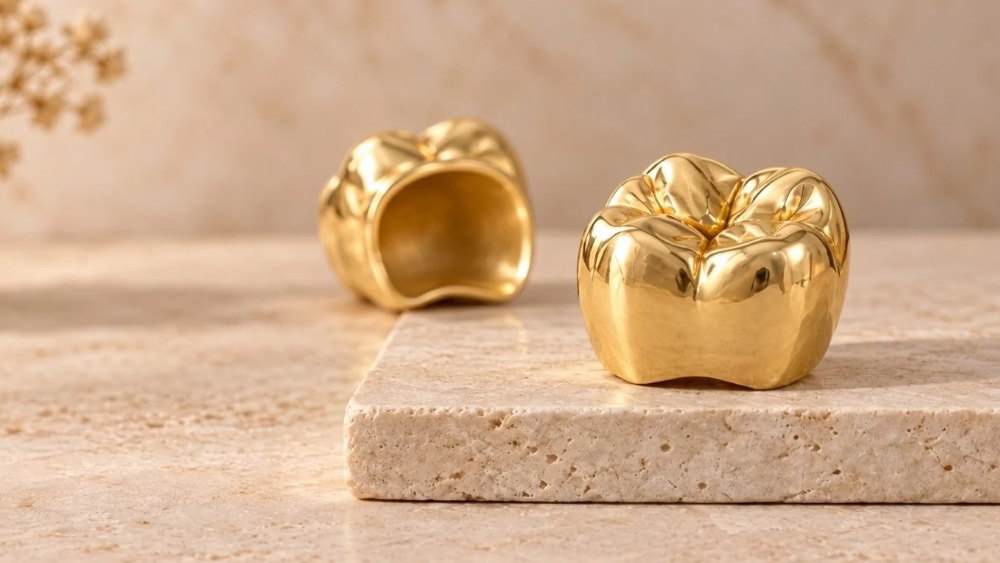
Gold tooth crowns are among the best restorations for durability and resistance to fracture. They are certainly a peculiar choice, now that tooth-coloured materials such as zirconia crowns and emax crowns are available. Yet, for back teeth, where chewing function is take priority over matching the natural tooth colour, they are the most resistant contender. Below, we reveal all about gold teeth caps!
A gold tooth crown, or gold dental cap, is a dental restoration that covers the visible part of a shaved tooth. It replaces missing tooth structure and restores the tooth’s shape and biting surface.
Gold crowns are most often considered for molars and sometimes premolars. Their metallic appearance is generally less noticeable in these positions than at the front of the mouth.
A dental gold crown is an alloy: gold combined with other metals to achieve properties suitable for chewing. Pure gold is too soft for a conventional tooth crown. A dental gold alloy may contain silver, copper, platinum or palladium. These additions influence strength, hardness and handling.
There is no single gold percentage used in every crown.
Term | What it means |
Gold alloy crown | A crown made from a dental alloy containing gold; the precise composition varies |
High noble alloy | At least 60% noble metals overall, including at least 40% gold by weight of the whole alloy. Example: 40% gold + 20% palladium + 40% other metals. |
Noble alloy | At least 25% noble metals overall, such as gold, platinum or palladium. No minimum gold content is required. |
Gold-coloured crown | A description of appearance that does not establish the alloy’s gold content |
The term “full gold crown” describes an all-metal restoration without a porcelain covering; it does not mean 100% gold. A high noble alloy is not pure gold, and the broader category of metal crowns includes alloys that contain no gold at all.
Patients with a metal allergy should ask about the exact composition rather than relying on the crown’s colour.
Treatment usually involves a preparation visit followed by a fitting visit, with laboratory fabrication between them.
The dentist examines the tooth and its supporting tissues, assesses the bite and takes radiographs where indicated. Existing decay, cracks or a failing restoration may affect whether the tooth can be predictably restored.
Before preparation, the dentist and patient agree on the crown material, taking account of any metal allergy and whether the restoration will show.
The tooth is shaped to receive the crown, usually with local anaesthetic. An impression or digital scan records the preparation and the relationship with the opposing teeth.
A temporary crown protects the prepared tooth while the definitive restoration is made.
At the fitting visit, the dentist removes the temporary crown and checks the new restoration’s seating, margins, contacts and bite. The crown is cemented once the fit is satisfactory.
An uncomfortable bite, continuing pain or unexpected sensitivity should be reviewed rather than assumed to be a normal adjustment.
A gold tooth crown costs between £600 and £1,500 privately in the UK, between $800 and £2,500 per tooth in the US and 150€ to 350€ in Turkey.
Gold crowns can remain functional for several decades. A study of 72 posterior gold restorations reported 98.6% survival at nine years. Some restorations required repair, so consider that “survival” does not necessarily mean remaining completely free from complications.
Choosing the right dental crown material often comes down to balancing durability, aesthetics, and cost. While gold crowns are renowned for their unmatched strength and longevity, modern alternatives like porcelain, zirconia, and porcelain-fused-to-metal (PFM) offer varying blends of natural appearance and resilience.
Crown type | Appearance | Main consideration |
Full gold alloy | Metallic | An established option when visible metal is acceptable |
Tooth-coloured porcelain over metal | Combines a metal framework with porcelain; the covering can chip | |
Lithium disilicate, including suitable e.max crowns | Tooth-coloured, with translucency | Useful where appearance matters; suitability depends on preparation and loading |
Tooth-coloured, with properties varying by formulation | Offers strong ceramic options; design and surface finishing matter |
Brush twice daily with fluoride toothpaste and clean between the teeth each day using floss or appropriately sized interdental brushes. Pay attention to the gumline and the contact areas beside the crown.
Limiting frequent sugary snacks and drinks helps reduce decay risk. Regular dental reviews allow the dentist to assess the crown margin, surrounding tissues and any changes in the bite.
If you grind or clench, your dentist may recommend a mouthguard or splint to help protect the teeth. A gold crown does not replace this management.
Avoid using teeth to open packaging or biting deliberately on hard objects. Arrange an assessment if the crown moves, food repeatedly catches beside it, or the surrounding gum becomes persistently sore.
A gold crown may be considered for a heavily restored back tooth when a full-coverage restoration is appropriate and the patient accepts a metallic appearance.
Gold may also be discussed when biting forces are strong. However, teeth grinding or clenching (bruxism), needs its own assessment. Changing the crown material does not remove the forces affecting the tooth, surrounding tissues or other restorations.
Known for their exceptional durability and biocompatibility, gold dental crowns offer unique benefits that newer materials struggle to match.
A full-cast gold crown has no outer porcelain layer to chip away. Its metal structure can withstand chewing forces without the brittle fracture behaviour associated with ceramics.
This does not make it indestructible. Metal can wear, a crown can loosen, and the supporting tooth can develop problems even when the restoration remains intact.
All-metal crowns can be made in relatively thin sections. In suitable cases, this allows a dentist to preserve more tooth structure than a design requiring space for both a metal framework and porcelain.
The amount removed is not fixed: existing damage, tooth shape and the required biting clearance all affect preparation.
Certain dental gold alloys have favourable wear behaviour against natural teeth. Laboratory research has found enamel-like wear rates for a soft gold alloy under specific test conditions.
That finding should not be interpreted as a promise of zero wear. Alloy composition, surface finish, opposing materials and grinding habits all influence what happens in the mouth. Likewise, ceramic crowns should not be treated as a single category: their behaviour varies with the material and its polishing.
Gold restorations have been followed for decades in clinical studies. This provides useful evidence about their performance over time, including the complications that can eventually lead to replacement.
For patients comfortable with visible metal, that established history can be a reason to consider gold alongside tooth-coloured options.
The clearest drawback of a gold dental cap is appearance. It will look different from the surrounding teeth.
Other limitations include:
A gold crown that comes off does not always need to be replaced. If the restoration is undamaged, still fits accurately and the supporting tooth is sound, a dentist may be able to clean and recement it. The first step is to establish why it loosened, since loss of cement, tooth decay and a fracture require different treatment.
Reusing the crown becomes more difficult if the tooth underneath needs substantial repair. Removing decay or rebuilding a broken area can change the tooth’s shape, leaving the existing crown unable to fit securely. In that situation, a new restoration may be needed even when the gold itself remains intact. The decision depends on the condition of both the crown and the tooth, rather than the value of the metal alone.
If a gold crown falls out, keep it in a clean container and take it to the dental appointment. Avoid chewing on the exposed tooth, and do not use household glue to reattach the crown. Arrange a dental assessment promptly, even if there is no pain, so the dentist can assess whether recementation or replacement is appropriate.
They contain real gold when made from a gold-containing dental alloy. They are not normally made from pure gold, because other metals are needed to provide suitable mechanical properties. The gold percentage varies between alloys.
Yes. Gold remains an option for selected restorations, particularly on back teeth where a metallic appearance is acceptable. Whether it is appropriate depends on the tooth, bite, available materials and the patient’s preferences.
Yes. The crown cannot decay, but the natural tooth can develop decay at its edge and beneath it. Good cleaning and dental reviews remain necessary even when the metal surface looks unchanged.
Not automatically. A tooth can receive a crown while retaining its living pulp. Root canal treatment is considered when the condition of the pulp requires it, rather than simply because gold is the chosen crown material.
A sound gold crown does not need replacement solely because it is old or metallic. Replacement may be considered for decay, poor fit, damage or an aesthetic concern, but the dentist should assess the risks of removing it and preparing the tooth again. If you are considering a tooth-coloured replacement, compare monolithic zirconia crowns and layered zirconia crowns.
WhatsApp us