
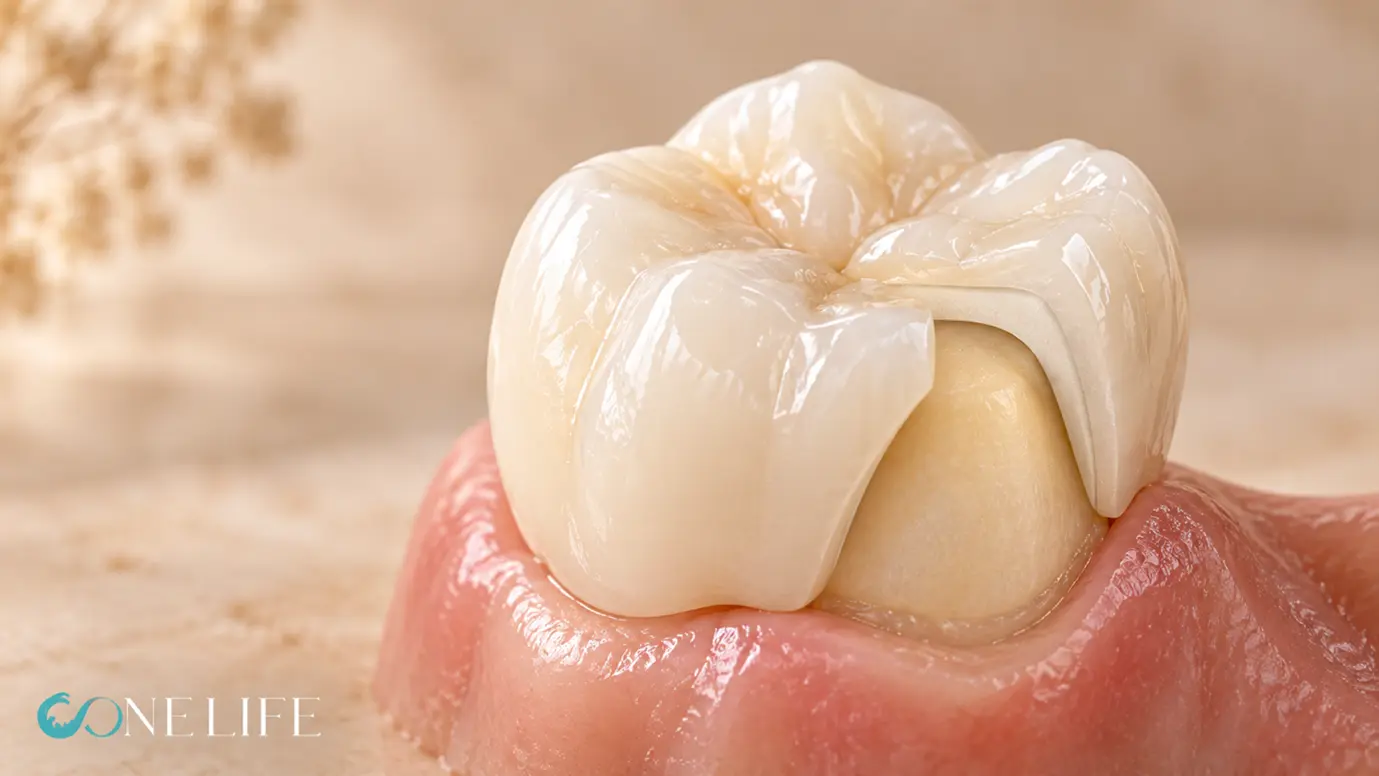
Layered zirconia is often chosen by dentists when a tooth requires a crown and appearance matters greatly; for example, for front teeth. They combine a zirconia core with an outer porcelain coating. This design has its uses and limitations. Below, we will give all important details you need to know before choosing this popular option.
What is layered zirconia?
Layered zirconia is a ceramic restoration made by applying veneering porcelain over a zirconia core. “Veneering porcelain” does not mean it’s a dental veneer. We are talking about a layered zirconia crown.
The central feature is the combination of two ceramics:
- The zirconia supplies the core strength
- The porcelain creates the natural-looking surface
Why add porcelain over a zirconia core?
Porcelain layering allows to build up visual characteristics akin to a natural tooth. After all, natural teeth are also layered and this affects how they reflect light.
1. Variations within a natural tooth
Natural teeth are not uniformly colored. The area near the gum line, the central body, and the biting edge can look different. A layered design gives the technician scope to reproduce these variations through the arrangement of the porcelain.
2. Balancing translucency and coverage
Translucency describes how light passes through a material. It contributes to visual depth, but it can also allow the underlying background to influence the result. Porcelain thickness and background shade affected the final color match.
When is a layered zirconia crown the best option?
Layered zirconia is usually the best option when the restoration is visible and appearance is a treatment priority. In other words, it is usually chosen for front, incision teeth. However, appearance must be considered alongside the bite, remaining tooth structure, and available space.
Full layering vs partial layering
Not every layered zirconia restoration has porcelain on every external surface. In a fully veneered design, porcelain covers much of the crown. In a partially layered design, it is concentrated on selected areas.
These are design choices. Partial layering still includes porcelain and therefore does not eliminate porcelain-related complications.
Is layered zirconia the same as multilayer zirconia?
No. “Layered zirconia” is porcelain added over a zirconia crown. “Multilayer zirconia” can describe variations in shade, translucency, or composition within the zirconia itself.
Our guide to monolithic versus layered zirconia discusses the comparison separately; here, the focus is on understanding the porcelain-covered option.
How a layered zirconia crown is made
The distinctive part of this treatment is the coordination between the clinical records, framework design, and porcelain build-up.
1. Recording the tooth and appearance
The dentist records the prepared tooth, nearby teeth, and bite with an impression or digital scan. Shade information helps communicate the intended appearance to the laboratory.
2. Designing the framework
The zirconia framework is commonly designed digitally, milled, and processed according to the material’s instructions. Its shape must provide support for the planned porcelain covering.
3. Building and firing the porcelain
In conventional layering, the technician applies compatible porcelain and fires it in a ceramic furnace. This stage develops the outer form and appearance. Processing matters as well as artistic skill. Cooling rate and porcelain thickness can influence cracks in porcelain-zirconia structures.
4. Checking the completed crown
At the fitting appointment, discuss appearance, comfort, and any concerns. Ask whether you can see the crown in your smile rather than judge it only in isolation.
Benefits and limitations of layered zirconia crowns
Layered zirconia crowns offer a method of customizing a ceramic restoration, but it also introduces a porcelain surface that requires careful planning.
Feature | What to discuss with your dentist |
Porcelain customization | Which visible details are important to reproduce? |
Zirconia framework | How will the framework support the porcelain? |
Background color | Could the prepared tooth or existing foundation affect the shade? |
Full or partial layering | Which surfaces will contain porcelain? |
Porcelain chipping | How would damage be assessed and managed? |
Tooth preparation | Why is full crown coverage appropriate for this tooth? |
Can the outer porcelain layer chip?
Yes. Porcelain chipping is an potential complication of layered zirconia. The outer ceramic can lose a small fragment even when the zirconia core remains intact. A chip and a framework fracture are different problems, too. Damage limited to the porcelain does not automatically mean the entire structure has broken.
To avoid these complications, tell the dentist about grinding, clenching, or previous ceramic fractures.
Can a chipped layered zirconia crown be repaired?
A small defect can be solved with smoothing and polishing. Larger defects may be repaired with a bonded material. Other fractures require laboratory work or replacement. This depend on the extent and location of damage, the exposed material, and whether the restoration remains functional.
If you notice a sharp edge or missing fragment, contact the dental team immediately. Do not file the crown or attempt to attach the fragment yourself.
How long do layered zirconia crowns last?
There is no guaranteed lifespan for every layered zirconia crown. Its condition over time depends on the restoration, supporting tooth, bite, and maintenance. This being said, extensive dental practice and research has proven a very high survival rate of over 80% after 10 years.
Ask what follow-up will involve and which changes should prompt an appointment. This is more useful than relying on a fixed number of years.
Caring for a layered zirconia crown
Brush twice daily for two minutes with fluoride toothpaste and clean between the teeth every day using a suitable method.
Ask your dentist to demonstrate cleaning around the restored tooth if access is difficult. A crown’s appearance can draw attention away from the gum line, but this area still needs regular plaque removal.
Attend the reviews recommended for your oral health. Mention changes in chewing comfort, a rough surface, a loose feeling, or food repeatedly collecting beside the crown.
Use your teeth for eating rather than opening packaging or biting objects. If you have been prescribed a protective appliance, clarify when to wear it and bring it to review appointments when requested.
FAQs
Is layered zirconia metal-free?
The crown’s zirconia framework and porcelain covering are ceramics, without the metal framework used in porcelain-fused-to-metal crowns. However, an implant, post, or other supporting component may contain metal. Ask about the complete restoration if this matters to you.
Can layered zirconia look natural on front teeth?
It can provide a natural-looking result, but appearance is not guaranteed by the material name. Ask to discuss the planned shape, shade, and match with neighboring teeth before the crown is completed.
Can it completely hide a dark tooth?
Not in every situation. Background color and ceramic thickness can affect shade matching. The dentist should assess the actual tooth or foundation instead of promising that the zirconia core will conceal any discoloration.
Does layering mean more tooth must be removed?
The dentist must provide suitable space for the framework and porcelain. The amount of preparation depends on the selected system and tooth, so there is no single measurement for every layered crown. Ask how the proposed preparation was determined.
Can layered zirconia be used on back teeth?
It may be considered in selected situations. Ask why porcelain layering is useful for that particular tooth and how the planned biting contacts will be managed. A recommendation should explain function as well as appearance.
Is a crown necessary just to improve tooth color?
Not automatically. Ask whether a less extensive treatment could address your concern. A crown involves preparation of the tooth, so the reason for full coverage should be clear before you choose its material.
References
- Shihabi S, Chrcanovic BR. Clinical outcomes of tooth-supported monolithic zirconia vs. porcelain-veneered zirconia fixed dental prosthesis, with an additional focus on the cement type: a systematic review and meta-analysis. Clinical Oral Investigations, 2023.
- Tabatabaian F, Aflatoonian K, Namdari M. Effects of veneering porcelain thickness and background shade on the shade match of zirconia-based restorations. Journal of Dental Research, Dental Clinics, Dental Prospects, 2019.
- American Dental Association, MouthHealthy. Crowns.
- The Zirconia Ceramic: Strengths and Weaknesses. The Open Dentistry Journal, 2014.
- Influence of thickness and cooling rate on development of spontaneous cracks in porcelain/zirconia structures. Australian Dental Journal, 2010
- Intraoral repair protocol for chipping or fracture of veneering ceramic in zirconia fixed dental prostheses. Journal of Adhesive Dentistry, 2015.
- American Dental Association, MouthHealthy. Brushing Your Teeth.
- American Dental Association, MouthHealthy. Flossing.