
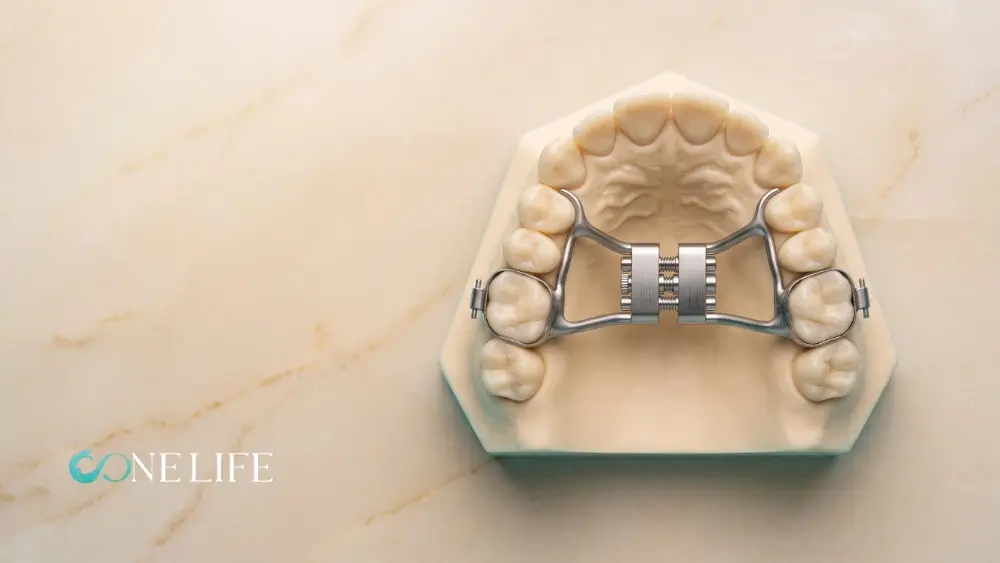
A crossbite is a type of dental misalignment, or malocclusion, where the upper and lower teeth don’t align correctly from side to side. That is, one or more upper teeth sit inside the lower teeth when biting down.
Crossbite is a developmental condition: it forms while the jaws and teeth are still growing, usually starting in early childhood. It’s not something that tends to appear suddenly in an adult, though tooth loss or jaw trauma can shift bite later in life. Since crossbite rarely corrects itself, it also often persists untreated from childhood into adulthood.
Crossbite vs. Overbite, Underbite, Open Bite, and Overjet
Crossbite, overbite, overjet, underbite, and open bite are all different types of malocclusion — related, but not interchangeable:
Type of Malocclusion | What Happens |
Crossbite | One or more upper teeth sit inside (not outside) the lower teeth |
Overbite | Upper front teeth vertically overlap the lower front teeth too much |
Overjet | Upper front teeth stick out horizontally, ahead of the lower teeth |
Underbite | Lower front teeth sit in front of the upper front teeth |
Open bite | Upper and lower front teeth don’t touch when biting down |
For a broader look at malocclusion, see our guide: Malocclusion: Causes and Treatment.
Types of Crossbites: How Orthodontists Classify It
Orthodontists consider origin, location, and extent to classify a crossbite precisely. Together, these layers give a full picture; for example, a “dental, unilateral posterior crossbite” tells the orthodontist both the cause and where to focus treatment.
1. Dental vs. Skeletal Crossbite
A dental crossbite involves teeth tipped or displaced, and usually respond well to braces or aligners. A skeletal crossbite involves the jaw bones, a narrow upper jaw or a wide or forward lower jaw, and often needs growth guidance in children or surgery in adults.
2. By Location: Anterior and Posterior Crossbite
An anterior crossbite affects the front teeth (upper incisors biting behind the lower ones); a posterior crossbiteaffects the back teeth, it’s the most frequently type, with the upper premolars and molars biting inside the lower ones.
3. By Extent: Unilateral, Bilateral, and Single-Tooth
- Unilateral: one side only — the most common
- Bilateral: both sides symmetrically; called a scissor bite when severe
- Single-tooth: just one tooth out of position, usually the easiest to fix
How Common Is Crossbite? Prevalence in the US, UK, and Worldwide
Crossbite falls under the wider umbrella of malocclusion, which affects over half of people worldwide by some estimates — though that figure describes malocclusion broadly, not crossbite specifically. Reliable data on sex-based differences in crossbite prevalence is inconsistent, so we won’t cite an unverified split here.
- In children ages 3-12, posterior crossbite is estimated at 5% to 8% (Bell & Kiebach, 2014).
- More broadly, other estimates put it between 7% and 23% of the population.
- Within posterior crossbite cases, the unilateral type accounts for 80-97%.
What Causes a Crossbite?
We found no verified source breaking cases down by exact percentage per cause — genetics is a leading factor, but it typically interacts with structural and behavioural causes rather than acting alone. Crossbite develops from a mix of genetic, structural, and behavioural factors, usually acting together rather than alone.
Common Cause | Category | How It Contributes |
Inherited jaw or tooth-size mismatch | Genetic | Parents can pass down jaw or tooth shapes that don’t fit together |
Cleft lip and/or palate | Genetic/structural | Affects upper jaw and arch development |
Overretained baby teeth | Dental | Blocks the permanent tooth into the wrong position |
Supernumerary (extra) teeth | Dental | Crowds the arch, pushing teeth out of alignment |
Prolonged thumb-sucking or pacifier use (past ~age 4) | Behavioral | Sustained pressure narrows the upper arch |
Chronic mouth breathing | Behavioral/functional | Linked to altered tongue posture and a narrower palate |
Risk Factors That Increase the Likelihood
- Family history of crossbite or narrow palates
- Chronic nasal obstruction (allergies, enlarged tonsils or adenoids) causing mouth breathing
- Early loss of baby teeth
- Non-nutritive sucking habits past age 3-4
The Risks of Leaving a Crossbite Untreated
Only an estimated 0-9% of crossbites self-correct without treatment. The earlier a crossbite is addressed, the simpler the correction tends to be. Left uncorrected, complications can include:
- Facial asymmetry, from the jaw shifting to compensate (a “functional shift”)
- Uneven or accelerated tooth wear
- Gum recession and bone loss on the affected side
- Jaw joint (TMJ) problems — an association seen in research, not a proven cause-and-effect
- Speech difficulties, in some cases
Crossbite Signs and Symptoms
Crossbite often has no obvious complaints, which is why it’s usually spotted by a dentist first.
Signs to Look For
- Upper teeth sitting inside the lower teeth when biting down
- The jaw shifting to one side when closing
- Uneven tooth wear
- A visibly asymmetric jawline, especially in children
Symptoms Patients Often Report
- Difficulty or discomfort chewing
- Jaw soreness, clicking, or popping
- Frequent cheek-biting
- Mouth breathing or speech changes
- Occasional headaches linked to jaw tension
How Is a Crossbite Diagnosed?
Diagnosis starts with a clinical exam checking how the teeth meet, jaw shift on biting, and facial symmetry. To distinguish dental from skeletal crossbite, orthodontists may also use dental impressions or scans, photographs, and X-rays, including cephalometric imaging. When a functional shift is suspected, a deprogramming splint can help reveal the jaw’s true resting position before deciding on treatment.
Prognosis: Why Early Detection Matters
The AAO recommends a first check-up by age 7, before the palatal sutures fuse — appliances like expanders can then guide growth, historically correcting around half of cases without further intervention. Once the jaw has finished growing, treatment still works but takes longer, and skeletal cases may need surgery instead.
Crossbite Complications by Type
- Anterior: excessive wear, chipping, or gum recession on the affected tooth; can influence jaw growth if several teeth are involved
- Unilateral posterior: linked to a functional mandibular shift — the main driver of facial asymmetry
- Bilateral posterior (scissor bite): no jaw shift, but uneven chewing and cheek biting across the arch
- Skeletal crossbite: highest long-term impact on facial harmony, most likely to need surgery if untreated
Can a Crossbite Be Prevented?
Many crossbites have a genetic or structural root and can’t be fully prevented — but managing certain risk factors helps:
- Weaning off thumb-sucking or pacifiers by age 3-4
- Treating chronic mouth breathing early
- Monitoring baby tooth loss
- Scheduling that first check-up around age 7
Prevention isn’t guaranteed, but early attention gives a child’s bite the best chance to develop normally.
Treating Crossbite in Children
In children, treatment focuses on guiding growth while the jaw is still developing. Common appliances include:
- Palatal expanders (rapid maxillary expansion, or RME) to widen a narrow upper jaw
- Quad helix or Coffin spring appliances, gentler alternatives for milder cases
- Finger springs, for correcting a single misaligned tooth
- Braces with cross-elastics, when multiple teeth are involved
- Delaire mask (facemask therapy), for children whose anterior crossbite stems from a skeletal, forward-growing lower jaw
Timing matters: the palate’s midline suture starts to fuse in the mid-teens, which is one reason early treatment, ideally starting around age 7-10, tends to be simpler and faster.
Crossbite Treatment in Teens and Adults
Once the jaw is fully or mostly grown, dental crossbites can still be corrected effectively with braces or clear aligners— it just typically takes longer than in a growing child. For skeletal crossbites in adults whose palatal suture has already fused, a surgically-assisted rapid palatal expansion (SARPE) may be used to widen the jaw with a minor surgical assist before orthodontics.
When Is Jaw Surgery Needed?
Full orthognathic (jaw) surgery is generally reserved for adults with a significant skeletal discrepancy that braces or expansion alone can’t resolve. It’s combined with orthodontic treatment before and after surgery, and the full process — including follow-up orthodontics — can take six months or more.
Whatever the age, following the orthodontist’s adjustment schedule and wear-time instructions closely makes a real difference to how smoothly, and how quickly, treatment goes.
Treatment doesn’t end when the appliance comes off, either: most patients wear a retainer for a period afterward, since a corrected bite can shift back without one — a crossbite that took months to correct can relapse in a matter of weeks if retention is skipped.
The Habsburg Jaw: A Famous Case of Crossbite-Linked Malocclusion
One of the best-documented examples of inherited jaw malocclusion in history isn’t a celebrity, but an entire royal dynasty. The so-called “Habsburg jaw” — technically a case of mandibular prognathism (a Class III skeletal pattern, where the lower jaw juts forward) — appeared in the Habsburg family starting with Maximilian I of Austria in the 15th century, and reached one of its most severe forms in Emperor Charles V of Spain, whose bite reportedly interfered with his speech.
To be precise: the Habsburg jaw is classified as prognathism, not crossbite specifically — though the two are closely related, since a forward-projecting lower jaw very often produces a front-tooth, or anterior crossbite, as well. A 2020 pedigree study spanning 409 members of 13 related royal families found the trait followed an autosomal dominant inheritance pattern, and the Habsburgs’ practice of marrying within the family is thought to have kept it going for more than two centuries. It’s a striking real-world illustration of just how strongly genetics can shape the jaw — exactly the kind of hereditary influence discussed earlier in this guide.
How Much Does Crossbite Treatment Cost?
Cost depends heavily on the severity of the crossbite, the type of appliance needed, and whether surgery is involved — so these are general ranges, not a quote for any specific case:
Country | Typical Cost Range | Notes |
UK | NHS: free for eligible under-18s (IOTN grades 3–5); Private: £2,000–£8,000, depending on appliance | Adult NHS coverage is rare and assessed case by case |
US | Roughly $3,200–$5,200 for a full course of treatment; financing often available from $89–$300/month | Costs vary by provider, region, and case complexity |
Canada | Approximately $3,000–$7,000 CAD (national average) | No standardized provincial fee guide — figures are market estimates, not official prices |
Australia | Approximately $3,500–$9,000 for an 18-month treatment plan | Currency wasn’t explicitly confirmed in our source — treat as an approximate figure |
Curious what your own treatment would actually cost? Book a free consultation and get a personalized quote.
FAQs
Can I fix a crossbite without braces?
In some cases, yes. Mild or single-tooth crossbites can sometimes be corrected with clear aligners or a simple removable appliance, especially in children whose jaws are still growing. More involved cases — particularly skeletal or multi-tooth crossbites — usually do need braces, and severe adult cases may require surgery alongside orthodontics.
Can adults be treated for a crossbite?
Yes. Crossbite can be corrected at any age. Dental crossbites typically respond well to braces or clear aligners in adults, just as in children; skeletal crossbites may need a surgical assist, such as SARPE or jaw surgery, since the jawbone is no longer growing.
Is crossbite genetic?
Genetics is one of the leading contributing factors — inherited jaw and tooth-size mismatches are common causes — but crossbite usually results from a combination of genetic, structural, and behavioral influences rather than genetics alone.
Does a crossbite get worse if left untreated?
It doesn’t reliably improve on its own: research suggests only 0-9% of crossbites self-correct. Left untreated, it can contribute to uneven tooth wear, jaw asymmetry, and the other complications discussed above.
How long does crossbite treatment take?
It depends on the type and severity. Elastics alone can work in as little as three to four months; palatal expanders typically take six to twelve months; full braces or aligner treatment can run from six months to two years or more, and surgical cases add further recovery and follow-up orthodontic time.
Is crossbite treatment painful?
Generally, no — most people feel mild pressure or soreness for a few days after an appliance is placed or adjusted, similar to typical orthodontic discomfort. Surgical correction, when needed, involves standard post-operative recovery managed with your surgical team. If soreness lasts more than a few days or feels severe, check in with your provider.
Sources
- Posterior Crossbite – StatPearls, National Library of Medicine
- Crossbite – Wikipedia
- Early Orthodontic Care at Age 7 – American Association of Orthodontists
- A Royal Family Heritage: The Habsburg Jaw – ENTtoday
- NHS Braces Cost – NHSDentistCost.com
- Crossbite Teeth: Causes, Cost & Treatment – Diamond Braces
- Malocclusion: Causes and Treatment