
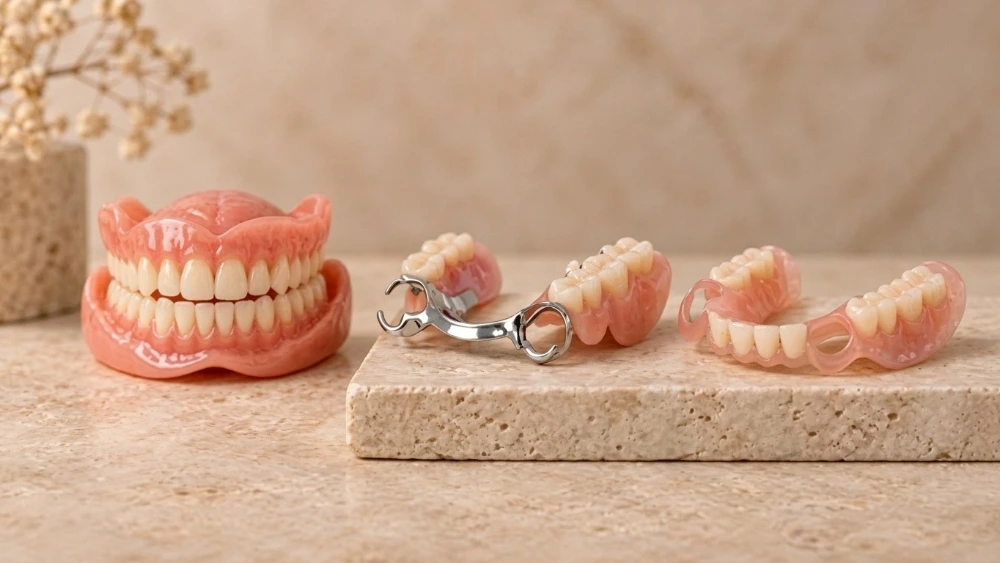
A removable denture can replace a single missing tooth, several teeth or a whole arch. Some rest on the gums, some clip around natural teeth, and others attach to implants. What they have in common is that you can take them out yourself.
Comfort, eating, cleaning and future adjustments all matter. If you are considering removable dentures, you will also need a clear plan for care.
A removable denture is a custom-made appliance with artificial teeth attached to a base. It replaces missing teeth and, where needed, some of the volume and appearance of lost gum tissue. You may also hear dentures called false teeth or dental plates.
A conventional complete denture relies on a close fit against the tissues, saliva and control from the surrounding muscles. Upper dentures commonly cover the palate to help form a seal. Lower dentures leave room for the tongue and have less surface area, which can make them harder to stabilise.
Partial dentures often use clasps or attachments on natural teeth. Implant-retained dentures connect to attachments on implants. Adhesive may provide extra retention, but it cannot correct a poor fit.
The terminology becomes easier when you separate three questions: how many teeth are being replaced, when the denture is fitted, and what holds it in place.
Denture option | What it replaces | How it is retained |
Conventional complete denture | All teeth in the upper or lower jaw | Fit against the tissues and surrounding muscle |
Removable partial denture | One or more missing teeth | Support from teeth and gums, often with clasps |
Immediate denture | Teeth being removed | Fitted over the extraction area at the extraction appointment |
Implant-retained removable denture | Usually a complete arch | Attachments connecting to implants |
Tooth-supported overdenture | Missing teeth | Support or retention from prepared natural teeth or roots |
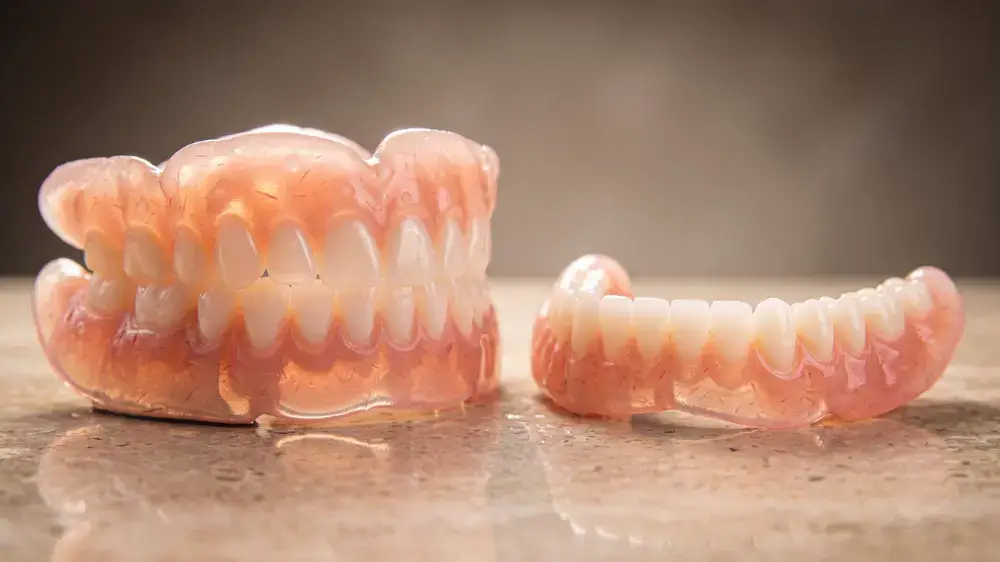
Full dentures replace every tooth in the upper jaw, lower jaw or both. Their gum-coloured bases also help restore support for the lips and cheeks.
They can be a practical choice when no suitable teeth remain and implant treatment is unwanted or unsuitable. They will feel different from natural teeth, though, and learning to control them takes practice.
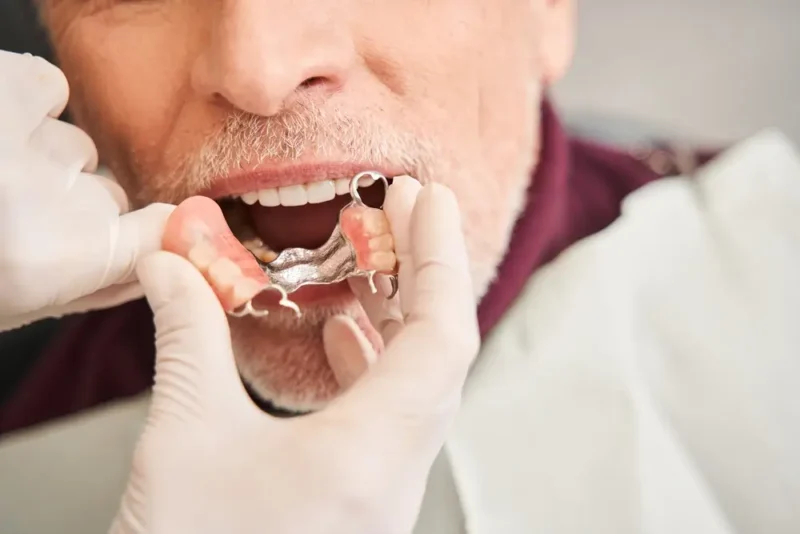
A partial denture fills gaps while keeping suitable natural teeth. The position and health of those teeth influence its design.
Some designs have metal clasps that may show when you smile. Others use less visible connectors or precision attachments, sometimes requiring crowns on supporting teeth. Discuss this before the appliance is made, particularly if appearance is a priority.
An immediate denture is made before teeth are removed and fitted at the extraction appointment, helping you avoid a visible gap during healing.
As the gums and bone change shape, it often needs adjustments, relining or replacement. Ask whether the fee includes the later definitive denture as well as the immediate appliance.
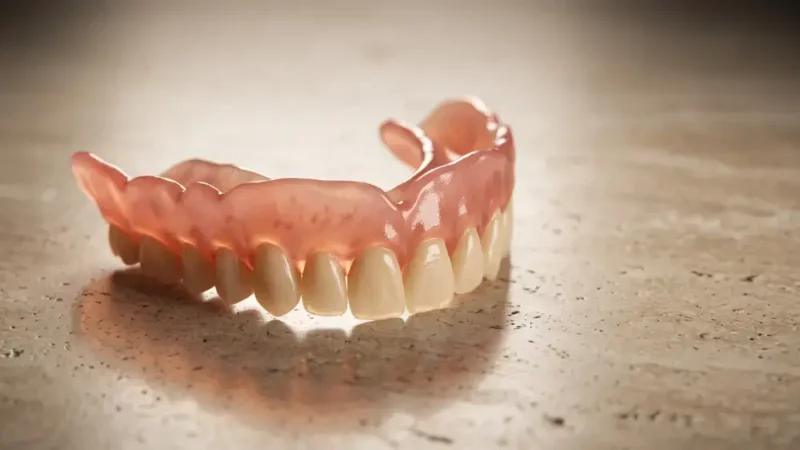
Often called snap-in dentures, these attach to dental implants for additional retention. You still remove them for cleaning.
Two implants are a well-established option for a complete lower overdenture in suitable patients. Upper-jaw treatment has different requirements. Some designs also rely partly on the gums for support, and attachment components can wear and need replacing.
A tooth-supported overdenture fits over selected natural teeth or roots prepared to help support or retain it. Those structures need careful cleaning and monitoring.
A temporary partial denture, sometimes called a flipper, can fill a gap during healing or while another treatment is planned. Ask whether it is intended for appearance, routine eating or longer-term use.
The base, framework and artificial teeth can be made from different materials. A “metal denture”, for instance, generally has a metal framework combined with gum-coloured acrylic and artificial teeth. It does not mean a row of visible metal teeth.
Material or construction | Common use | Advantage | Limitations |
Acrylic resin, commonly PMMA | Complete dentures, many partials and immediate dentures | Versatile construction; repairs and additions are often possible | Can need more bulk and may fracture or wear |
Cobalt-chromium framework with acrylic sections | Removable partial dentures | Strong, rigid framework that can be thinner than all-acrylic designs | Metal may be visible; suitability depends on the remaining teeth |
Flexible thermoplastic materials, including nylon-based systems | Selected partial dentures | Gum-coloured flexible clasps may be less noticeable | Adjustment, relining and adding teeth can be more restricted, depending on the system |
Milled or 3D-printed denture resins | Digitally manufactured appliances | Digital records support design and, in some workflows, reproduction | Properties and repair options vary by material and manufacturing system |
Dentures may be suitable when missing teeth affect your appearance or function, when a fixed replacement is unsuitable, or as an interim option during other treatment.
Your dentist will assess the remaining teeth, gums, supporting tissues and bite, along with relevant medical conditions and medicines.
Everyday needs matter too. Mention any difficulty handling small objects, previous denture problems or concerns about speaking at work.
Removable dentures can improve appearance, help with chewing and speech, and restore lip support. Partial dentures also allow suitable natural teeth to remain.
The trade-offs include daily removal and cleaning, an adjustment period and maintenance as the mouth changes. Some movement, food trapping or visible clasps may occur. Conventional dentures do not replace tooth roots or prevent the underlying ridge from changing after tooth loss.
“Permanent dentures” is used inconsistently in advertising. The clearest question is whether you can remove the appliance yourself. A snap-in denture remains removable even when its implants are intended to stay in the jaw long term.
Factor | Conventional removable denture | Removable implant-retained denture | Fixed implant restoration |
Removal at home | Yes | Yes | No |
Implant surgery | Not required for retention | Required unless suitable implants already exist | Required unless suitable implants already exist |
Main retention | Fit and, for some partials, natural teeth | Implant attachments | Fixed connection to implants |
Cleaning | Remove and clean the denture and mouth | Remove; clean denture, attachments and mouth | Clean around and underneath in the mouth |
Maintenance | Fit reviews, possible relines and repairs | Fit reviews plus attachment and implant maintenance | Implant and prosthetic maintenance |
Initial cost considerations | No implant-placement component | Implants and attachments add to the fee | Surgical and fixed prosthetic treatment add to the fee |
Treatment involves clinical appointments and laboratory work. Some stages can be combined; others may need repeating to get the result right.
Conventional fabrication usually takes several appointments over a number of weeks, depending on the case and laboratory. Preliminary treatment, healing after extractions or a repeat trial fitting can extend the schedule.
Immediate dentures are prepared before extraction. Implant-retained treatment also involves surgical planning and healing where required. Ask for a timetable specific to your treatment rather than assuming every denture can be completed during a short stay.
New dentures may feel bulky at first, with extra saliva or a temporary change in speech. These sensations often settle as you adapt. Persistent pain or difficulty deserves a review.
Start with soft foods such as eggs, fish, soft rice and cooked vegetables. Cut food into small pieces, chew slowly on both sides and gradually try more demanding textures. Follow any separate instructions after extractions.
Biting into a whole apple or pulling at crusty bread with the front teeth can dislodge a denture; cutting these foods first may help. Sticky foods, hard nuts and small seeds can also be troublesome. Take care with hot food and drinks, as palatal coverage can affect how you judge temperature.
Reading aloud helps your tongue and lips adjust to the new shape. Persistent clicking or movement may need a fitting or bite check.
For appearance, tooth position and lip support matter as much as shade. Use the trial fitting to check how much tooth shows and whether any clasps are visible.
Denture adhesive is a purpose-made product placed between a denture and the tissues to improve retention. It may also help reduce food getting beneath the base. It is different from a denture repair product and must never be replaced with household glue.
Not everyone needs adhesive. If the denture repeatedly lifts or you need increasing amounts to keep it in place, have the fit checked.
Adhesive format | How it is used | Practical consideration | What to check |
Cream or paste | Small amounts applied in the positions specified by the manufacturer | Allows targeted placement; excess can squeeze out | Amount, application pattern and whether the denture should be dry |
Powder | A light layer applied according to the product instructions | Provides a thin coating but requires careful dispensing | Whether to moisten the denture and how to remove excess |
Strips, pads or wafers | Positioned on the fitting surface as directed | A preformed format may be easier for some people to handle | Size, positioning, compatibility and removal instructions |
There is no single best denture glue for everyone. Check product suitability for partials, flexible materials, soft linings or implant attachments. Apply only the recommended amount to a clean denture and remove residue from the appliance and mouth each day.
Some adhesives contain zinc; chronic overuse can be harmful. Zinc-free products are available. If you need increasing amounts or repeated applications, arrange a fit check. After extractions, ask when adhesive can be used and avoid fresh sockets unless your dentist advises otherwise.
Artificial teeth cannot develop decay, but dentures still collect plaque and food debris. Any remaining natural teeth need their own care.
Handle dentures over a folded towel or a basin containing water to cushion a fall. Avoid hot water, abrasive products and ordinary abrasive toothpaste on the appliance. Metal components and soft linings may need particular cleaning products.
Generally, remove them before sleeping to let the tissues rest. Your dentist may give different instructions for the first night after fitting an immediate denture.
Follow the storage instructions for your appliance. Many acrylic dentures are kept moist in water or an appropriate solution, while some clinical protocols advise dry storage after cleaning. Check the cleanser’s permitted soaking time and keep the denture in a labelled container away from heat, pets and children.
Problem | Possible explanation | Appropriate next step |
Repeated slipping or rocking | Changes in the supporting tissues, fit or bite | Arrange a fit assessment; a reline or replacement may be considered |
A sore spot or ulcer | Local pressure, rubbing or another oral condition | Request an adjustment and assessment rather than modifying the denture yourself |
Redness, burning or persistent odour | Hygiene difficulties, inflammation or infection | Review cleaning and seek a dental examination |
Clicking or difficulty speaking | Adaptation, movement or a bite-related issue | Practise initially; persistent problems need review |
A cracked base, broken tooth or loose clasp | Damage or component wear | Stop attempting DIY repairs and contact a dentist |
An attachment feels less secure | Wear or another issue in an implant-retained system | Have the attachments and implant tissues checked |
Wear, damage and changes in the mouth affect a denture’s useful life. There is no replacement interval that suits everyone. The American College of Prosthodontists recommends assessment for replacement after more than five years in use, among other triggers; this does not mean every denture must be replaced at five years.
Depending on the problem, your dentist may recommend:
A standard acrylic denture costs about $1,000–$3,000 per jaw in the US, £500–£1,500 per jaw privately in the UK, and £350–£600 ($450–$800) in Turkey. Partial dentures usually cost less than full ones. Implant-retained dentures cost the most, at $5,000–$15,000 per jaw in the US, £3,000–£7,000 in the UK and £1,800–£3,500 in Turkey. On the NHS in England, any denture is covered by the Band 3 charge of £332.10.
Three things change the price most:
Treatment | Pricing basis | US | UK | Turkey |
Complete acrylic denture | Per jaw | $1,000–$3,000 | £500–£1,500 | £350–£600 / $450–$800 |
Acrylic partial denture | Per appliance | $300–$900 | £400–£900 | £200–£400 / $260–$520 |
Cobalt-chrome partial denture | Per appliance | $950–$1,900 | £700–£1,800 | £450–£700 / $520–$900 |
Flexible partial denture | Per appliance | $900–$2,000 | £550–£1,500 | £500–£800 / $650–$1,050 |
Immediate denture | Per appliance | $1,000–$3,000 | £950–£1,500 | £320–£950 / $420–$1,260 |
Implant-retained removable denture | Per jaw (2–4 implants) | $5,000–$15,000 | £3,000–£7,000 | £1,800–£3,500 / $2,300–$4,500 |
These are typical 2026 ranges, not quotes. Turkey prices cover treatment only, not flights or a hotel. GBP/USD conversions use about $1.30 to £1.
Ask whether the quote includes assessment, impressions, fitting and initial adjustments. Extractions, relining and a definitive replacement after an immediate denture may cost extra. For implant-retained options, confirm whether implants and attachments are included.
Depending on the gap and the health of your mouth, alternatives include tooth-supported bridges, implant crowns, implant bridges and fixed full-arch restorations. In selected cases, monitoring an unrestored space may also be reasonable.
Conventional bridges may require preparation of supporting teeth; implants require assessment for surgery and an appropriate restoration. Discuss the benefits and maintenance of each suitable option, including how it would affect teeth you can retain.