
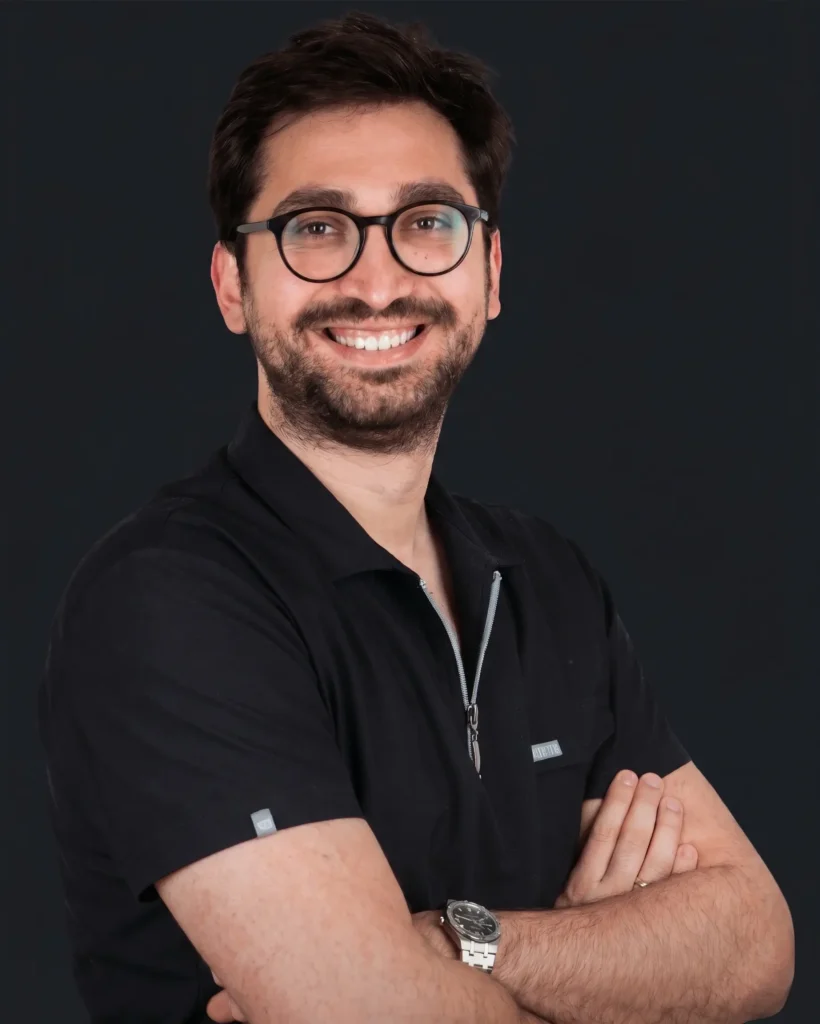
Dr. Aykut Gürel is an oral and maxillofacial surgeon who has made zygomatic implants the centre of his career. He qualified in dentistry at Istanbul University and completed his specialist training in Oral & Maxillofacial Surgery at Marmara University, where his specialty thesis compared the accuracy of zygomatic implants placed freehand with those placed using computer-assisted guided methods. Today he plans every zygomatic case digitally and, where the anatomy suits it, places the implants through a patient-specific titanium surgical guide, a protocol still uncommon in Turkey. He treats patients in Turkish and English.
Full name | Uzm. Dt. Aykut Gürel |
Qualifications | DDS · Specialist (doctorate-level) degree in Oral & Maxillofacial Surgery |
Specialty thesis | Accuracy of zygomatic implants placed freehand vs. computer-assisted (Marmara University) |
Zygomatic system | JDZygoma implants with the Z-GO Guide™ fully guided protocol, JDentalCare, Modena, Italy |
In practice since | 10+ years |
Languages | Turkish · English |
Core focus | Zygomatic implants, guided implant surgery, full-arch rehabilitation (All-on-4 / All-on-6), sinus lift and bone grafting, impacted teeth, jaw surgery |
Registration |
Zygomatic implants are the treatment patients reach when they have been told there is not enough bone left. It is also the implant surgery where the margin for error is smallest. When we looked for the surgeon to lead these cases, Dr. Gürel was our first choice, for reasons you can check.
Most zygomatic implants are still placed freehand: the surgeon aims a long drill by eye and experience through a narrow window of bone. Because the implant is so long, a small wobble at the entry point becomes a much larger error at the tip, inside the cheekbone and close to the eye socket. Guided surgery transfers a plan made on your 3D scan into your mouth, so each drill follows the path that was planned.
For zygomatic cases Dr. Gürel works with JDZygoma implants and the Z-GO Guide™ system from JDentalCare, an implant manufacturer founded in 2006 in Modena, Italy. Z-GO Guide™ combines three parts: zygomatic planning modules in JD’s guided-surgery software (powered by Real Guide™), a patented bone-supported titanium guide made by JDLab, and a dedicated drill kit for fully guided placement. JDZygoma implants have FDA 510(k) clearance (K240143).
A 2023 systematic review in the Journal of Clinical Medicine pooled 14 studies and 511 zygomatic implants, comparing how far each implant ended up from its plan (Fan et al., 2023):
Method | Deviation at entry | Deviation at tip (apex) | Angle deviation |
Freehand | 2.04 mm | 3.23 mm | 4.9° |
Static surgical guide | 1.19 mm | 1.80 mm | 2.2° |
Dynamic navigation | 1.81 mm | 2.95 mm | 3.5° |
In these studies, surgical guides placed the implant tip about 1.4 mm closer to plan on average than freehand placement. A guide improves precision; it does not replace the surgeon’s judgement, which is why Dr. Gürel decides case by case whether to use one.
Qualification | Institution |
Doctor of Dental Surgery (DDS) | Istanbul University, Faculty of Dentistry |
Specialty training and specialist degree in Oral & Maxillofacial Surgery: thesis comparing the accuracy of zygomatic implants placed freehand and with computer-assisted methods on maxillary models | Marmara University, Faculty of Dentistry, Istanbul |
Rotation | Where |
Emergency Medicine | Marmara University, Faculty of Medicine |
Anaesthesiology & Reanimation | Marmara University, Faculty of Dentistry |
Plastic & Reconstructive Surgery | Marmara University, Faculty of Medicine |
Otolaryngology (ENT) | Marmara University, Faculty of Medicine |
Course | Provider |
Zygomatic Implant Cadaver Course (theory and hands-on, completed successfully) | VESTA Academy, Istanbul, supported by Implant Swiss |
Z-GO Guide™ training, if any | JDentalCare |
Role | Where |
Oral & Maxillofacial Surgeon, lead for zygomatic and complex implant cases | One Life Dental |
Oral & Maxillofacial Surgeon, international patients | Dentopol Ümraniye, Istanbul |
Owner and clinical lead (team of five dentists) | Derya Dental Polyclinic, Maltepe, Istanbul |
Founder | TrueLine Surgical Solutions: patient-specific surgical guide design and manufacture |
Resident, Oral & Maxillofacial Surgery | Marmara University, Faculty of Dentistry |
Zygomatic surgery under general anaesthesia is performed in Acıbadem Altunizade Hospital or Medicana Çamlıca Hospital.
Below we list all treatments Dr. Aykut Gürel can help you with.
Specialty thesis | In Vitro Comparison of the Accuracy of Zygomatic Implants Placed on Maxillary Models Using Freehand and Computer-Assisted Methods, Marmara University |
Applied work | Patient-specific surgical guide design and manufacture through TrueLine Surgical Solutions |
One thread runs through everything he does: making zygomatic surgery more predictable by moving it from freehand to planned, guided placement. He studied it in his thesis, builds guides through his own company, and applies it in surgery.
Research topics: zygomatic implants · computer-assisted implant surgery · surgical guide accuracy · digital surgical planning
WhatsApp us