
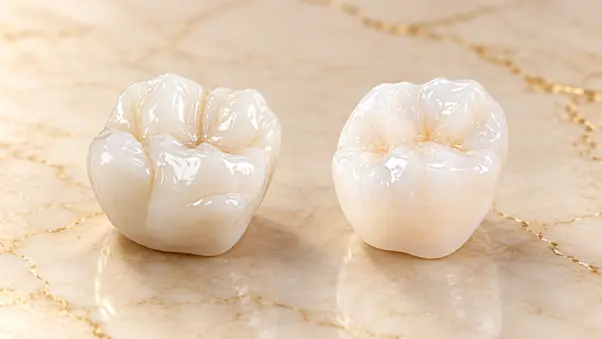
Zirconia and e.max can both produce natural-looking teeth. Their differences lie in how each balances strength, light transmission and their cost. Choosing between them starts with the tooth: how much structure remains, its underlying colour, the available space and the way the teeth meet. In this article, we cover each point in detail with the knowledge of ITI member Dr. Astolfi.
Zirconia vs e.max crowns at a glance
Zirconia crowns | E.max crowns | |
Material | Crystalline zirconium dioxide ceramic | Lithium disilicate glass-ceramic |
Advantage | High strength, particularly in stronger formulations | Optical versatility for matching natural teeth |
Appearance | Varies with formulation, thickness and finishing | Available in different translucencies and opacities |
Best teeth for | Front and back teeth, according to the product and design | Front and back teeth in suitable cases |
Construction | Monolithic or layered with veneering ceramic | Monolithic or supplemented with veneering ceramic |
Main limitations | Greater translucency can involve reduced mechanical properties | Lower fracture toughness than high-strength zirconia |
Possible complications | Fracture, loss of retention and chipping of veneering ceramic | Fracture, loss of retention and chipping of veneering ceramic |
What are zirconia crowns?
Zirconia crowns are made from zirconium dioxide, a crystalline ceramic. Although zirconium is a metallic element, zirconia is an oxide ceramic. These crowns are therefore classified as all-ceramic restorations.
Changes in composition affect its strength, resistance to crack growth and translucency. More translucency generally involves less strength compared with conventional zirconia.
Monolithic zirconia
A monolithic crown has its main shape formed from zirconia, without an extensive outer layer of veneering porcelain. Staining, glazing and polishing help establish the final appearance.
This avoids chipping of a separate veneering layer. The crown can still fracture or lose retention, however, and the supporting tooth remains vulnerable to dental disease.
Layered zirconia
A layered zirconia crown combines a zirconia framework with an outer veneering ceramic. This gives the technician additional control over colour, translucency and surface detail.
The outer ceramic introduces a potential site for chipping. Its thickness and support need careful design, especially where biting forces act on the restoration.
What are e.max crowns?
E.max are lithium disilicate crowns. Lithium disilicate is a glass-ceramic containing reinforcing crystals. Crowns can be pressed or manufactured using computer-aided design and milling.
Different shades, translucencies and opacities allow the laboratory to work with the underlying tooth colour and surrounding teeth. E.max is often associated with front teeth, but lithium disilicate crowns also have established applications on premolars and molars.
Strength and fracture resistance
Hardness, strength and clinical longevity describe different things:
- Hardness concerns resistance to scratching or indentation.
- Flexural strength measures resistance to failure under bending in a laboratory test.
- Fracture toughness describes resistance to the spread of a crack.
- Clinical survival measures whether a restoration remains in service.
Does e.max break more easily?
Lithium disilicate has lower fracture toughness than zirconia, but this does not make e.max crowns inherently fragile. For example, a crown with adequate ceramic thickness and well-managed bite contacts faces different conditions from a thin restoration exposed to repeated heavy loading.
In short, a stronger material cannot compensate for every problem in preparation, fit or cementation. Each case must be reviewed individually.
Appearance: which crown looks more natural?
Natural teeth have variations in colour, translucency and texture. Reproducing those details matters more than selecting the whitest shade or the material.
This being said, lithium disilicate has optical qualities that reproduce the appearance of natural enamel and dentine more closely. This is particularly valuable for front incisor teeth. Modern zirconia can also produce convincing results, however; zirconia should not automatically be dismissed as opaque or artificial.
Covering a dark tooth: case study of how emax’s naturalness can be a disadvantage
Maximum translucency is not always an advantage. Let’s consider an interesting example. A dark tooth or discoloured core can show through a translucent emax crown and affect its final shade.
A more opaque zirconia crown may help conceal the underlying colour. Lithium disilicate also offers opacity options, but the available space and degree of discolouration influence what can be achieved.
Shape and surface detail
Material selection is only part of the aesthetic result. A crown that is too bulky, too long or poorly matched at the gumline can look unnatural regardless of its ceramic.
Photographs, shade records and communication with the laboratory help guide proportions, texture and colour transitions.
Front teeth versus back teeth
Tooth position provides useful context, but each tooth presents its own combination of aesthetic and mechanical demands.
Front teeth
Lithium disilicate can be a suitable option when matching neighbouring teeth is a priority and sufficient space is available.
Zirconia can also suit front teeth, particularly where masking a dark underlying tooth or providing greater mechanical resistance matters.
For example, two front teeth may need different ceramic opacities if one has a dark core and the other retains a lighter natural colour.
Premolars and molars
Back teeth experience substantial chewing forces. High-strength monolithic zirconia is an important option where mechanical demands are considerable.
E.max crowns are also used on posterior teeth. Their suitability rests on adequate thickness, support and a preparation that meets the selected product’s requirements.
A blanket rule that every molar needs zirconia overlooks these differences.
Grinding and clenching
Grinding can place repeated stress on the crown and supporting tooth. Choosing a stronger ceramic addresses only part of the problem.
The dentist also checks tooth wear, contact patterns and the space available for the restoration. A protective appliance may be recommended, although it cannot eliminate every complication.
Tooth preparation and cementation
Both materials require space for a crown with a suitable shape and thickness. The amount of tooth reduction varies with the product, construction and condition of the tooth.
Some zirconia systems permit thinner restorations in defined applications. This does not mean every zirconia crown requires less preparation than every e.max crown.
Insufficient space can leave a crown too thin or force an excessively bulky shape. Where enough healthy tooth remains, an onlay or another partial-coverage restoration may offer an alternative to full coverage.
Why fitting protocols differ
Zirconia and lithium disilicate have different chemical structures and require different surface treatments.
The cementation approach also takes account of the preparation’s retention and the manufacturer’s instructions. Correct surface preparation and moisture control help achieve reliable placement.
For the patient, the useful question is whether the proposed crown can be fitted predictably to the remaining tooth, rather than whether one cement is universally best.
Zirconia vs e.max crowns cost
There is no universal price difference between zirconia and e.max crowns. Fees vary by practice, location, laboratory work and treatment complexity.
A practice may charge the same amount for both materials or apply different fees for particular designs. A highly characterised front crown, for example, may require more laboratory work than a relatively straightforward posterior restoration.
What affects the total cost?
Cost factor | What to clarify |
The specific ceramic and construction | |
Laboratory work | Whether detailed shade matching or layering is needed |
Preparatory treatment | Whether decay removal, a core build-up or other treatment is required |
Temporary crown | Whether provision and adjustments are included |
Appointments | Which fitting and review visits are covered |
Future problems | The terms for adjustments, repairs and replacement |
Root canal treatment and post placement are not routine requirements for every crown. Where needed, they can add to the overall fee.
For treatment abroad, include travel, accommodation and possible return visits in the budget. A lower initial quotation does not necessarily mean a lower total commitment.
How long do zirconia and e.max crowns last?
Both materials have evidence supporting +10 years of lifespan at 90% of cases, but neither has a fixed expiry date. These figures come from studies involving different patients and treatment conditions. Replacement can become necessary because of decay, tooth fracture, loss of retention or damage to the restoration.
Wear and everyday maintenance
Zirconia’s hardness does not mean it inevitably damages opposing teeth. Surface roughness and finishing influence wear, making appropriate polishing important after bite adjustments.
Both crown types need daily care:
- Brush twice daily with fluoride toothpaste.
- Clean between the teeth and around crown margins.
- Avoid biting hard objects or opening packaging with your teeth.
- Wear a protective appliance if prescribed.
- Attend dental reviews at the recommended interval.
Which material should you choose?
Ask the dentist to explain the recommendation in relation to your tooth.
For a visible tooth, the discussion may focus on shade matching and masking. For a heavily loaded molar, mechanical resistance and available thickness may carry more weight.
A useful explanation connects those findings to the proposed ceramic and construction. “Zirconia is stronger” or “e.max looks better” is too general to explain every treatment decision. See our dental crowns page for the options available.
FAQs
Are zirconia crowns better than e.max crowns?
Neither is best for every tooth. High-strength zirconia can be advantageous under substantial loading, while lithium disilicate offers useful optical properties. The specific ceramic, remaining tooth and crown design determine suitability.
Will I need root canal treatment before getting a crown?
Not automatically. Root canal treatment is needed when the condition of the pulp requires it, rather than simply because a zirconia or e.max crown is planned. A tooth can receive a crown while remaining vital.
Can zirconia and e.max crowns be whitened?
Whitening does not predictably lighten either ceramic. If you want a lighter overall smile, discuss whitening natural teeth before the crown shade is selected. Changing an existing crown’s underlying shade generally requires replacement.
Can an existing crown be replaced with a different material?
Yes, in suitable cases. The dentist first checks the underlying tooth, available space and reason for replacement. Removing an old crown can reveal problems that change the proposed treatment.
Can either crown develop a dark line at the gum?
Neither requires a metal framework, so neither produces the same exposed metal edge associated with some metal-ceramic crowns. Gum recession can still reveal a margin, root surface or dark underlying tooth.
Will a new crown feel different?
feels high, catches food repeatedly or causes persistent discomfort, arrange a review rather than assuming you must adapt to it.
References
- Kongkiatkamon S, Rokaya D, Kengtanyakich S, Peampring C. Current classification of zirconia in dentistry: an updated review. PeerJ. 2023;11.
- Waldecker M, Behnisch R, Rammelsberg P, Bömicke W. Five-year clinical performance of monolithic and partially veneered zirconia single crowns—a prospective observational study. Journal of Prosthodontic Research. 2022;66(2):339–345.
- Gehrt M et al. Clinical results of lithium-disilicate crowns after up to 9 years of service. Clinical Oral Investigations. 2013.
- Pieger S, Salman A, Bidra AS. Clinical outcomes of lithium disilicate single crowns and partial fixed dental prostheses: a systematic review. Journal of Prosthetic Dentistry. 2014.